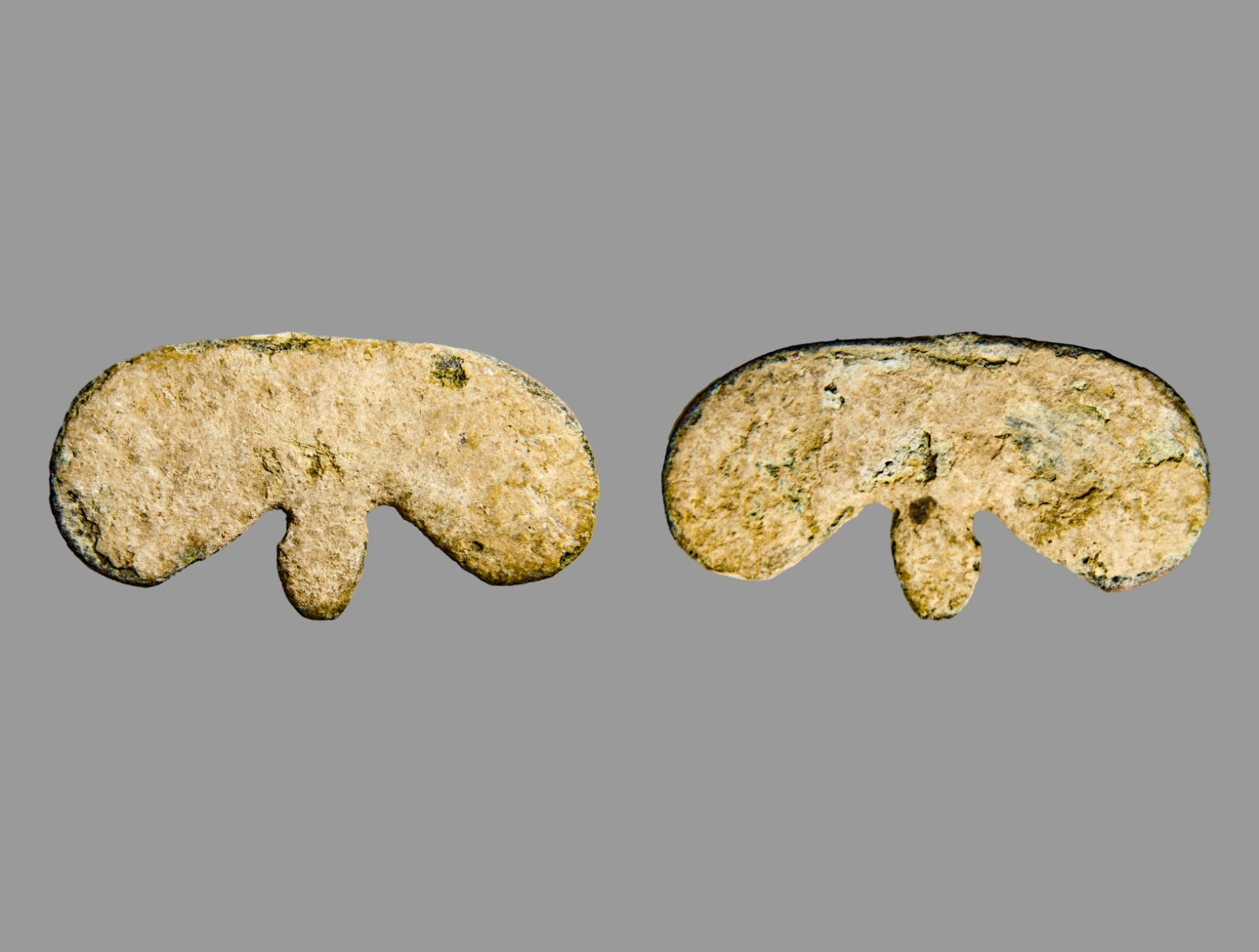
Ancient Roman Imperial Cast Bronze Winged Phallic Mount / Harness Applique — Fascinum Apotropaic Charm (26 mm — c. 1st–3rd Century AD)
Authenticity & Guarantee
Certification: Certified Authentic — includes signed Certificate of Authenticity (COA) with full provenance documentation.
Provenance: Ex-private European collection, legally acquired from international sales; Classical Roman Provincial Sphere.
Item Specifications & Exact Dimensions
Object: Cast Bronze Winged Phallic Applique / Harness Mount / Protective Amulet (Fascinum)
Culture / Period: Roman Imperial Era
Date Range: Circa 1st Century AD – 3rd Century AD (c. 100 – 300 AD)
Exact Width: 26 mm (2.6 cm)
Material: Cast Bronze (Copper Alloy)
Form & Architecture: Crescentic / winged phallic geometry featuring broad lateral winged lobes flanking a distinct central downward-projecting phallic shaft; reverse face flat for flush mounting onto leather horse harness straps (phaleris), belt fittings, or wooden domestic protective plaques
Condition: Exceptional, 100% complete ancient condition. Intact structural wings and central phallic projection; preserved under an authentic, heavy pale sand-tan to calcareous burial crust over a dense dark charcoal-olive bronze core. Free of modern restoration or tooling.
HISTORICAL CONTEXT & TYPOLOGICAL LORE
The Roman Cult of the Divine Phallus (Fascinum)
In ancient Roman religion and magic, the phallus—personified as the divine embodiment Fascinum—was revered as the ultimate apotropaic symbol. Far from being vulgar, phallic imagery held a sacred protective function in Roman society. It was believed to possess supreme spiritual power to neutralize fascinatio (the evil eye / malevolent envy, invidia), which was thought to bring illness, bad luck, and defeat in battle.
Equestrian & Military Harness Appliques (26 mm)
At 26 mm, this compact bronze mount was designed to be fastened onto leather horse tack, military belts (cingulum militare), or cavalry breast collars. Roman soldiers and horsemen decorated their mounts with bronze fascina to protect their warhorses from harm during campaigns and speed across frontier roads. The addition of winged or crescentic side lobes amplified the amulet\'s protective efficacy, combining solar and phallic warding magic in a single casting.
Typological Analysis & Exact Classification
Primary Class: Classical Antiquity Personal & Equestrian Equipment / Roman Phallic Mount
Sub-Class: Winged / Crescentic Bronze Fascinum Applique Class
Manufacturing Technique: Two-part mold cast copper alloy, hand-trimmed with flat reverse mounting surface.
Comparable Archaeological Examples & Museum Accession Numbers
British Museum (Accession No. 1856,0701.2292): Roman bronze winged phallic harness mount and apotropaic pendant.
Museum of London: Roman military and civilian bronze phallic mounts recovered from urban excavation strata.
Metropolitan Museum of Art (Accession No. 74.51.5410): Roman Imperial copper alloy winged phallic applique.
TRN2-1

Related Items:
Ancient Roman Bronze Winged Phallic Applique 26mm Fascinum c. 100-300 AD COA
$200.00
Ancient Roman Imperial Wrought Iron Scale Weight 60.47g Double Uncia Artifact
$345.00
Wonderful Ancient Roman Greek Bronze Figure Of A Male
$299.99