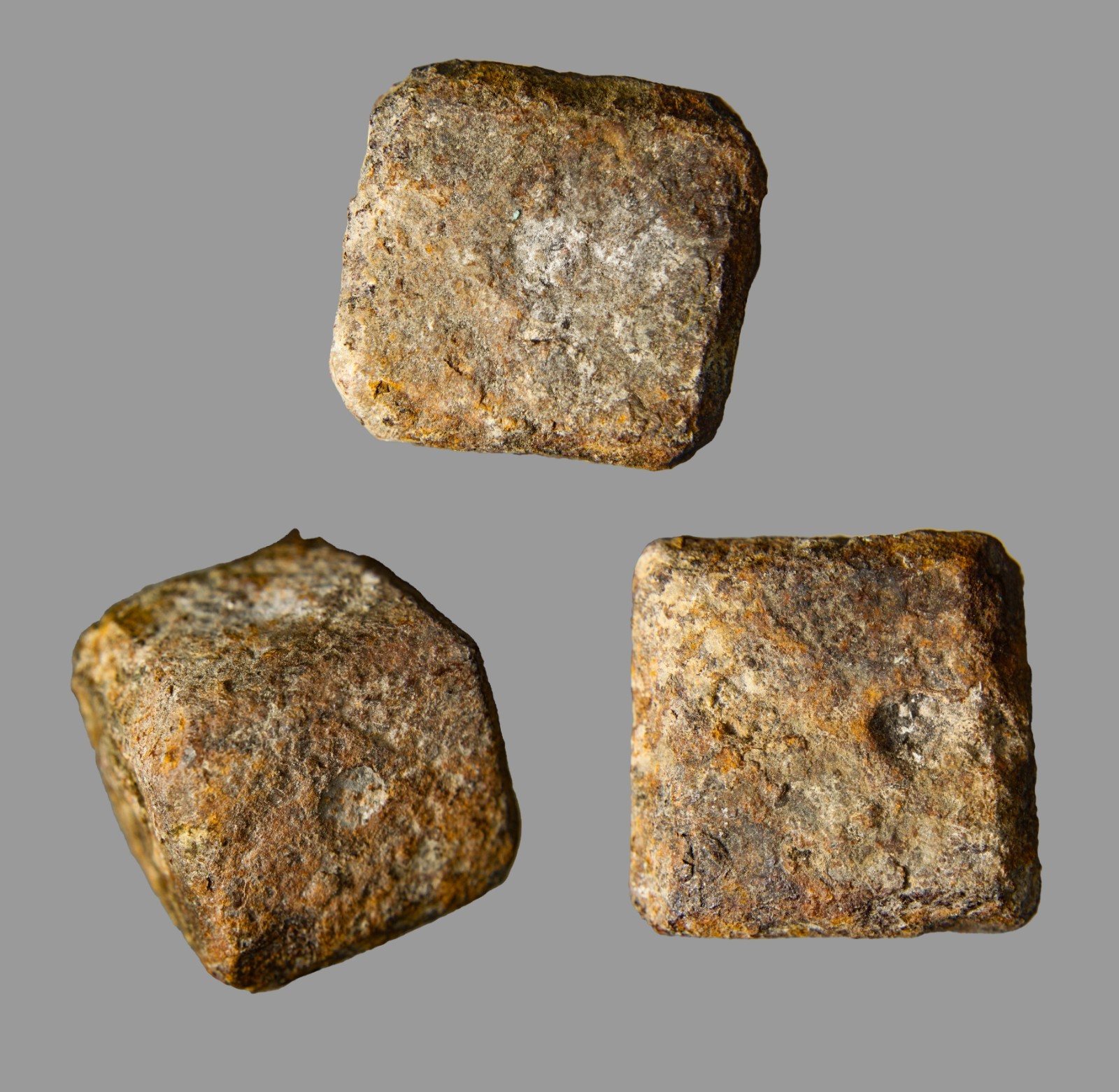
Ancient Roman Imperial Hand-Forged Wrought Iron Cubical Commercial Weight — 2 Unciae Standard / Heavy Sextans Variant (60.47 grams — c. 1st–4th Century AD)
Authenticity & Guarantee
Certification: Certified Authentic — includes signed Certificate of Authenticity (COA) with full provenance documentation.
Provenance: Ex-private European collection, legally acquired from international sales; Classical Roman Provincial / Military Frontier Sphere.
Item Specifications & Exact Dimensions
Object: Hand-Forged Wrought Iron Cubical Commercial / Quartermaster Scale Weight
Culture / Period: Roman Imperial Era
Date Range: Circa 1st Century AD – 4th Century AD (c. 100 – 400 AD)
Exact Weight: 60.47 grams
Metrological Denomination: 2 Unciae Standard (Double Ounce / Heavy Sextans Variant — ~2.2 Unciae)
Material: Hand-Forged Wrought Iron (Ferrous Alloy)
Form & Architecture: Solid cubical / polyhedral wrought iron block forged with bevelled corners and flattened resting faces; hand-hammered matrix preserved under a thick, consolidated reddish-brown iron oxide crust mixed with pale sandy calcareous burial deposits
Condition: Exceptional, 100% complete ancient iron condition. Solid structural core retaining its exact ancient mass of 60.47g; preserved under a stable, mineralized iron oxide surface. Free of active flaking, rust corrosion, or modern cleaning/restoration.
HISTORICAL CONTEXT & TYPOLOGICAL LORE
Roman Iron Metrology & Military Logistics (Castra)
While cast bronze weights dominated civilian urban markets (fora), hand-forged wrought iron weights played an essential role in Roman military camps (castra), grain commissaries (annona), metal foundries, and bulk trade networks along frontier provinces. Iron was favored by legionary quartermasters for heavy-duty daily operations where durability was paramount.
Metrological Standard & Hand-Forged Craft (60.47g)
At 60.47 grams, this solid block corresponds to the Roman 2 Unciae Standard (where 1 Roman Uncia = ~27.28g, making a double-ounce unit ~54.56g–60g under heavy commercial/military weight variations). Legionary armorers and municipal blacksmiths forged iron weights by hammering red-hot blooms, adjusting the final mass by trimming or filing the corners until it matched official bronze master weights.
Typological Analysis & Exact Classification
Primary Class: Classical Antiquity Commercial & Military Equipment / Roman Iron Weight
Sub-Class: 2 Unciae Cubical Hand-Forged Wrought Iron Weight Class
Manufacturing Technique: Hand-forged bloomery iron block with chiseled/filed mass adjustment.
Comparable Archaeological Examples & Museum Accession Numbers
British Museum (Accession No. 1856,0701.2335): Roman wrought iron cubical scale weights recovered from military garrison contexts.
Museum of London: Roman civilian and military iron commercial weights excavated from Thames waterfront trade layers.
Römisch-Germanisches Zentralmuseum (Mainz): Roman Provincial iron quartermaster weights from Rhine frontier fortresses.
TRN2-1

Related Items:
Wonderful Ancient Roman Greek Bronze Figure Of A Male
$299.99
Ancient Roman Bronze Winged Phallic Applique 26mm Fascinum c. 100-300 AD COA
$200.00
NGC King of Judaea AE Herod The Great (40-4 BC) Bronze Prutah High Grade
$112.59