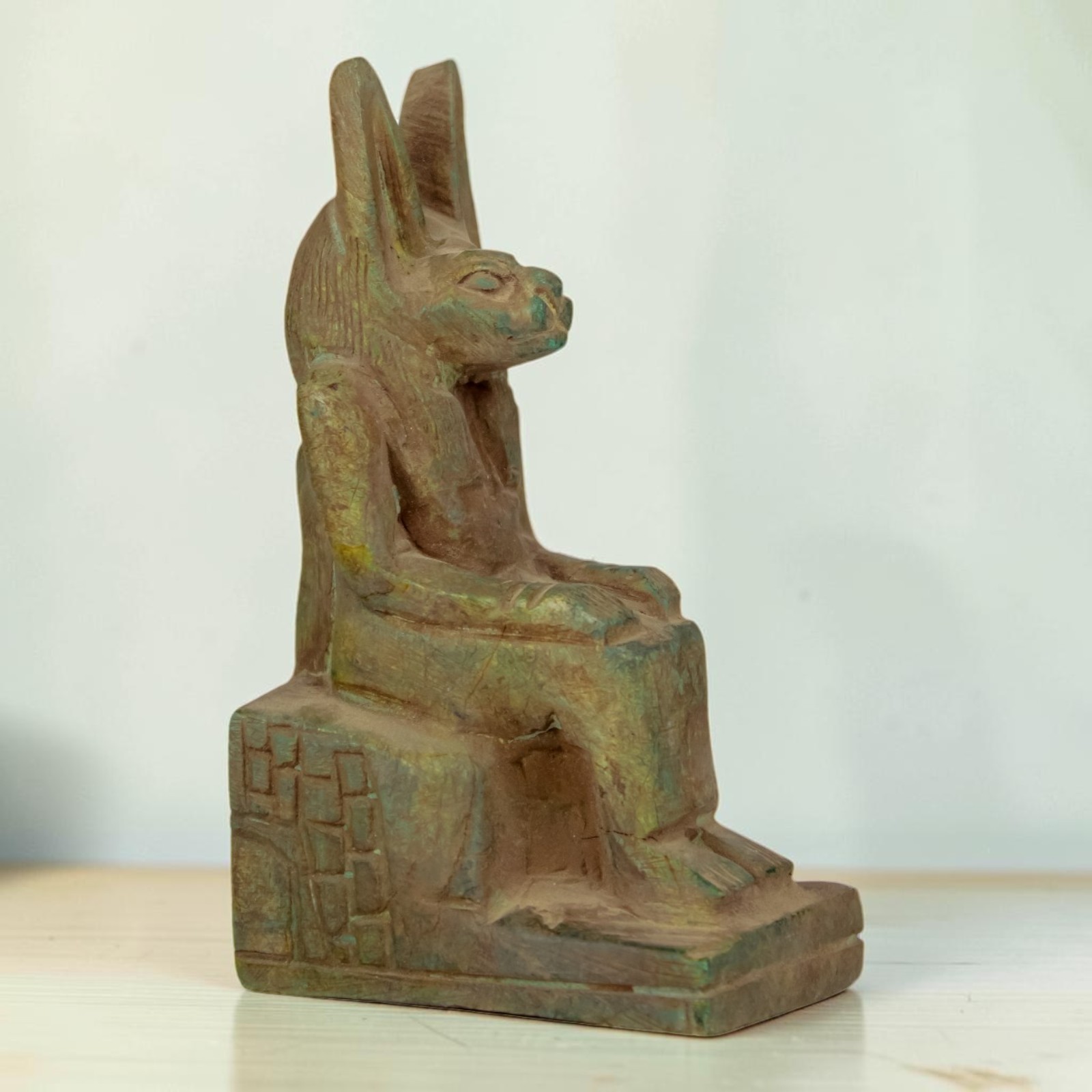
Unique Ancient Egyptian Statue Anubis God Pharaonic Antiquities Rare Antique BCDescription
Under a blistering, sand‑blown sky, the Nile moved like a silver throat through the belly of Egypt. It was a world of sun‑cracked mud, reed huts, and the high, square silhouettes of temples where gods and men met at the edge of law and mystery. In that world, where the living and the dead always pressed one another like the two sides of a reed‑woven mat, Anubis walked with a patience older than the first burials.
They called him by many names—Inpw to those who spoke in old stone tongues, "He who is upon his mountain" to rural priests, and to caravan children, simply "the Jackal." But the jackal was only a sign, a skin to clothe a function. Anubis was the measure by which death became order: the shaper of coffins, the binder of bandages, the guardian of thresholds. He was as much a craftsman as a judge, a maker of safe passages. Where other gods thundered or ripened fields, Anubis did the precise, intimate work nobody else desired: the preparation of a human soul for its journey.
The story begins with a woman named Meret. She lived beyond the delta swamps, a potter who understood clay as if it were an old friend’s hand. Her husband, a reed‑cutter named Hapu, had been carried off by fever during a brutal dry season. In village terms the ritual had been done: mourners had torn at clothing, offerings had been left at the threshold, and a basic burial followed. But Hapu’s children—small, gaping things of hunger and grief—were not satisfied. They wanted their father to go beyond the absence that had swallowed him. Meret, exhausted and poor, could not provide proper mummification or the decorated amulet that would protect a ba. So she went to the northern road, to the temple of the local god, to ask help.
Temples had limits. The high priests kept tablets of debts and rites; their hands were busy with state matters, not the delicate errands of every household. Yet the temple itself was older than the kings who paid taxes into it, and old places listened. A night came when Meret, raw with weeping, lay down by the temple wall trying to sleep. Moonlight cupped the carved offerings; a breeze lifted down the scent of incense and Nile mud. A jackal padded near her, lean and patient, and Meret, because grief loosens the borders of sense, called to it and offered the last of the bread from her pack.
The jackal—black‑eared and more than a creature—stood. He looked at her without the thin bright panic of the wild dog. In his gaze there was, strange in such a small thing, the vastness of measure. He touched the bread with a careful nose, then pressed his head respectfully to Meret’s knee. She laughed through a sob, took his ear between two fingers, and slept like a woman who feels a hand she trusts on her shoulder.
When she woke, the jackal had become part of a shade between the pillars. His fur lengthened into linen‑fold sleeves; his muzzle drew into a noble profile, and from the jackal’s broad chest rose the image of a man neither old nor young, a figure with the gait of someone who had carried heavy things for a very long time. Around his shoulders lay a stole of gold thread; in his hands he held a length of the finest linen. His voice was like the rustle of papyrus.
"You have called," he said. "You called with bread and with bare need. I am Anubis, and I hear what is left unguarded."
Meret knelt. She could not understand every word he spoke—speech softened when gods took the low roads—but she felt the shape of meaning. She told him of Hapu: the fever, the hurried grave, the unfinished prayers. Anubis listened, and as he listened his patience unspooled into action. He drew from the air the bitter herb that stilled rot, and from the folds of his linen he plucked a pin that kept hearts from wandering. He showed Meret hands—perfect, ancient hands—folding the body as careful fingers fold a reed mat, smoothing the face, setting the tongue on its proper hinge and closing the eyes with exactness.
"Death is not a thing that happens all at once," Anubis said. "It is a crossing. If the house of a person falls apart, the soul will wander among the ruins. A good passage requires a home‑made body and a remembered name."
Meret learned the rites then—how to hold the breath in the right syllable, how to lay the amulet at the chest, how to wind linen until the body looked like a reed bundle of preserved stories. Under Anubis’s direction she saw Hapu made again as if from clay. She could not afford the painted eye of Horus for the coffin, but Anubis taught her to carve a simple eye from a shard of pottery and to fix it with glue made from bread crumbs and honey, which, in his hands, smelled like the barley of the gods. He taught her the spells too—the precise series of words that pulled a name from the dark and held it like a lamp.
Word of this careful resurrection moved along the reeds. People who had been refused by the priests arrived at Meret’s door with offerings of figs and knives and shards of pottery. She mummified a mother whose son could not stand the thought of a world without lullabies; a fisherman whose nets had been eaten by crocodiles; a slave girl whose owner had given her no proper name. Anubis came each time, never imposing, always exact. He showed Meret how to stitch the funerary collar so that it would not cut the chest in the afterlife, how to fold feet so that the dead could walk between the pillars of judgment.
But the story is not only of mercy. Gods have borders and jealousies. The Sun‑father, Ra, was a god of journeys too, and his chariots crossed the sky. Osiris, who represented kingship and resurrection, had a deeper, governmental claim to the afterlife. When Meret’s humble, low‑cost sanctuary gained notice, some high priests said this guild of common mummifiers diluted the sacred order; funerals were state business. They saw in Anubis a transgression—not of malice but of unruly devotion. Anubis did not answer their letters. Gods do not write letters.
A king died the following year—a young one who had been carved into stone with a thousand epithets. The state demanded pomp: gold, chariots, a hundred priests. Yet in that royal tomb, the heart of the dead king, when weighed before Osiris's throne by the scales of Maat, was heavy. The crowd gasped. What the state had provided had brought spectacle but not balance. The dead king’s scales revealed private debts, unrighted cruelties. The people murmured: a king could be imperfect like any man. In the whispered heat of the palace, someone said the necessary thing: "We need him who knows the margin between life and death, who can stitch the small things back together."
And so Anubis was invited into the court, not as a protest but as recognition. He came not boasting but with the same linen he used at Meret’s potter's bench. He placed the scales, adjusted their cords with exact fingers, and taught the court a ceremony that combined the state's order with the intimacy he had always practiced. From then on, Anubis’s hand was on the scales, and the verdict of the afterlife grew precise. He became the master of that weighing—the balance of heart and feather—so that souls were judged not only by the loudness of offerings but by the private weight of deeds.
Time folded and refolded. Cities rose and fell like the layered skins of a snake. Meret’s potter house became a ruin under a later generation’s reeds. Hapu’s children, then old and gray, told the story of the jackal who taught them to stop wandering. They said that Anubis’s name was a comfort because it remembered the small middle moments: the laying of fingers to eyelids, the knot that would hold a father’s hand in the dark, the syllable said under breath that kept a name from dissolving.
Gods, too, age in the telling, but Anubis’s work never exhausted. He remains at the threshold, a watcher with a craftsman’s hands. He does not rage like storm gods, nor does he steal the green of fields; he holds what cannot be ignored—the human need to be seen whole when the world grows thin. In the massive temples, in the mud huts, and by the graves that only remembered one name, people lay bread and small amulets. They do not beg for the impossible. They ask for a crossing well kept.
And so the story of Anubis is not only a god’s origin or a myth about a once‑heroic trick. It is a story about the righteousness of craft, the holiness of small acts, and the idea that even in death there can be dignity when someone attends with patient hands. Under the sand, in the places where papyrus roots drink deep, his shadow still waits—by the scales, by the linen, and by the quiet graves—until the next one calls.Size : As Shown At Pictures.
Our Guarantee 👌That the Item Will Delivered to You As Shown in Pictures Therefore we recommend that you see the picture well and then take your decision and take your responsibility.
Shipment ✈️ :DHL Fast Shipping 4-12 Days with track number - We Offer Combine Shipping 📦
Returns : 🔁I check myself each product and sell only the best quality products. In any case, if you are not satisfied with the product, first, please contact me and I will do everything to your 💯 satisfaction.

Related Items:
Unique Ancient Egyptian Statue Thoth God Pharaonic Antiquities Rare Antique BC
$79.00
Unique Ancient Egyptian Statue Anubis God Pharaonic Antiquities Rare Antique BC
$89.00
Unique Ancient Egyptian God Apep Statue Rare Antiques Artifact BC
$490.00