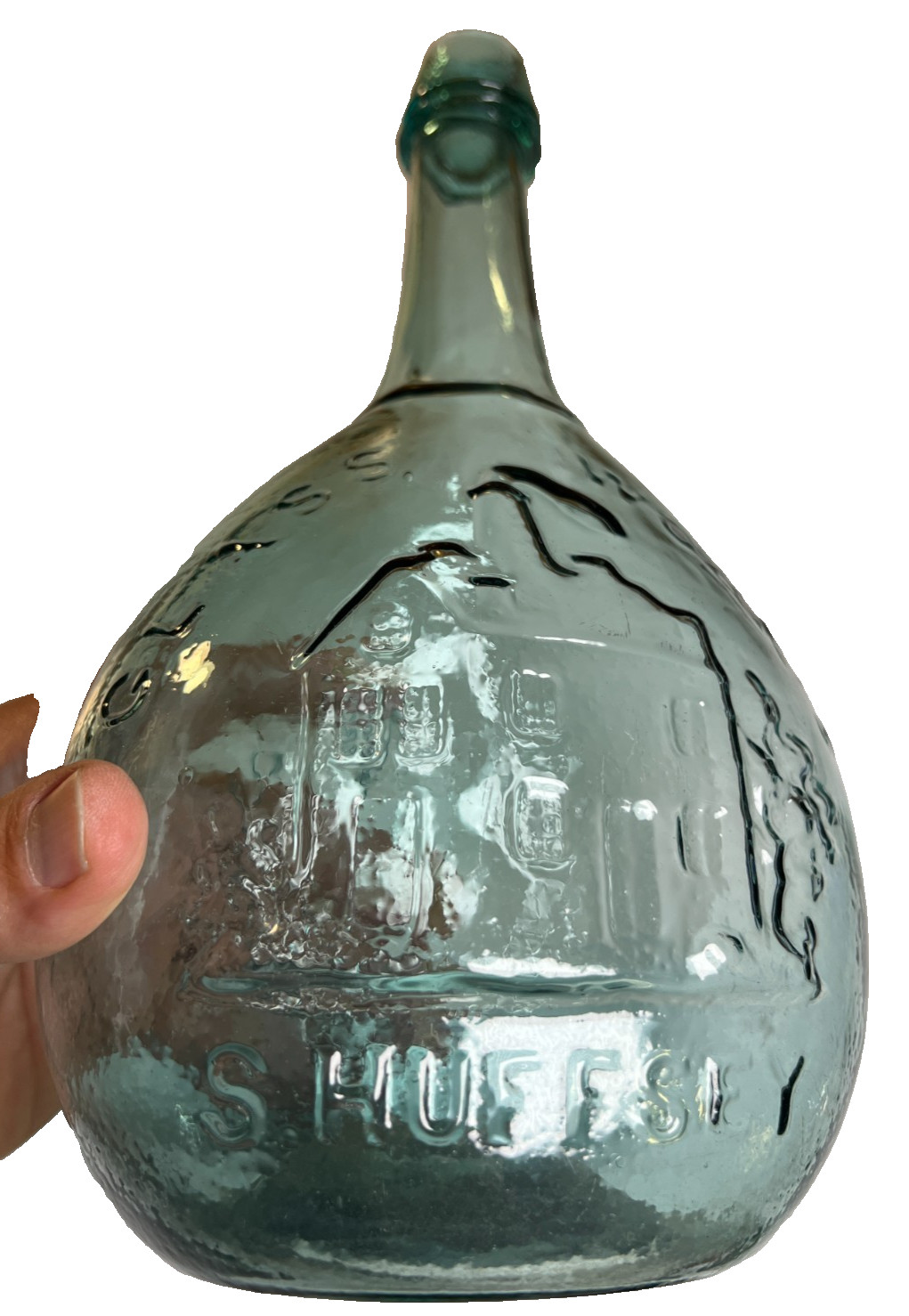
A Magnificent Jenny Lind Historical Flask in Exceptional Blue-Green Glass
Offered here is an outstanding circa 1850–1855 Jenny Lind portrait calabash flask, blown for Philadelphia glass entrepreneur Samuel Huffsey and cataloged by historical-flask collectors as GI-99.
Standing an impressive 10 1/2 inches tall, this is the desirable large quart-size form—a bold, sculptural piece of early American glass considerably larger and more commanding than the little pocket flasks encountered more frequently.
The color is especially beautiful. Rather than ordinary pale aqua, the glass has a pronounced teal to peacock blue-green character, becoming dramatically deeper and more saturated through the thick base, embossed decoration, and massive applied mouth. Light transforms it from cool blue-aqua into rich green-blue depending upon the angle and background.
This is not merely an antique bottle. It is an artifact of one of the first truly nationwide American celebrity crazes.
Embossed Jenny Lind Portrait
One face bears:
JENNY LIND
Beneath the name is a molded portrait bust of the celebrated singer, surrounded by graceful laurel branches.
The opposite face is embossed:
GLASS WORK’S
S. HUFFSEY
Between the inscriptions appears a remarkably detailed 19th-century glasshouse, complete with factory buildings, tall chimney, rising smoke, foliage, and architectural details.
This precise Jenny Lind/Huffsey mold is identified as GI-99 in the standard McKearin classification system for American historical flasks.
Who Was Jenny Lind?
Johanna Maria “Jenny” Lind (1820–1887) was a Swedish opera singer internationally celebrated as the “Swedish Nightingale.”
By the late 1840s, Lind had become one of Europe’s most admired singers—not merely for her voice, but also for her modest public personality and highly publicized charitable work.
Showman P. T. Barnum recognized her extraordinary marketing potential and persuaded her to tour America. Remarkably, Barnum reportedly had never heard her sing before arranging the engagement. What he understood was the power of reputation, publicity, and celebrity.
Lind arrived in New York on September 1, 1850, where enormous crowds gathered merely to see her disembark. Tickets to her first American concert were saleed, and the ensuing excitement became known as “Lind Mania.” Her name and likeness appeared on sheet music, furniture, hats, gloves, pianos, household goods—and historical flasks such as this one. Her American tour lasted until May 1852. Massachusetts Historical Society, Smithsonian Music
Unlike many celebrity endorsements, these bottles were not necessarily commissioned or financially authorized by Lind herself. They were part of the enormous commercial response to her fame—an early demonstration of how a public personality could become a nationwide brand.
Samuel Huffsey and the Glass Works
The S. HUFFSEY named beneath the embossed factory was Samuel Huffsey, a Philadelphia glassblower, mold maker, glass manufacturer, and dealer.
Huffsey had deep practical experience in the trade. Surviving historical research places him working as a glassblower at Philadelphia’s famous Dyottville works as early as the 1820s. By the early 1850s, the Huffsey concern was advertising itself as a manufacturer and dealer in numerous varieties of glassware, with a Philadelphia sales office.
The GI-99 flask is generally attributed to the Isabella Glass Works at New Brooklyn, New Jersey, in the South Jersey glassmaking district, and was produced for Huffsey’s Philadelphia trade. A specialist sale catalog likewise identifies the flask as made for Samuel Huffsey of Philadelphia, probably at Isabella. Jeffrey S. Evans & Associates
South Jersey was ideally suited to glassmaking. The Pine Barrens supplied abundant sand, wood for furnace fuel, and nearby transportation routes to Philadelphia, New York, and other growing markets. Glassmaking communities often included not only the furnace and blowing room, but workers’ houses, a company store, blacksmith, sawmill, mold shop, and storage buildings.
The smoking factory embossed upon this flask was therefore more than ornamental—it proudly represented the industrial source of the product.
What Did It Originally Contain?
This was a quart-size liquor or spirits flask.
Unlike a pocket flask intended to disappear inside a coat, the large calabash form was designed as a substantial household or tavern container. It could have held:
- Whiskey
- Brandy
- Gin
- Rum
- Cordials or other spirits
Because the bottle names a glass manufacturer rather than a particular distiller, its exact original contents cannot be proven. It was probably sold as a generic commercial spirits container, filled by a liquor dealer, grocer, tavern keeper, or regional bottler.
The broad applied mouth accepted a cork and made the vessel practical to fill, pour, recork, and potentially reuse. Bottles were valuable household objects in the 1850s and were commonly retained and refilled long after their original contents had been consumed.
Calling it a “whiskey flask” is appropriate as a collector category, but the more historically exact description is a large quart-size liquor flask capable of holding several kinds of spirits.
The Calabash Form
“Calabash” refers to the flask’s distinctive shape: a broad, rounded, almost gourd-like body tapering sharply into a long neck.
The form was inspired by the naturally hollow calabash gourd, which had been used for centuries as a vessel. American glassmakers transformed that practical organic shape into an ideal canvas for elaborate pictorial embossing.
At 10 1/2 inches tall, this is the full-size quart calabash, not a reduced pocket version. Its large body gave the mold maker room for the unusually ambitious portrait, wreath, lettering, and complete factory scene.
Hand-Blown Character
The photographs reveal abundant evidence of genuinely early manufacture:
- Large circular open/glass-tipped pontil scar
- Massive hand-applied mouth
- Wonderfully uneven and drippy lower collar
- Slightly irregular upper rim
- Thick, richly colored glass around the finish
- Uneven mold strike and natural distortion
- Whittled and rippled surface texture
- Numerous seed bubbles
- Larger trapped bubbles at the base
- Visible mold seams stopping below the separately applied finish
- Natural variation in glass thickness and color saturation
The mouth is particularly impressive. It was formed by adding molten glass to the completed neck and tooling it by hand. The wonderfully heavy, slightly off-center, drippy construction is not damage—it is exactly the kind of individual workmanship collectors want in early American glass.
The base displays the prominent pontil scar left when the vessel was transferred from the blowpipe to a pontil tool so the glassworker could finish the mouth. This is direct physical evidence of pre-machine, individually finished production.
A Particularly Desirable Color
Standard GI-99 examples are most often described simply as aqua. This example is more visually exciting.
The body has a definite blue-green or teal cast, while the thicker base, embossing, and applied mouth intensify into a striking peacock green-blue. The mouth practically glows.
Lighting always affects early aqua glass, so I would describe the color carefully as:
Strong teal-blue aquamarine with peacock blue-green saturation in the thicker glass.
That is both accurate and persuasive. I would avoid calling it a solid “peacock blue” throughout, because the thinner body remains translucent blue-aqua. Its appeal comes from the dramatic range of color across the bottle.
Condition
Excellent condition for an approximately 170-year-old historical flask.
- No chips
- No cracks
- No repairs
- No distracting haze
- Bright, clean, and highly displayable
- Strong overall embossing
- Superb original applied mouth
- Prominent original pontil scar
The base shows expected light shelf wear and scattered fine scratches consistent with genuine age and use. Any bubbles, rippling, asymmetry, tooling marks, or irregularities are original manufacturing characteristics—not later damage.
Please study all photographs, as they form an important part of the description and beautifully document the color, condition, embossing, applied finish, and pontil.
Why This Example Stands Out
The GI-99 is already an important and instantly recognizable historical flask. This particular example adds several especially desirable qualities:
- Large and impressive quart size
- Full 10 1/2-inch height
- Strong teal-blue aquamarine color
- Dramatically saturated peacock-colored mouth and base
- Exceptionally crude, heavy applied lip
- Prominent pontil scar
- Attractive glass bubbles and surface character
- Excellent condition
- Fascinating connection to Jenny Lind, P. T. Barnum, Philadelphia, and the South Jersey glass industry
It combines American glassmaking, popular entertainment, industrial history, and the birth of modern celebrity marketing in one spectacular object.

Related Items:
S Huffsey Teal Calabash Flask Bottle Open Pontil Isabella Glass New Brooklyn NJ
$595.00
Beautiful Green Jenny Lind Huffsey Calabash Flask 1850s Reproduction
$49.97