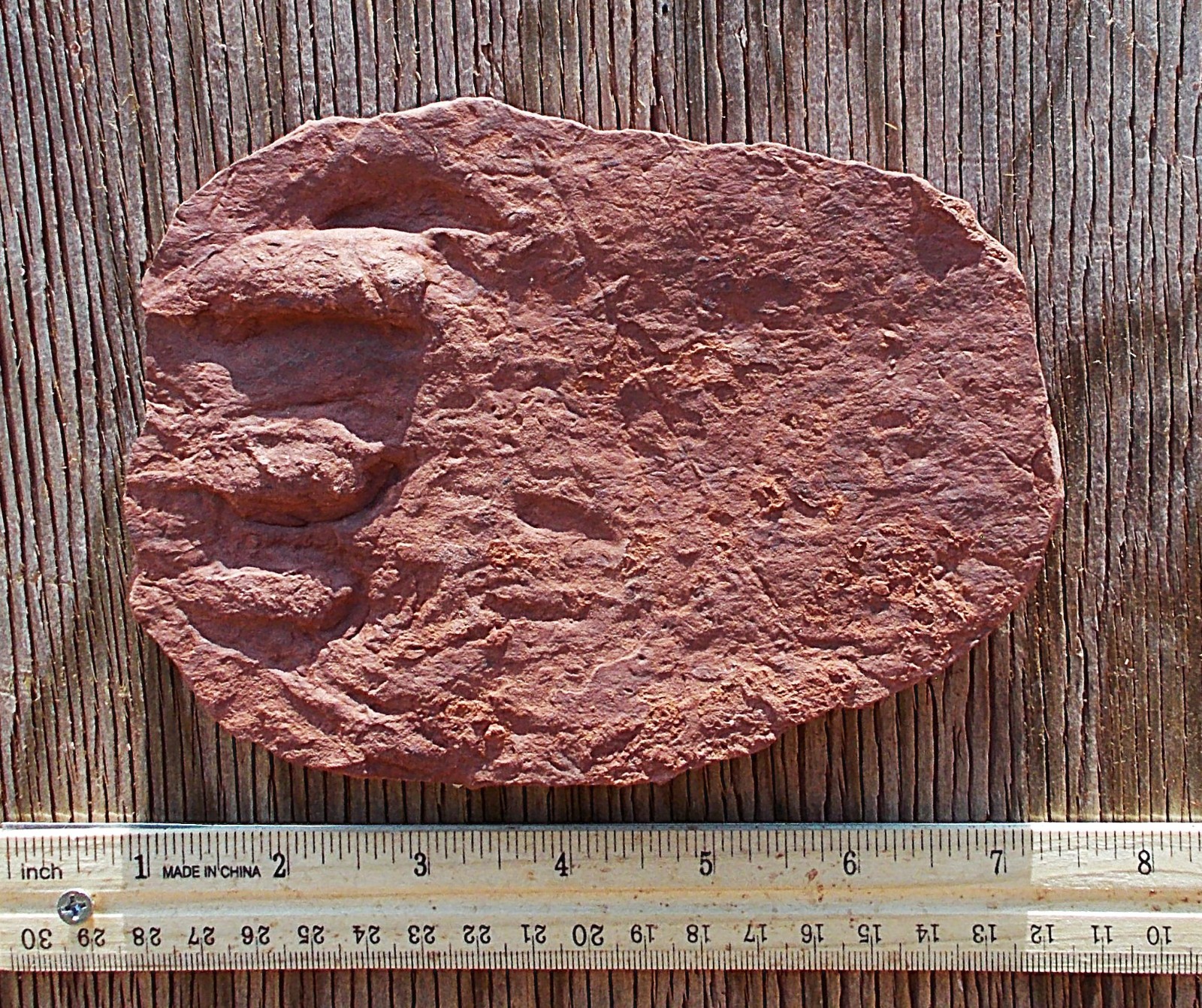
The footprint in the photo is of a dorsum-side manus. The dorsum side is the top of a manus or pes. Dorsum traces in ichnology areusually the result of decay resistant claws and/or a complete manus (usuallysevered) either pressed or partially buried in mud. After water orsome animal removed or transferred the upside-down manus of a dead animal, additionalsediments formed a cast of the claws and sometimes of the wrist (Henry Ortiz, the El Pueblo ichnotelmafacies 2026).
The dorsum area is trimmed as an estimate only.The claws are true size and true-form casts. These same claws have ben found up to five inches long in the El Pueblo ichnotelmafacies. Whether a reptilian or amphibian remains uncertain although a predacious amphibian that grew to a very large size is being considered. Dorsum-side footprints are note that we have changed from early Permian to Kasimovian late- Pennsylvanian.You can read Kasimovian-age abstract by Henry Ortiz on academiaedu.com. After years of research, the El Pueblo ichnotelmafacies (swamp facies) turned out to be late Pennsylvanian. The site represents an early departure from quasi-marine rain-forest swamps to a foreland basin and on to sinkhole-induced swamps produced by the dissolution of carbonate beds. Karst subsidence produced a chain of swamps leading down from the upland to the lowland. (Within the foreland basin the ladder of swamps was inverted because the decline was toward the mountains that were slowly subsiding.) Burial of the lowland progressed as uplifts triggered by inter-continental pressure weatheredanderodedduring heavy rainfall. The geological-time stage represents the formation of Pangea. The late Pennsylvanian taxa was diverse and finely integrated into a very efficient reproductive and self sustaining foodchain system. The El Pueblo ichnotelmafacies was mistakenly identified as early Permian within the New Mexico geological record, something that has probably happened elsewhere. Thanks to the footprints of giant dragonflies and thirty-inch-long centipedes, the early Permian record now stands corrected.The El Pueblo ichnotelmafacies is the only early genesis world source at present for Dimetrodon and other rare footprints.The different taxa in the El Pueblo swamp clarrified that both amphibians and reptilians did not wait for the beginning of the Permian Period to diversify, e.g., an early Gorgonops and a four-digit Eryops were contemporaneous in the El Pueblo swamp of over 305 million years ago (Henry Ortiz 2026).

Related Items:
Own a dorsum-side (top of manus) footprint.
$159.00

President Donald J. Trump Deluxe Limited Edtion Frame. Own A Piece Of History.
$34.99

🚨 Own A CGC 9.4 Comic from GEORGE PEREZ'S Collection First Appearance
$94.95