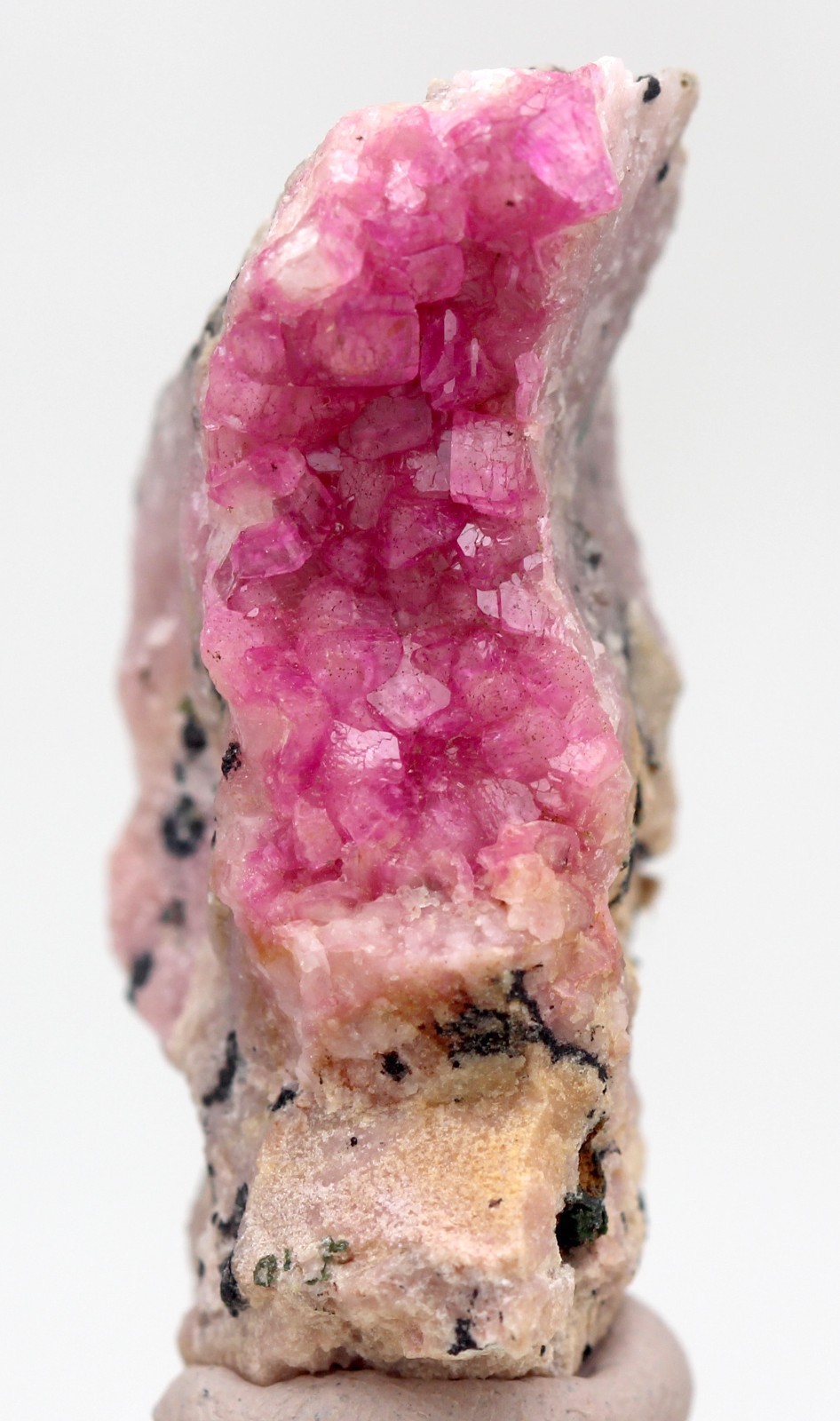
This specimen weighs 13.14 grams. It measures 37 mm x 17 mm x 16 mm.
I offer a shipping discount for customers who combine their payments for multiple purchases into one payment!
The discount is regular shipping price for the first item and just 50 cents for each additional item!
To be sure you get your shipping discount just make sure all the items you want to purchase are in your cart.
sales you win are added to your cart automatically.
For any \"buy it now\" items or second chance offers, be sure to click the \"add to cart\" button, NOT the \"buy it now\" button.
Once
all of your items are in your cart just pay for them from your cart and
the combined shipping discount should be applied automatically.
I offer a money back guarantee on every item I sell.
If you are not 100% happy with your purchase just send me a message to let me know
and I will buy back the item for your full purchase price.
Hi there, I am selling this really beautiful cobalto calcite mineral specimen. It is from the Mashamba West Mine, Katanga Provice, in the Democratic Republic of the Congo. Some call it colbtian calcite and others call it cobalto-calcite. It is really beautiful. It is a collection piece of mine that I have had. I thought I would try selling off some things from my old collection. I hope it finds a good home out there, and I am sure it will. If you have any questions, do not hesitate to ask me. Have fun offerding, thanks so much for visiting my sale and have a great day!
Here\'s some info about this mineral from Wikipedia:
Calcite
From Wikipedia, the free Carbonate minerals
Formula
(repeating unit) CaCO3
Strunz classification 5.AB.05
Crystal system Trigonal
Crystal class Hexagonal scalenohedral (3m)
H-M symbol: (3 2/m)
Space group R3c
Unit cell a = 4.9896(2) Å,
c = 17.0610(11) Å; Z = 6
Identification
Color Colorless or white, also gray, yellow, green,
Crystal habit Crystalline, granular, stalactitic, concretionary, massive, rhombohedral.
Twinning Common by four twin laws
Cleavage Perfect on [1011] three directions with angle of 74° 55\'[1]
Fracture Conchoidal
Tenacity Brittle
Mohs scale hardness 3 (defining mineral)
Luster Vitreous to pearly on cleavage surfaces
Streak White
Diaphaneity Transparent to translucent
Specific gravity 2.71
Optical properties Uniaxial (-)
Refractive index nω = 1.640–1.660
nε = 1.486
Birefringence δ = 0.154–0.174
Solubility Soluble in dilute acids
Other characteristics May fluoresce red, blue, yellow, and other colors under either SW and LW UV; phosphorescent
References [2][3][4]
Crystal structure of calcite
Calcite is a carbonate mineral and the most stable polymorph of calcium carbonate (CaCO3). The Mohs scale of mineral hardness, based on scratch hardness comparison, defines value 3 as \"calcite\".
Other polymorphs of calcium carbonate are the minerals aragonite and vaterite. Aragonite will change to calcite at 380–470 °C,[5] and vaterite is even less stable.
Contents [hide]
1 Etymology
1.1 \"Alabaster\", as used by archaeologists
2 Properties
3 Use and applications
4 Natural occurrence
5 Formation processes
6 In Earth history
7 Gallery
8 See also
9 References
10 Further is derived from the German Calcit, a term coined in the 19th century from the Latin word for lime, calx (genitive calcis) with the suffix -ite used to name minerals. It is thus etymologically related to chalk.[6]
\"Alabaster\", as used by archaeologists[edit]
When applied by archaeologists and stone trade professionals, the term alabaster is used not just as in geology and mineralogy, where it is reserved for a variety of gypsum; but also for a similar-looking, translucent variety of fine-grained banded deposit of crystals are trigonal-rhombohedral, though actual calcite rhombohedra are rare as natural crystals. However, they show a remarkable variety of habits including acute to obtuse rhombohedra, tabular forms, prisms, or various scalenohedra. Calcite exhibits several twinning types adding to the variety of observed forms. It may occur as fibrous, granular, lamellar, or compact. Cleavage is usually in three directions parallel to the rhombohedron form. Its fracture is conchoidal, but difficult to obtain.
It has a defining Mohs hardness of 3, a specific gravity of 2.71, and its luster is vitreous in crystallized varieties. Color is white or none, though shades of gray, red, orange, yellow, green, blue, violet, brown, or even black can occur when the mineral is charged with impurities.
Calcite is transparent to opaque and may occasionally show phosphorescence or fluorescence. A transparent variety called Iceland spar is used for optical purposes. Acute scalenohedral crystals are sometimes referred to as \"dogtooth spar\" while the rhombohedral form is sometimes referred to as \"nailhead spar\".
Single calcite crystals display an optical property called birefringence (double refraction). This strong birefringence causes objects viewed through a clear piece of calcite to appear doubled. The birefringent effect (using calcite) was first described by the Danish scientist Rasmus Bartholin in 1669. At a wavelength of ~590 nm calcite has ordinary and extraordinary refractive indices of 1.658 and 1.486, respectively.[8] Between 190 and 1700 nm, the ordinary refractive index varies roughly between 1.9 and 1.5, while the extraordinary refractive index varies between 1.6 and 1.4.[9]
Calcite, like most carbonates, will dissolve with most forms of acid. Calcite can be either dissolved by groundwater or precipitated by groundwater, depending on several factors including the water temperature, pH, and dissolved ion concentrations. Although calcite is fairly insoluble in cold water, acidity can cause dissolution of calcite and release of carbon dioxide gas. Ambient carbon dioxide, due to its acidity, has a slight solubilizing effect on calcite. Calcite exhibits an unusual characteristic called retrograde solubility in which it becomes less soluble in water as the temperature increases. When conditions are right for precipitation, calcite forms mineral coatings that cement the existing rock grains together or it can fill fractures. When conditions are right for dissolution, the removal of calcite can dramatically increase the porosity and permeability of the rock, and if it continues for a long period of time may result in the formation of caves. On a landscape scale, continued dissolution of calcium carbonate-rich rocks can lead to the expansion and eventual collapse of cave systems, resulting in various forms of karst topography.
Use and applications[edit]
High-grade optical calcite was used in World War II for gun sights, specifically in bomb sights and anti-aircraft weaponry.[10] Also, experiments have been conducted to use calcite for a cloak of invisibility.[11] Microbiologically precipitated calcite has a wide range of applications, such as soil remediation, soil stabilization and concrete repair.
Calcite, obtained from an 80 kg sample of Carrara marble,[12] is used as the IAEA-603 isotopic standard in mass spectrometry for the calibration of δ18O and δ13C.[13]
Natural occurrence[edit]
The largest documented single crystal of calcite originated from Iceland, measured 7×7×2 m and 6×6×3 m and weighed about 250 tons.[14][15]
Calcite is a common constituent of sedimentary rocks, limestone in particular, much of which is formed from the shells of dead marine organisms. Approximately 10% of sedimentary rock is limestone.
Calcite is the primary mineral in metamorphic marble. It also occurs as a vein mineral in deposits from hot springs, and it occurs in caverns as stalactites and stalagmites.
Lublinite is a fibrous, efflorescent form of calcite.[16]
Calcite may also be found in volcanic or mantle-derived rocks such as carbonatites, kimberlites, or rarely in peridotites.
Calcite is often the primary constituent of the shells of marine organisms, e.g., plankton (such as coccoliths and planktic foraminifera), the hard parts of red algae, some sponges, brachiopods, echinoderms, some serpulids, most bryozoa, and parts of the shells of some bivalves (such as oysters and rudists). Calcite is found in spectacular form in the Snowy River Cave of New Mexico as mentioned above, where microorganisms are credited with natural formations. Trilobites, which became extinct a quarter billion years ago, had unique compound eyes that used clear calcite crystals to form the lenses.[17]
Formation processes[edit]
Calcite formation can proceed via several pathways, from the classical Terrace ledge kink model[18] to the crystallisation of poorly ordered precursor phases (amorphous calcium carbonate, ACC) via an Ostwald ripening process, or via the agglomeration of nanocrystals.[19]
The crystallization of ACC can occur in two stages: first, the ACC nanoparticles rapidly dehydrate and crystallize to form individual particles of vaterite. Secondly, the vaterite transforms to calcite via a dissolution and reprecipitation mechanism with the reaction rate controlled by the surface area of calcite.[20] The second stage of the reaction is approximately 10 times slower. However, the crystallization of calcite has been observed to be dependent on the starting pH and presence of Mg in solution.[21] A neutral starting pH during mixing promotes the direct transformation of ACC into calcite. Conversely, when ACC forms in a solution that starts with a basic initial pH, the transformation to calcite occurs via metastable vaterite, which forms via a spherulitic growth mechanism.[22] In a second stage this vaterite transforms to calcite via a surface-controlled dissolution and recrystallization mechanism. Mg has a noteworthy effect on both the stability of ACC and its transformation to crystalline CaCO3, resulting in the formation of calcite directly from ACC, as this ion destabilizes the structure of vaterite.
Calcite may form in the subsurface in response to activity of microorganisms, such as during sulfate-dependent anaerobic oxidation of methane, where methane is oxidized and sulfate is reduced by a consortium of methane oxidizers and sulfate reducers, leading to precipitation of calcite and pyrite from the produced bicarbonate and sulfide. These processes can be traced by the specific carbon isotope composition of the calcites, which are extremely depleted in the 13C isotope, by as much as −125 per mil PDB (δ13C).[23]
In Earth history[edit]
Calcite seas existed in Earth history when the primary inorganic precipitate of calcium carbonate in marine waters was low-magnesium calcite (lmc), as opposed to the aragonite and high-magnesium calcite (hmc) precipitated today. Calcite seas alternated with aragonite seas over the Phanerozoic, being most prominent in the Ordovician and Jurassic. Lineages evolved to use whichever morph of calcium carbonate was favourable in the ocean at the time they became mineralised, and retained this mineralogy for the remainder of their evolutionary history.[24] Petrographic evidence for these calcite sea conditions consists of calcitic ooids, lmc cements, hardgrounds, and rapid early seafloor aragonite dissolution.[25] The evolution of marine organisms with calcium carbonate shells may have been affected by the calcite and aragonite sea with mottramite.
Trilobite eyes employed calcite.
Calcite crystals inside a test of the cystoid Echinosphaerites aurantium (Middle Ordovician, northeastern Estonia).
Rhombohedrons of calcite that appear almost as books of petals, piled up 3-dimensonally on the matrix.
Calcite crystal canted at an angle, with little balls of hematite and crystals of chalcopyrite both on its surface and included just inside the surface of the crystal.
Thin section Calcite crystals inside a recrystallized bivalve shell in a biopelsparite.
Several well formed milky white casts, made up of many small sharp calcite crystals, from the sulfur mines at Agrigento, Sicily.
Manganoan calcite.
Reddish rhombohedral calcite crystals from China. Its red color is due to the presence of iron.
Calcite (var.: Cobaltoan calcite).
Sand calcites (calcites heavily included with desert sand) in South Dakota
Calcite from Ojuela Mine, Mapimí, Mapimí Municipality, Durango, Mexico.

Related Items:
9oz COBALTO CALCITE Morocco AMAZING PINK Mineral Crystals
$29.99
4Lb Wholesale Rare minerals Flat of 22 specimens of high quality Collection, #31
$175.00
COBALTO CALCITE Crystal Mineral Specimen Druzy Cluster Cobaltian CONGO
$39.99