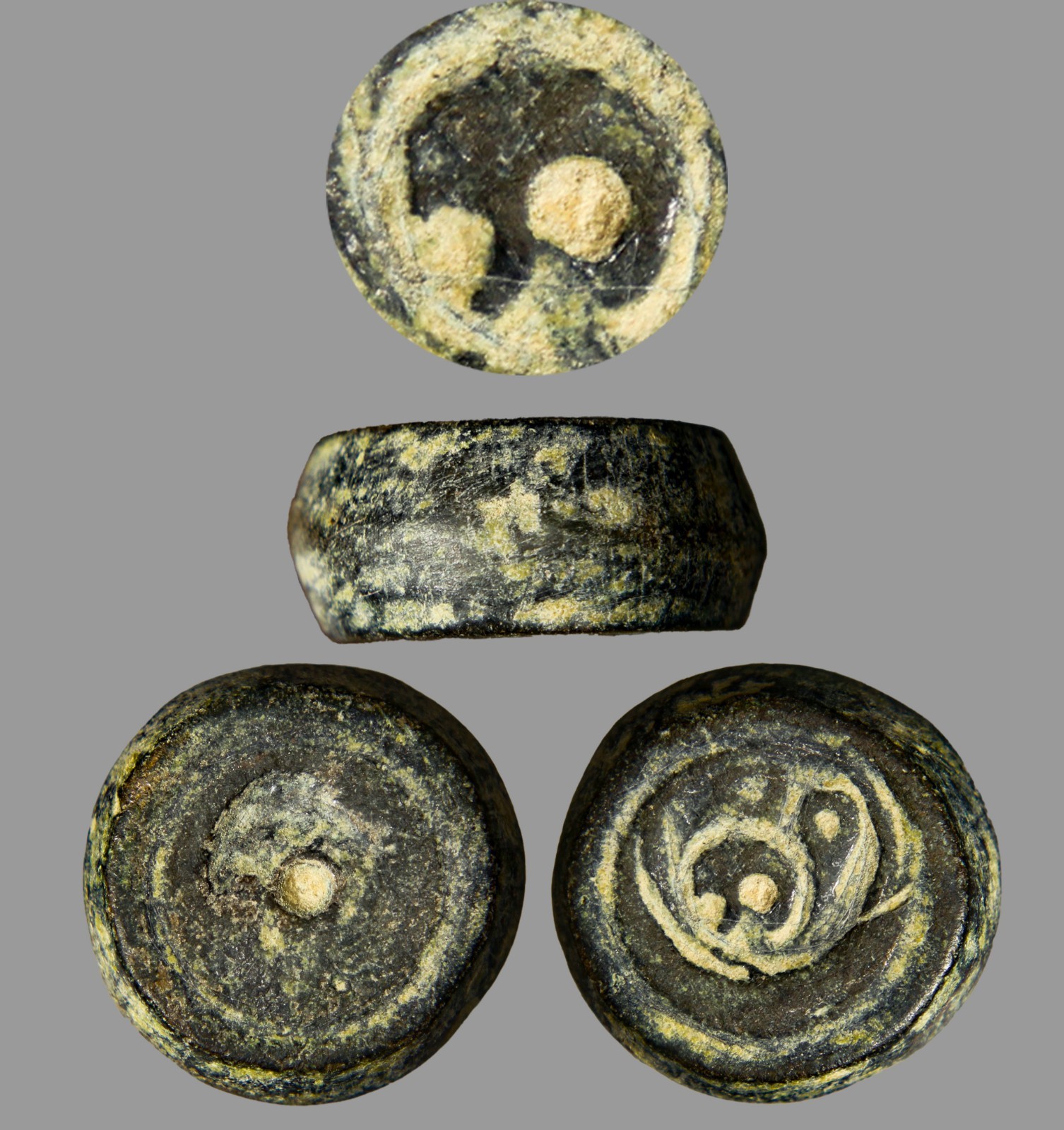
RARE Animal-Countermarked Roman Bronze Weight (8.41g — 2 Solidi / 1/3 Uncia Standard / c. 1st–4th Century AD)
Authenticity & Guarantee
Item Specifications & Exact Dimensions
Object: Lathe-Turned Biconical Bronze Commercial / Coin Weight with Central Animal Verification Countermark
Primary Feature: Extremely Rare Official Animal Countermark (Bear / Lion / Boar Motif) deeply impressed within a raised circular boundary
Culture / Period: Roman Imperial to Late Roman Era
Date Range: Circa 1st Century AD – 4th Century AD (c. 100–400 AD)
Weight: 8.41 grams (conforms precisely to the Roman 2 Solidi coin weight standard [2 × 4.25g = 8.5g] and the 1/3 Uncia / 2 Sextulae trade mass)
Material: Heavy Cast Bronze (Copper Alloy)
Form & Architecture: Biconical / barrel-shaped bronze disc with concentric lathe-turned ring moldings; upper face features a deeply struck circular countermark matrix depicting a quadruped animal (bear or lion) enclosed by a raised border; reverse face features a central lathe-pivoting calibration depression
Condition: Exceptional, complete ancient condition. Crisp, deeply impressed animal countermark, sharp lathe-molded profiles, heavy solid metal mass, preserved under an authentic dark charcoal-olive bronze patina with creamy pale sandy-white earthen deposits highlighting the stamped motif. Free of modern restoration or tooling.
HISTORICAL CONTEXT & TYPOLOGICAL LORE
THE ANIMAL COUNTERMARK: Municipal Seals & Military Emblematic Stamps
While Roman geometric or numerical weights are occasionally found, animal countermarks are among the rarest metrological artifacts in Roman archaeology. Struck into the bronze matrix by local market inspectors (agoranomoi or aediles), animal countermarks served as official heraldic seals certifying the weight\'s accuracy for commercial transactions and tax assessments.
Symbolism: Bears, Lions, and Regional Civic Badges
In Roman provincial administration, animal figures carried specific regional and military significance:
Civic Heraldry & Local Authority: Cities across Roman Syria, Judaea, Asia Minor, and the Danube frontier adopted specific beasts—such as the bear, lion, or boar—as official municipal badges to stamp verified trade goods, weights, and coinage.
Legionary Badges: Military garrisons stationed along frontier trade corridors routinely stamped official equipment and weights with legionary symbols (such as the bear or boar) to regulate trade passing through military supply hubs (canabae).
Anti-Fraud Certification: The deep impression guaranteed buyers and tax collectors that the 8.41g piece had not been tampered with, filed, or clipped.
Metrological Standard: 2 Solidi / 1/3 Uncia
At 8.41 grams, this piece functioned as a precision 2 Solidi coin weight used by bankers (nummularii) and merchants to weigh gold Solidi coinage, as well as a 1/3 Uncia (2 Sextulae) commercial weight for high-value trade items including raw silk, perfumes, and silver scrap.
Typological Analysis & Exact Classification
Comparable Archaeological Examples & Museum Accession Numbers
British Museum (Accession No. 1888,1208.12): Roman bronze official trade weight stamped with an animal verification mark.
Israel Antiquities Authority (IAA Collection, Marisa & Caesarea Strata): Stamped Roman bronze weights bearing animal and civic countermarks.
TRN1-6

Related Items:
Antiquity Roman Bronze 2 Solidi Weight 8.41g Stamped Bear Animal Seal AD 100-400
$225.00
Ancient Roman Legionary Antiquity Signet Ring Size 9 Military c. 1st-3rd C AD
$145.00
Afghan Old Agate Roman Stone beads Wonderful Strand Necklace
$84.00