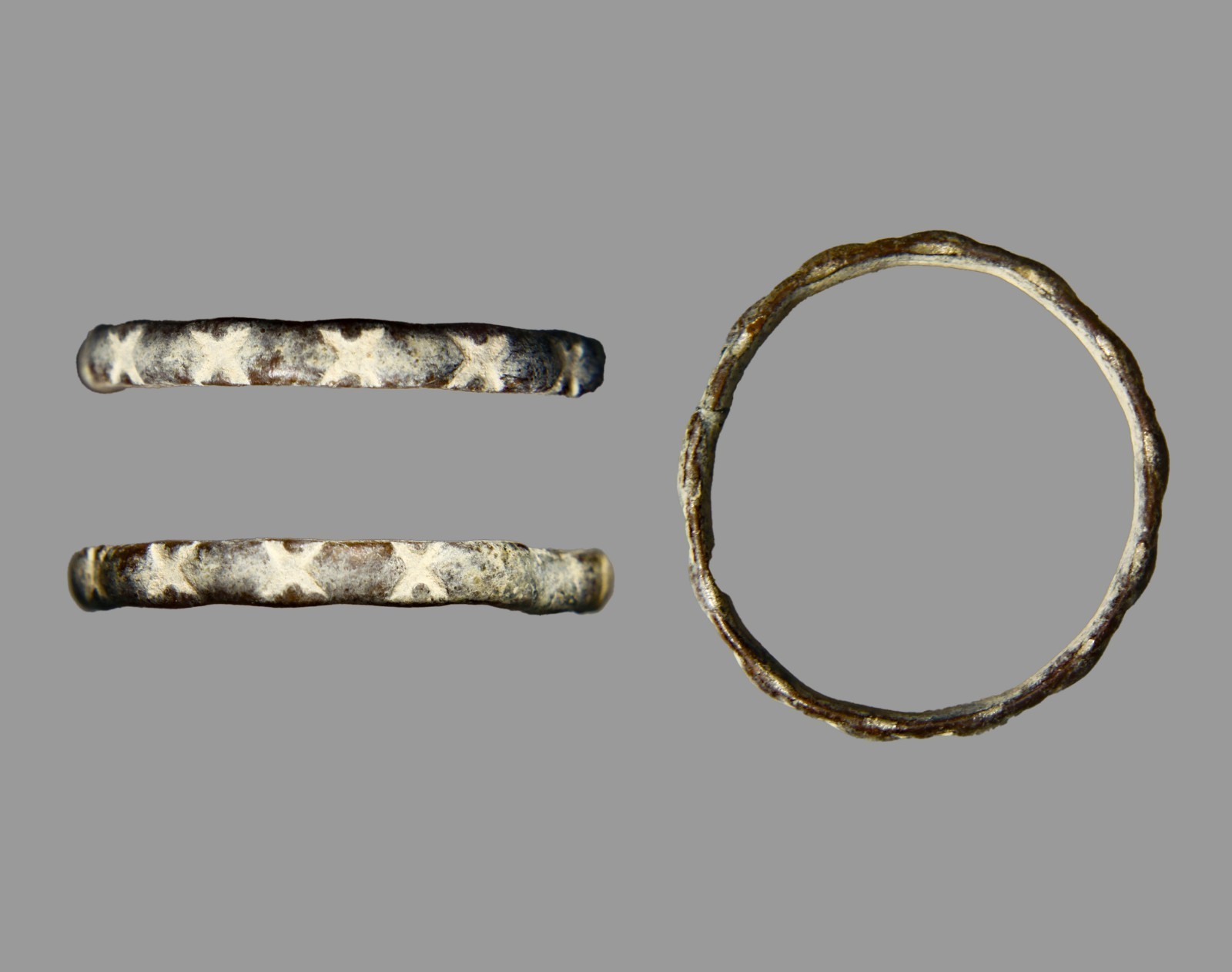
Ring size 8
Throughout the ancient cities of Mesapotamia and the Near Levant, bronze band rings adorned with continuous geometric patterns were widely worn by both men and women. Repeating linear symbols—such as the crossed 'X' motif (crux decussata)—represent some of the oldest decorative traditions in Near Eastern metallurgy, appearing on stamp seals, bronzes, and personal jewelry across the Kassite, periods
Apotropaic Function of the Repeating 'X' Motif
In Near Eastern folklore, continuous geometric bands served a dual purpose: aesthetic elegance and spiritual protection. The repeating cross or star-like 'X' pattern functioned as an apotropaic grid, designed to encircle the finger and seal the wearer against demonic influences, illness, and the malevolent gaze of harmful entities like Lamashtu.
Typological Analysis & Exact Classification
Primary Class: Ancient Near Eastern Personal Equipment / Bronze Finger Band
Sub-Class: Continuous Incised Geometric Cross ('X') Band Class
Manufacturing Technique: Cast copper alloy circular band with hand-chiseled exterior geometric matrix details.
Comparable Archaeological Examples & Museum Accession Numbers