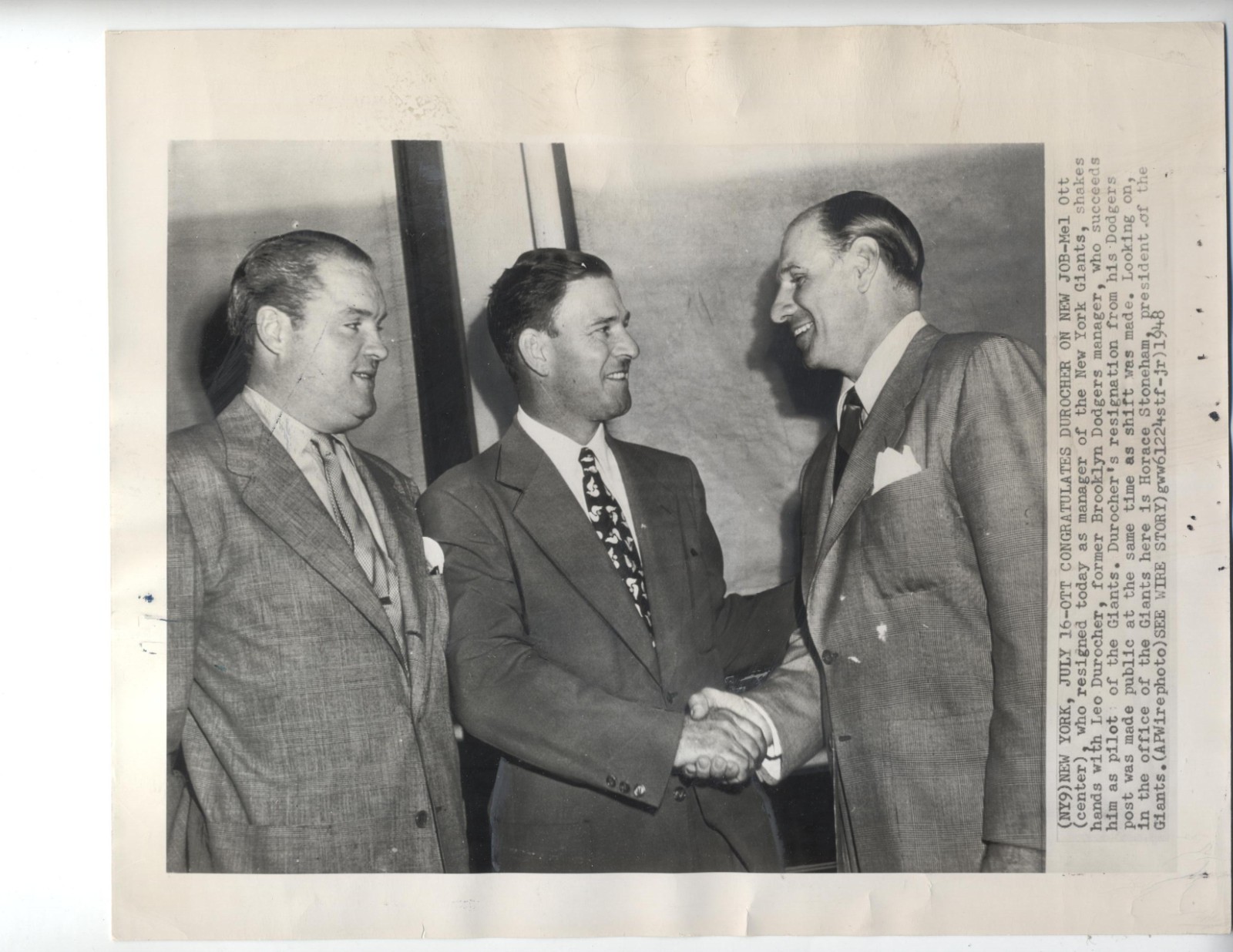
Own a piece of baseball history with this unique offering: an original 1948 Associated Press wire photo capturing the moment Mel Ott congratulated Leo Durocher on taking over as manager of the New York Giants. The photo features Mel Ott, the resigning manager, shaking hands with Leo Durocher, his successor and the former Brooklyn Dodgers manager, while Giants President Horace Stoneham looks on. This incredible photograph, dated July 16, 1948, is accompanied by a vintage newspaper clipping and library reference card that detail the significance of this iconic managerial change, marking a pivotal moment in the fierce Giants-Dodgers rivalry. This set is a must-have for any serious collector of baseball memorabilia, New York sports history, or vintage photography.
Details
Item: Vintage 8x10 Black & White Press Photograph
Date: July 16, 1948
Location: New York, NY (Giants\' offices)
Subjects: Mel Ott, Leo Durocher, Horace Stoneham
Key Content: Resignation of Mel Ott as NY Giants manager, appointment of Leo Durocher (ex-Dodgers manager) as his successor.
Original AP Wire Photo: The full 8x10 photograph, in excellent vintage condition with original sepia toning, includes the detailed caption text printed directly along the right-hand margin.
Vintage Newspaper Clipping: A smaller, halftone newspaper print of the same image, likely from July 17, 1948, featuring the headline \"Mel Ott (left), He\'s Out; Leo Durocher, He\'s In.\"
Reference Library Card: A separate, smaller card stamped twice with a purple ink library stamp reading \"RECEIVED EXAMINER REFERENCE LIBRARY JUL 17 1948.\" This card holds the newspaper clipping.
Overall Presentation: The larger photograph and the reference card with the clipping are mounted on a larger piece of white paper, showing wear, creasing, and minor smudging consistent with its age and press library history.
Text Transcriptions
Right Margin of the Photo (Printed Typeface):
\"(NY9)NEW YORK, JULY 16--OTT CONGRATULATES DUROCHER ON NEW JOB--Mel Ott (center) who resigned today as manager of the New York Giants, shakes hands with Leo Durocher, former Brooklyn Dodgers manager, who succeeds him as pilot of the Giants. Durocher\'s resignation from his Dodgers post was made public at the same time as shift was made. Looking on, in the office of the Giants here is Horace Stoneham, president of the Giants. (APWirephoto) SEE WIRE STORY) gww61224stf-jr) 1948\"
Newspaper Clipping Headline (under halftone image):
\"Mel Ott (left), He\'s Out; Leo Durocher, He\'s In\"
Reference Library Card Stamps (Purple Ink):
\"RECEIVED EXAMINER REFERENCE LIBRARY JUL 17 1948\" (Repeated twice)
Historical Significance and Biographical Information
Mel Ott (1909–1958):
A legendary outfielder for the New York Giants (1926–1947), known for his distinctive leg-kick batting style.
A member of the National Baseball Hall of Fame (inducted 1951).
Hit 511 career home runs, an NL record for decades, and won the 1933 World Series.
Managed the Giants from 1942 to 1948, a difficult period during and after WWII. This photo captures his graceful resignation in favor of his \"enemy\" rival manager.
Leo Durocher (1905–1991):
A colorful and controversial player and manager.
A Hall of Fame shortstop (inducted 1994).
Known for his aggressive, \"win-at-all-costs\" managing style, often famously associated with the phrase, \"Nice guys finish last.\"
Most famously managed the Brooklyn Dodgers (1939–1946, 1948), including during the pivotal arrival of Jackie Robinson, and the New York Giants (1948–1955), leading them to the 1954 World Series title.
This photo is iconic as it shows him \"crossing the river\" to lead the hated rival.
Horace Stoneham (1903–1990):
President of the New York Giants from 1936 to 1976.
Oversaw the team\'s move from the Polo Grounds in New York to San Francisco in 1958.
His presence confirms the official nature of the managerial shift depicted.
Keywords for :
New York Giants, Brooklyn Dodgers, Mel Ott, Leo Durocher, Horace Stoneham, MLB, Baseball history, Hall of Fame, HOF, Managerial change, Resignation, Polo Grounds, Associated Press, AP Wirephoto, Press photo, Original photo, Vintage photograph, 1948, New York sports, Sports memorabilia, Newspaper clipping, Examiner Reference Library, Jackie Robinson era, Baseball rivalry, Nice guys finish last.
Melvin Thomas Ott (March 2, 1909 – November 21, 1958), nicknamed \"Master Melvin\", was an American professional baseball right fielder, who played in Major League Baseball (MLB) for the New York Giants, from 1926 through 1947.He batted left-handed and threw right-handed. Though unusually slight in stature for a power hitter, at 5 feet 9 inches (1.75 m), 170 pounds (77 kg),[1] Ott led the National League in home runs a then-record six times. He was an All-Star for 11 consecutive seasons,[a] and was the first National League player to surpass 500 career home runs.Ott was elected to the National Baseball Hall of Fame in 1951.
Early lifeOtt was born in Gretna, Louisiana, a suburb of New Orleans. He was a second cousin of the Roman Catholic Bishop of Baton Rouge, Stanley Joseph Ott.[2] Despite his average height, he quickly established himself as a gifted athlete, especially in baseball. During high school, he played on a semi-pro team three or four days a week. He already showed considerable power at a young age and was getting paid for it. His team had a tradition of passing the hat whenever a player hit a home run that figured in a victory, meaning Ott was taking home money for playing baseball as early as 14.[3]
Playing careerDespite his power, Ott\'s hometown minor league team, the New Orleans Pelicans, refused to sign him because of concerns about his size. He then found a job at a lumber company in Patterson, near Morgan City, where he became a sensation on the company baseball team. Company owner Henry Williams was particularly impressed with Ott. While visiting New York, he suggested that Giants manager John McGraw give him a tryout. Ott was skeptical at first, so Williams bought Ott a train ticket to New York.[3]Ott arrived in New York in early September. He quickly impressed observers with his hitting, especially McGraw, who predicted that he would be \"one of the greatest lefthand hitters the National League has ever seen.\" He formally signed Ott to a contract in January 1926.[3]
Regular seasonOtt had originally been a catcher, but McGraw concluded that Ott was too small to be a major league catcher and converted him into an outfielder. After two years as a part-time player, he became the regular right fielder in 1929 at the age of 20. He didn\'t disappoint, hitting .328 in 150 games while setting career highs in home runs (42) and RBI (151)—both records for players who were 20 years old or younger at the start of the season.[1][3] Ott\'s 1929 batting average of .328 is his second highest season average for a full-time player trailing only his 1930 campaign with a .349 average.[1] By the time Ott reached the age of 25, he had accumulated 1,249 hits, the second highest total for a 25-year-old in MLB history, behind only Ty Cobb (1,433).[4]
Ott\'s 1933 Goudey baseball cardOtt was a six-time NL home run leader, in 1932, 1934, 1936–1938, and 1942.[1] From 1928 through 1945, he led the New York Giants in home runs. This 18-season consecutive dominance is a record; no other player has ever led his team in more consecutive years in a single Triple Crown category. He was both the youngest player to hit 100 home runs and the first National Leaguer to hit 500 home runs. He passed Rogers Hornsby to become the all-time NL home run leader in 1937 and held that title until Willie Mays passed him in 1966.
Ott\'s 1940 Bowman Play Ball baseball cardOtt was noted for reaching base via the base on balls (BB), or walk. He drew five walks in a game three times. He set the National League record for most walks in a doubleheader, with six, on October 5, 1929, and did it again on April 30, 1944. He tied an MLB record by drawing a walk in seven consecutive plate appearances (June 16–18, 1943). He also led the NL in walks six times: in 1929, 1931–1933, 1937, and 1942.He twice scored six runs in a game, on August 4, 1934, and on April 30, 1944. He is the youngest major leaguer to ever hit for the cycle. Ott was the first NL player to post eight consecutive 100-RBI seasons, and only Willie Mays, Sammy Sosa, Chipper Jones, and Albert Pujols have since joined him.He used a batting style that was then considered unorthodox, lifting his forward (right) foot prior to impact. When McGraw first saw Ott\'s style, he called it \"the most natural swing I\'ve seen in years.[3] Alvin Dark said that Ott \"lifted his lead foot right off the ground like he was getting ready to kick at a dog\".[5] This style helped him hit for power. More recent players who used a similar style include Harold Baines and Kirby Puckett, as well as the Japanese home run king, Sadaharu Oh.In 1943, all of his 18 home runs came at home; only two other players ever had a greater number of all-homefield home runs. Of Ott\'s 511 career home runs, 323 of them, or 63%, came at home.[6] Because of this, his home run record historically has been downplayed, suggesting that a 257-foot (78 m) foul line at the Polo Grounds resulted in higher numbers at home. Sportswriters often jokingly referred to him as the master of the \"Chinese home run\" as such short homers were called at the time; Ott would often respond by noting that if it was so easy to inflate his homer totals by hitting over that fence, all other hitters in the league would be doing it.[7]As a balance, the Polo Grounds had the deepest power alleys in baseball. Also, Ott hit more career home runs in foreign stadiums than any other National League hitter at the time of his retirement. In some of his better seasons, he hit more homers on the road than in the Polo Grounds.There may be reason to believe that he was a better hitter than his record suggests because of differences in National League and American League ball specifications.[8] Those differences are considered the greatest in the history of the game and made it considerably harder for National League hitters to achieve home runs.Ott was also a skilled fielder. He was a master at playing balls that bounced off the fences at the Polo Grounds, allowing him to garner 26 assists in 1929, his first full season as a full-time player. He would never even approach that figure again, as baserunners quickly realized it was far too risky to run on balls hit in Ott\'s direction.[3]During the prime of Ott\'s career, 11 seasons from 1931 to 1941, American League batters averaged 21% more home runs—peaking at 41% more home runs—than their National League counterparts. Babe Ruth and Jimmie Foxx, contemporaries, and both American League players, were the only batters to surpass Ott\'s record during this time.
Post-seasonOtt played in the World Series in 1933, 1936, and 1937, winning in 1933. He hit two home runs during the 1933 World Series.[1] In Game 1, he had four hits, including a two-run home run in the first inning.[9] In Game 5, he drove in the series-winning run with two outs in the top of the 10th, driving a pitch into the center-field bleachers.[10] In the 1936 World Series, Ott had seven hits and one home run.[1] In 1937, he had four hits and one home run.[1] Playing in 16 World Series games, Ott batted .295 (18-for-61) with eight runs, four home runs and 10 RBI.[1]
Career statisticsIn his 22-season career, Ott batted .304 with 511 home runs, 1,860 RBI, 1,859 runs, 2,876 hits, 488 doubles, 72 triples, 89 stolen bases, 1,708 BB, .414 on-base percentage and a .533 slugging percentage. Defensively, he recorded a .974 fielding percentage. He hit better than .300 10 times in his major league career.[1] At the time of his retirement, he had hit 200 more home runs than the next-highest National Leaguer.
Managerial careerAfter longtime teammate Bill Terry retired as manager in 1941, he named Ott as player-manager. Ott continued as a regular player for another five years, and remained productive at the plate for much of that time. In 1942, he led the league in home runs (30), runs scored (118), and walks (109).[1] He finished second in home runs (26) and third in slugging percentage (.544) in 1944.[11] In 1945, he hit .308 and finished tied for fourth in home runs (21).[3]On the second day of the 1946 season, a day after hitting what would be his final career home run, he injured his knee while diving for a fly ball.[3] The injury effectively ended his career; he only appeared in 29 more games for the rest of 1946, and retired after making only four cameo appearances in 1947.[1] He stayed on as manager until Leo Durocher replaced him midway through the 1948 season.[3]The Giants\' best finish during Ott\'s tenure was third place in 1942, one of only three times he finished with a winning record. However, his 1943 and 1944 teams were decimated by World War II, which saw a number of established players drafted into the military.[3]It was in reference to Ott\'s supposedly easy-going managing style that then-Dodgers manager Durocher made the oft-quoted and somewhat out-of-context comment, \"Nice guys finish last!\" Ott was the first manager to be ejected from both games of a doubleheader, when the Giants lost both games to the Pittsburgh Pirates on June 9, 1946.[12]Ott spent the remaining two-and-a-half years of his contract helping his former teammate Carl Hubbell run the Giants\' farm system. In 1951, Ott succeeded Chuck Dressen as manager of the Oakland Oaks of the Pacific Coast League, leading the club to an 80–88 record and seventh-place finish.[13] In 1952, the Oaks finished 104–76 under Ott, good for second place in the PCL.[14]
MLB honors
Mel Ott\'s number 4 was retired by the New York Giants in 1949.Ott was elected to the Baseball Hall of Fame in 1951 with 87.2% of the vote.[15] His number \"4\" was also retired by the Giants in 1949, and it is posted on the facade of the upper deck in the left field corner of Oracle Park.[16]He was a National League All-Star for 12 consecutive seasons, from 1934 through 1945 (All-Star selections only began in 1933; Ott had at least three All-Star caliber seasons prior to that, as well as in 1945, when MLB cancelled the 1945 contest and selections).[17]He is one of only six National League players to spend a 20+ year career with one team (Cap Anson, Stan Musial, Willie Stargell, Tony Gwynn, and Craig Biggio being the others).In 1999, Ott was a nominee for the Major League Baseball All-Century Team. That same year, The Sporting News placed Ott at number 42 on its list of \"Baseball\'s 100 Greatest Players\".[18] In 2020, The Athletic ranked Ott at number 32 on its \"Baseball 100\" list, compiled by sportswriter Joe Posnanski.[19]
Broadcasting career
Ott (left) in the broadcast booth with Van Patrick, 1957Ott spent the 1953 and 1954 seasons out of baseball for the first time since coming to New York in 1925. In 1955, he joined the Mutual radio network to recreate baseball games. From 1956 to 1958, Ott teamed with Van Patrick to broadcast the games of the Detroit Tigers on radio and television.
DeathOtt was injured in an auto accident in Bay Saint Louis, Mississippi, in November 1958. He was transferred to a hospital in New Orleans, where he died a week later at the age of 49.[20] He was interred in Metairie Cemetery. Ott died in a similar manner to two other New York Giants Hall of Famers: Frankie Frisch in 1973 and Carl Hubbell in 1988, both of whom had been teammates with Ott (Frisch in Ott\'s rookie season in 1926 and Hubbell for his entire career from 1928 to 1943).
LegacyOtt is remembered in his hometown of Gretna, where a park is named in his honor. Since 1959, the National League has honored the league\'s annual home run champion with the Mel Ott Award.[21][22] In the 1989 film Field of Dreams, Ott was one of several deceased players portrayed in farmer Ray Kinsella\'s Iowa cornfield. In 2006, Ott was featured on a United States postage stamp, as one of a block of four honoring \"Baseball Sluggers\" — the others being Mickey Mantle, Hank Greenberg, and Roy Campanella. In announcing the stamps, the U.S. Postal Service stated, \"Remembered as powerful hitters who wowed fans with awesome and often record-breaking home runs, these four men were also versatile players who helped to lead their teams to victory and set impressive standards for subsequent generations.\"[23] Ott is also remembered in the name of the Little League of Amherst, New York. The Mel Ott Little League began in 1959, named for Ott soon after his death.Ott\'s name frequently appears in crossword puzzles, on account of its letter combination and brevity.[24]Ott is mentioned in the poem \"Line-Up for Yesterday\" by Ogden Nash, first published in Sport magazine in January 1949: O is for Ott
Of the restless right foot.
When he leaned on the pellet,
The pellet stayed put.[25]Ott is mentioned in Frank D. Gilroy\'s 1964 Pulitzer Prize-winning play “The Subject was Roses” near the beginning of Act 1, Scene 2, when John and Timmy have just returned home from a 1946 Giants vs. Cubs game.JOHN: What\'ll we drink to?TIMMY: The Chicago Cubs.JOHN: Think it\'ll help them?TIMMY: Can it hurt?JOHN: To the Cubs.TIMMY: To the Cubs.JOHN: Sixteen to three.TIMMY: I\'m still glad we went.JOHN: So am I. That was a beautiful catch Ott made.TIMMY: Yes.JOHN: For a moment I thought he lost it in the sun.
See also Major League Baseball titles leaders
List of Major League Baseball annual runs batted in leaders
List of Major League Baseball annual home run leaders
List of Major League Baseball annual runs scored leaders
List of Major League Baseball career home run leaders
List of Major League Baseball career hits leaders
List of Major League Baseball career doubles leaders
List of Major League Baseball career runs scored leaders
List of Major League Baseball career runs batted in leaders
List of Major League Baseball career total bases leaders
List of Major League Baseball players to hit for the cycle
List of Major League Baseball player-managersThe New York Giants were a Major League Baseball team in the National League that began play in the 1883 season as the New York Gothams[a] and became known as the Giants in 1885. They continued as the New York Giants until the team moved to San Francisco after the 1957 season, where the team continues its history as the San Francisco Giants. The team moved west at the same time as its longtime rival, the Brooklyn Dodgers, also in the National League, moved to Los Angeles in Southern California as the Los Angeles Dodgers, continuing the National League, same-state rivalry.During most of their 75 seasons in New York City, the Giants played home games at various incarnations of the Polo Grounds in Upper Manhattan. Numerous inductees of the National Baseball Hall of Fame and Museum played for the New York Giants, including Christy Mathewson (a member of the Hall of Fame\'s inaugural class), John McGraw, Mel Ott, Bill Terry, Willie Mays, Monte Irvin, Frankie Frisch, Ross Youngs and Travis Jackson. During the club\'s tenure in New York, it won five of the franchise\'s eight World Series championships and 17 of its 23 National League pennants. Famous moments in the Giants\' New York history include the 1922 World Series, in which the Giants swept the Yankees in four games, Bobby Thomson\'s 1951 home run known as the \"Shot Heard \'Round the World\", and the defensive feat by Willie Mays during the first game of the 1954 World Series known as \"the Catch\".The Giants had intense rivalries with their fellow New York teams the New York Yankees and the Brooklyn Dodgers, facing the Yankees in six World Series and playing the league rival Dodgers multiple times per season. Games between any two of these three teams were known collectively as the Subway Series.The New York Giants of the National Football League were named after the team; to distinguish the two clubs, the football team was legally incorporated as the New York Football Giants, which remains its corporate name to this day.The New York Giants had an overall win–loss record of 6,067–4,898–157 (.553) during their 74 years in New York. Nineteen former New York Giants players were elected to the National Baseball Hall of Fame.
History
Early days
The 1883 New York GothamsThe Giants began as the second baseball club founded by millionaire tobacconist John B. Day and veteran amateur baseball player Jim Mutrie. The Gothams, as the Giants were originally known, entered the National League seven years after its 1876 formation, in 1883, while their other club, the Metropolitans played in the rival American Association (1882–1891). Nearly half of the original Gothams players were members of the disbanded Troy Trojans in upstate New York, whose place in the National League the Gothams inherited. While the Metropolitans were initially the more successful club, after they won the 1884 AA championship, Day and Mutrie began moving star players to the NL Gothams, whose fortunes improved while the Metropolitans\' afterwards slumped.It is said that after one particularly satisfying victory over the Philadelphia Phillies, Mutrie (who was also the team\'s manager) stormed into the dressing room and exclaimed, \"My big fellows! My giants!\"[6] From then on (1885), the club was known as the Giants. However, more recent research has suggested that the New York World was already widely using the Giants nickname throughout the 1885 season, before the legendary game was played.[7]The team won its first National League pennant in 1888, as well as a victory over the St. Louis Browns in an early incarnation of the pre-modern-era World Series. They repeated as champions the next year with a pennant and world championship victory over Brooklyn.The Giants\' original home stadium, the Polo Grounds, also dates from this early era. It had been built in 1876 as a pitch for playing polo, and was located north of Central Park adjacent to Fifth and Sixth Avenues and 110th and 112th Streets, in Harlem in upper Manhattan. After their eviction from that first incarnation of the Polo Grounds after the 1888 season, they moved further uptown to various fields which they also named the \"Polo Grounds\" located between 155th and 159th Streets in Harlem and Washington Heights, playing at the famous Washington Heights location at the foot of Coogan\'s Bluff until the end of the 1957 season, when they moved to San Francisco.The Giants were a powerhouse in the late 1880s, winning their first two National League Pennants and World Championships in 1888 and 1889. But nearly all of the Giants\' stars jumped to the upstart newly organized rival loop, the Players\' League, whose New York franchise was also named the Giants, in 1890. The new team even built a stadium next door to the NL Polo Grounds. With a decimated roster, the NL Giants finished a distant sixth. Attendance took a nosedive, and the financial strain affected Day\'s tobacco business as well. The Players\' League dissolved after the single season, and Day sold a minority interest in his NL Giants to the defunct PL Giants\' principal backer, Edward Talcott. As a condition of the sale, Day had to fire Mutrie as manager. Although the Giants rebounded to third place in 1891, Day was forced to sell a controlling interest to Talcott at the end of the \'91 season.In 1894, the Giants, as runner-up in the National League, took part in the 1894 Temple Cup championship series against the Baltimore Orioles, sweeping in four games and winning the first Temple Cup.Four years later, Talcott sold the Giants to Andrew Freedman, a real estate developer with ties to the Tammany Hall, the political machine of the Democratic Party that ran New York City. Freedman was one of the most detested owners in baseball history, getting into heated disputes with other owners, writers and his own players, most famously with star pitcher Amos Rusie, author of the first Giants no-hitter. When Freedman offered Rusie only $2,500 for 1896, the disgruntled hurler sat out the entire season. Attendance fell off throughout the league without Rusie, prompting the other owners to chip in $50,000 to get him to return for 1897. Freedman even hired former owner Day as manager for part of the 1899 season.[8][9]
The John McGraw era
Primary logo, 1904–1907.In 1902, after a series of disastrous moves that left the Giants 53+1⁄2 games behind the front-runner, Freedman signed John McGraw as player-manager, convincing him to jump in mid-season from the Baltimore Orioles (1901–1902) of the fledgling American League and bring with him several of his teammates. McGraw went on to manage the Giants for three decades until 1932, one of the longest and most successful tenures in professional sports. Hiring \"Mr. McGraw\", as his players referred to him, was one of Freedman\'s last significant moves as owner of the Giants, since after that 1902 season he was forced to sell his interest in the club to John T. Brush. McGraw went on to manage the Giants to nine National League pennants (in 1904, 1905, and every year from 1911 to 1913) and three World Series championships (in 1905, 1921, and 1922), with a tenth pennant and fourth world championship as Giants owner in 1933 under his handpicked player-manager successor, Bill Terry.The Giants already had their share of stars beginning in the 1880s and 1890s, such as \"Smiling\" Mickey Welch, Roger Connor, Tim Keefe, Jim O\'Rourke, and John Montgomery Ward, the player-lawyer who formed the renegade Players\' League in 1890 to protest unfair player contracts. McGraw, a veteran of the infamous 1890s Baltimore Orioles, in his three decades managing the Giants, McGraw managed star players including Christy Mathewson, \"Iron Man\" Joe McGinnity, Jim Thorpe, Red Ames, Casey Stengel, Art Nehf, Edd Roush, Rogers Hornsby, Bill Terry and Mel Ott.The Giants under McGraw famously snubbed their first modern World Series chance in 1904 by refusing the invitation to play the reigning world champion Boston Americans (Red Sox) because McGraw considered the newly established American League of 1901 as little more than a minor league and disliked its firebrand president Ban Johnson. He also resented his Giants\' new intra-city rival New York Highlanders, who almost won the pennant but lost to Boston on the last day, and stuck by his refusal to play whoever won the 1904 AL pennant.
Hall of Fame pitcher Christy MathewsonThe ensuing criticism resulted in Brush\'s taking the lead to formalize the rules and format of the World Series. The Giants won the 1905 World Series over Connie Mack\'s Philadelphia Athletics, with Christy Mathewson nearly winning the series single-handedly with a still-standing record three complete-game shutouts and 27 consecutive scoreless innings in that one World Series.The Giants then had several frustrating years. In 1908, they finished in a tie with the Chicago Cubs due to a late-season home tie game with the Cubs resulting from the Fred Merkle baserunning \"boner\". They lost the postseason replay of the tie game (ordered by NL president Harry Pulliam) to the Cubs (after disgruntled Giants fans had set fire to the stands the morning of the game), who would go on to win their second (consecutive, and their last for the next 108 years) World Series. That post-season game was further darkened by a story that someone on the Giants had attempted to bribe umpire Bill Klem. This could have been a disastrous scandal for baseball, but because Klem was honest and the Giants lost the duel between Christy Mathewson and Mordecai \"Three-Fingered\" Brown 4–2, it faded over time.
The Giants at the batting cage in 1923The Giants experienced a mixture of success and hard luck in the early 1910s, losing three straight World Series in 1911–1913 to the A\'s, Red Sox and A\'s again (two seasons later, both the Giants and the A\'s, decimated by the short-lived rival third loop, the Federal League of 1914–1915, with the \"jumping ship\" signings of many of their stars, finished in last place). After losing the 1917 Series to the Chicago White Sox (the last World Series win for the White Sox until 2005), the Giants played in four straight World Series in the early 1920s, winning the first two over their Polo Grounds tenants, the Yankees, who had won the first two of their many pennants, led by their new young slugger Babe Ruth, then losing to the Yankees in 1923 after the original Yankee Stadium had opened that May. They also lost in 1924, when the Washington Senators won their only World Series while in D.C. From 1923 to 1927, the team held their spring training at Payne Park in Sarasota, Florida.[10]
Primary logo, 1913–1914, 1916
Cap logo, 1917–1922, 1928–1929
Cap logo, 1923–1927, 1930–1932
Cap logo, 1933–1935, 1947–1948
Cap logo, 1936–1939
Cap logo, 1940–1946
From 1908 through 1948, the Giants used the same interlocking \"NY\" shape using various colors schemes.
1930–1957: Five pennants in 28 seasonsMcGraw handed over the team to Bill Terry midway through the 1932 season. Terry served as manager for nine-and-a-half years, serving as player-manager until 1936. Under Terry, the Giants won three pennants, defeating the Senators in the 1933 World Series but swept by the Yankees in consecutive fall classics, 1936 and 1937. Aside from Terry himself, the other stars of the era were slugger Mel Ott and southpaw hurler Carl Hubbell. Known as \"King Carl\" and \"The Meal Ticket\", Hubbell gained fame in the first two innings of the 1934 All-Star Game (played at the Polo Grounds) by striking out five future AL Hall of Famers in a row: Babe Ruth, Lou Gehrig, Jimmie Foxx, Al Simmons and Joe Cronin.Ott succeeded Terry as manager in 1942, but the war years proved to be difficult for the Giants. Midway during the 1948 season Brooklyn Dodgers manager Leo Durocher left as Dodgers skipper to manage the Giants, not without controversy. Not only was such a midseason managerial switch unprecedented, but Durocher had been accused of gambling in 1947 and subsequently suspended for that whole season by Baseball Commissioner Albert \"Happy\" Chandler. Durocher\'s ensuing eight full seasons managing the Giants proved some of the most memorable for their fans, particularly because of the arrival of five-tool superstar Willie Mays, their two pennants in 1951 and 1954, their unexpected sweep of the powerful (111–43) Cleveland Indians in the 1954 World Series and arguably the two most famous plays in Giants history.
1951: The \"Shot Heard \'Round the World\"
Main article: Shot Heard \'Round the World (baseball)The \"Shot Heard \'Round the World,\" or Bobby Thomson\'s come-from-behind ninth-inning walk-off home run that won the National League pennant for the Giants over their bitter rivals, the Brooklyn Dodgers, in the deciding game of a three-game playoff series ended one of baseball\'s most memorable pennant races. The Giants had been 13+1⁄2 games behind the league-leading Dodgers in August, but under Durocher\'s guidance and with a 16-game winning streak, got hot and caught the Dodgers to tie for the lead on the next-to-last day of the season.
Mays\'s catch and the 1954 Series
Willie Mays in 1954
Main article: The Catch (baseball)In Game 1 of the 1954 World Series at the Polo Grounds against the Cleveland Indians, Willie Mays made \"The Catch,\" a dramatic over-the-shoulder catch of a fly ball by Vic Wertz after sprinting with his back to the plate on a dead run to deepest center field. At the time the game was tied 2–2 in the eighth inning, with men on first and second and nobody out. Mays caught the ball 450 ft (140 m) from the plate, whirled and threw the ball to the infield, keeping the lead runner, Larry Doby, from scoring. Doby advanced to third on the play, and then new pitcher Marv Grissom walked Dale Mitchell to load the bases. Grissom then struck out Dave Pope looking and got Jim Hegan to fly out to left fielder Monte Irvin to end the inning.Grissom got out of another jam in the ninth when 1953 AL MVP Al Rosen flew out to Irvin with two outs and two on.In the tenth, Grissom faced more trouble, but got Hall of Fame pitcher Bob Lemon to line out with runners on the corners and 2 outs, preserving the tie game.In the bottom of the tenth, Willie Mays drew a 1 out walk and stole second base, thus prompting Lemon to intentionally walk Hank Thompson. And with runners on first and second with one out, pinch hitter Dusty Rhodes hit a walk off home run that just squeaked over the right field wall at an estimated 260 feet (79 m).The underdog Giants went on to sweep the series in four straight, despite the Indians\' American League 111–43 regular season. The 1954 World Series title would be their last appearance in the World Series as the New York Giants, with the team moving to San Francisco to start the 1958 season.
New York Giants of the 1950s
Cap logo featuring a different serif design, 1949–1957.In addition to Bobby Thomson and Willie Mays, other memorable New York Giants of the 1950s include Hall of Fame manager Leo Durocher, coach Herman Franks, Hall of Fame outfielder Monte Irvin, outfielder and runner-up for the 1954 NL batting championship (won by Willie Mays) Don Mueller, Hall of Fame knuckleball relief pitcher Hoyt Wilhelm, starting pitchers Larry Jansen, Sal Maglie, Jim Hearn, Marv Grissom, Dave Koslo, Don Liddle, Max Lanier, Rubén Gómez, Al Worthington, and Johnny Antonelli, catcher Wes Westrum, catchers Ray Katt and Sal Yvars, shortstop Alvin Dark, third baseman Hank Thompson, first baseman Whitey Lockman, second basemen Davey Williams and Eddie Stanky, outfielder-pitcher Clint Hartung and utility men Johnny Mize, Bill Rigney, Daryl Spencer, Bobby Hofman, Joey Amalfitano, Tookie Gilbert, and 1954 Series hero Dusty Rhodes, among others. In the late 1950s and after the move to San Francisco two Hall of Fame first basemen, Orlando Cepeda and Willie McCovey, joined the team.
1957: Move to California
Main article: History of the San Francisco GiantsThe Giants\' final three years in New York City were unmemorable. They stumbled to third place the year after their World Series win, and attendance fell off precipitously. Even before then, the Polo Grounds had become an albatross around the team. It had not been well maintained since the 1940s, and any renovations would have been hindered by the fact that the Giants did not own the parcel of land on which it stood. The Polo Grounds had almost no parking, and the neighborhood around it had become less desirable.While seeking a new stadium to replace the crumbling Polo Grounds, the Giants began to contemplate a move from New York, initially considering Metropolitan Stadium in Bloomington, Minnesota, which was home to their top farm team, the Minneapolis Millers. Under the rules of the time, the Giants\' ownership of the Millers gave them priority rights to a major league team in the area (the Senators wound up there as the Minnesota Twins in 1961).At this time, the Giants were approached by San Francisco mayor George Christopher. Despite objections from shareholders such as Joan Whitney Payson, majority owner Horace Stoneham entered into negotiations with San Francisco officials around the same time the Dodgers\' owner Walter O\'Malley was courting the city of Los Angeles. O\'Malley had been told that the Dodgers would not be allowed to move to Los Angeles unless a second team moved to California as well. He pushed Stoneham toward moving, and so in the summer of 1957 both the Giants and Brooklyn Dodgers announced their moves to California, ending the three-team golden age of baseball in New York City.New York would remain a one-team town with the New York Yankees until 1962, when former Giants minority owner Joan Whitney Payson founded the New York Mets and brought National League baseball back to the city (as part of MLB\'s first wave of expansion). Mets chairman M. Donald Grant had represented Payson on the Giants board, and as such had been the only board member to vote against the Giants\' move to California. The \"NY\" script on the Giants\' caps and the orange trim on their uniforms, along with the blue background used by the Dodgers, would be adopted by the Mets, honoring their New York NL forebears with a blend of Giants orange and Dodgers blue.
Rivalry with the Dodgers
Main article: Dodgers–Giants rivalryThe historic and heated rivalry between the Giants and the Dodgers is more than a century old. It began when the Giants and Brooklyn Bridegrooms (later known as the Dodgers) faced each other in the 1889 World Series, the ancestor of the Subway Series, and both played in separate, neighboring cities (New York and Brooklyn were separate cities until 1898, when they became neighboring boroughs of the newly expanded New York City). When both franchises moved to California after the 1957 season, the rivalry was easily transplanted, as the cities of San Francisco and Los Angeles have long been economic, political, and cultural rivals, representative of the broader Northern/Southern California divide.
Baseball Hall of Famers
John Montgomery Ward
Carl Hubbell
Mel Ott
New York Giants Hall of Famers
Affiliation according to the National Baseball Hall of Fame and Museum
New York Gothams/GiantsDave Bancroft
Jake Beckley
Roger Bresnahan *
Dan Brouthers
Jesse Burkett
Roger Connor *
George Davis *
Leo Durocher
Buck Ewing *
Frankie Frisch
Burleigh Grimes
Gabby Hartnett
Rogers Hornsby
Waite Hoyt
Carl Hubbell *
Monte Irvin
Travis Jackson *
Tim Keefe *
Willie Keeler
George Kelly *
King Kelly
Tony Lazzeri
Freddie Lindstrom *
Ernie Lombardi
Rube Marquard *
Christy Mathewson *
Joe McGinnity *
John McGraw *
Joe Medwick
Johnny Mize
Hank O\'Day
Jim O\'Rourke *
Mel Ott *
Edd Roush
Amos Rusie *
Ray Schalk
Red Schoendienst
Bill Terry *
John Montgomery Ward *
Mickey Welch *
Hoyt Wilhelm
Hack Wilson
Ross Youngs * Players and managers listed in bold are depicted on their Hall of Fame plaques wearing a Giants or Gothams cap insignia.
* New York Giants listed as primary team according to the Hall of FameOtherThe following inducted members of the Hall of Fame played or managed for the Giants, but either played for the Giants and were inducted as a manager having never managed the Giants, or managed the Giants and were inducted as a player having never played for the Giants: Cap Anson – inducted as player, managed Giants in 1898.
Hughie Jennings – inducted as player, managed Giants from 1924 to 1925.
Bill McKechnie – inducted as manager, played for Giants in 1916.
Frank Robinson – inducted as player, managed Giants from 1981 to 1984.
Casey Stengel – inducted as manager, played for Giants from 1921 to 1923.Retired numbers
See also: List of Major League Baseball retired numbersThe New York/San Francisco Giants have retired 11 numbers. Two were retired while the team was in New York. After the team moved west, they retired three more numbers used by New York players and honored two New York players who played before numbers were commonly June 26, May 12, 1972Every New York Giant whose number has been retired has been elected to the National Baseball Hall of Fame.In 1944, Carl Hubbell (#11) became the first National Leaguer to have his number retired by his team.[11] Bill Terry (#3), Mel Ott (#4), and Hubbell played or managed their entire careers for the New York Giants. Willie Mays (#24) began his career in New York and moved with the Giants to San Francisco in 1958.Similarly honored are John McGraw (3B, 1902–06; manager, 1902–32) and Christy Mathewson (P, 1900–16), members of the New York team before the introduction of uniform numbers; they have the letters \"NY\" displayed in place of a number.Broadcaster Russ Hodges (1949–57) is represented by an old-style radio microphone displayed in place of a number.
Team captainsThe Giants have had ten official recorded captains over the years:[12] Jack Doyle, 1902
Dan McGann, 1903–1907[13][14]
Larry Doyle, 1908–16
Gus Mancuso, 1937–38
Mel Ott, 1939–47
Alvin Dark, 1950–56Season records
Further information: List of San Francisco Giants seasons
Total Games Wins Losses Win %
New York Gothams/Giants regular season record 10,965 6,067 4,898 .553
New York Giants postseason record[15][b] 82 39 41 .488
All-time regular and postseason record 11,047 6,106 4,939 .552
Pre-World Series postseason record 23 16 7 .696
Overall record 11,070 6,122 4,946 .552
Home stadiumsLeo Ernest Durocher (French spelling Léo Ernest Durocher) (/dəˈroʊ.ʃər/; July 27, 1905 – October 7, 1991), nicknamed \"Leo the Lip\" and \"Lippy\", was an American professional baseball player, manager, and coach. He played in Major League Baseball as an infielder. Upon his retirement, he ranked fifth all-time among managers with 2,008 career victories, second only to John McGraw in National League history. Durocher still ranks twelfth in career wins by a manager. A controversial and outspoken character, Durocher\'s half-century in baseball was dogged by clashes with authority, the baseball commissioner, the press, and umpires; his 100 career ejections as a manager trailed only McGraw when he retired, and he still ranks third on the all-time list.[1] He won three National League pennants and one world championship. In 25 years as a manager, Durocher had only 4 losing seasons.Durocher was posthumously elected to the Baseball Hall of Fame in 1994.
Early lifeLeo Ernest Durocher was born on July 27, 1905, in West Springfield, Massachusetts, the youngest of four sons born to French Canadian parents.[2] His mother was a hotel maid, and his father was a railroad engineer.[2] His parents were immigrants from Quebec, and both they and Durocher\'s older brothers spoke only French; Durocher began attending elementary school without knowing how to speak English.[2]The Durochers lived only two blocks from Rabbit Maranville, who taught Durocher the game of baseball and gave him a glove.[2] Durocher became a good athlete while in high school and was offered a scholarship to Holy Cross, but was suspended from school after he hit a teacher, and never returned.[2] Durocher became a prominent semi-professional athlete, with several Springfield-area employers competing to have him play on their company teams.[3]
Professional career
Minor leaguesAfter being scouted by the New York Yankees, Durocher broke into professional baseball with the Hartford Senators of the Eastern League in 1925.
New York Yankees (1925, 1928–1929)Durocher was called up to the Yankees and played in two games. Durocher spent two more seasons in the minors, playing for the Atlanta Crackers of the Southern Association in 1926 and St. Paul Saints of the American Association in 1927.[4]Durocher rejoined the Yankees in 1928. A regular player, he was nicknamed \"The All-American Out\" by Babe Ruth.[5] Durocher was a favorite of Yankee manager Miller Huggins, who considered Durocher a potential managerial candidate for his competitiveness, passion, ego, and facility for remembering situations. Durocher\'s outspokenness did not endear him to Yankee ownership, however, and his habit of passing bad checks to finance his expensive tastes in clothes and nightlife annoyed Yankee general manager Ed Barrow.
Durocher\'s 1933 Goudey baseball cardDurocher helped the team win their second consecutive World Series title in 1928, then demanded a raise.
Cincinnati Reds (1930–1933)Durocher was later sold to the Cincinnati Reds on February 5, 1930. Durocher spent the remainder of his professional career in the National League.
St. Louis Cardinals (1933–1937)After playing three seasons with the Reds, Durocher was traded to the St. Louis Cardinals in mid-1933. Upon joining the Cardinals, he was assigned uniform number 2,[6] which he wore for the rest of his career, as player, coach, and manager. That team, whose famous nickname \"Gashouse Gang\" was supposedly inspired by Durocher, were a far more appropriate match for him; in St. Louis, Durocher\'s characteristics as a fiery player and vicious bench jockey were given full rein. Durocher remained with the Cardinals through the 1937 season, captaining the team and winning the 1934 World Series (their third title in nine years) before being traded to the Brooklyn Dodgers.
Brooklyn Dodgers (1938–1941, 1943, 1945)Primarily a shortstop, Durocher played through 1945, though his last year as a regular was 1939; after that year he never played more than 62 games in a season. He was known as a solid fielder but a poor hitter. In 5,350 career at bats, he batted .247, hit 24 home runs, and had 567 runs batted in.Durocher was named to the NL\'s All-Star team three times, once with St. Louis and twice with the Dodgers. In the 1938 game in Cincinnati, Durocher hit the only Little League home run in All-Star Game history.[7]Also in 1938, Durocher made history of a sort by making the final out in Johnny Vander Meer\'s second consecutive no-hitter.[8]
Managerial career
Brooklyn Dodgers (1939–1946, 1948)After the 1938 season—Durocher\'s first year as Brooklyn\'s starting shortstop—he was appointed player-manager by the Dodgers\' new president and general manager, Larry MacPhail. The two were a successful and combustible combination. MacPhail spared no expense in purchasing and trading for useful players (and sometimes outright stars), such as Dolph Camilli, Billy Herman, and Kirby Higbe. He also purchased shortstop Pee Wee Reese from the Boston Red Sox. By the middle of the 1940 season, Reese impressed Durocher enough that he gave up his spot as the regular shortstop so Reese could get a chance to play, though Durocher would make \"cameo\" appearances in the lineup in 1943 and 1945. Other major purchases by MacPhail included another young star, Pete Reiser, when he was ruled a free agent from the Cardinals\' farm system. MacPhail found stalwarts such as American League veterans Dixie Walker and Whitlow Wyatt off the waiver wire.In his first season as player-manager, Durocher came into his own. The most enduring image of Durocher is of him standing toe-to-toe with an umpire, vehemently arguing his case until his inevitable ejection from the game. Durocher\'s fiery temper and willingness to scrap came to epitomize the position for which he was to become most famous. As manager he valued these same traits in his players. His philosophy was best expressed in the phrase for which he is best, albeit inaccurately, remembered: \"Nice guys finish last\" (Durocher\'s actual phrasing \"Nice guys, finish last\" was a pair of clause fragments describing a team). Durocher once said, \"Look at Mel Ott over there. He\'s a nice guy, and he finishes second. Now look at the Brat (Eddie Stanky). He can\'t hit, can\'t run, can\'t field. He\'s no nice guy, but all the little son-of-a-bitch can do is win.\"Durocher was also notorious for ordering his pitchers to hit batters. Whenever he wanted a batter hit, he would yell, \"Stick it in his ear!\"In 1939 the Dodgers were coming off six straight losing seasons, but Durocher led a quick turnaround. In 1941, his third season as manager, he led the Dodgers to a 100–54 record and the National League pennant, their first in 21 years. In the 1941 World Series the Dodgers lost to the Yankees in five games. They bettered their record in 1942, winning 104 games but just missing out on winning a second consecutive pennant.Despite all the success of his first three years, Durocher and MacPhail had a tempestuous relationship. MacPhail was a notorious drinker and was as hot-tempered as his manager. He often fired Durocher in the midst of a night of drinking. The following morning, however, MacPhail inevitably hired Durocher back. Finally, at the end of the 1942 season, MacPhail\'s tenure with the Dodgers came to an end when he resigned to rejoin the United States Army. His replacement, former Cardinal boss Branch Rickey, retained Durocher as skipper. Durocher managed the Dodgers continuously through 1946 (having ceased as a player during the 1945 season) and led Brooklyn to the first postseason NL playoff series in history, which they lost to the Cardinals, two games to none.Durocher also clashed regularly with Commissioner Albert \"Happy\" Chandler. Chandler, who had been named to the post in 1945, warned Durocher to stay away from some of his old friends who were gamblers or bookmakers or had mob connections, and who had a free rein at Ebbets Field. Durocher was particularly close with actor George Raft, with whom he shared a Los Angeles house, and he admitted to a nodding acquaintance with Bugsy Siegel.Durocher, who encouraged and participated in card schools within the clubhouse, was something of a pool shark himself and a friend to many pool hustlers. He also followed horse racing closely. Matters came to a head when Durocher\'s affair with married actress Laraine Day became public knowledge, drawing criticism from Brooklyn\'s influential Catholic Youth Organization.[9] The two later eloped and married in Texas in 1947.[10] In the 1950s, Day hosted a radio program called Day with the Giants and later authored a book by the same title describing the life of a manager\'s wife.
Nice guys finish last
Further information: Nice guyThe saying \"nice guys finish last\" is a condensation by journalists of a quotation by Durocher[11]—he did not originally say this himself, though it has often been attributed to him, and he did appropriate it as his own. The original quotation was \"The nice guys are all over there, in seventh place\" (July 6, 1946)[12][13] about the 1946 New York Giants—seventh place was next to last place in the National League. This was shortly afterwards rendered as \"\'Nice Guys\' Wind Up in Last Place, Scoffs Lippy\",[14] thence its present form.[13]In his autobiography, Nice Guys Finish Last (1975), Durocher quoted himself incorrectly, 29 years afterward, as his sayings were contradicted by the contemporary records (see references above), although they show his philosophy, as epitomized in this maxim: The Giants, led by Mel Ott, began to come out of their dugout to take their warm-up. Without missing a beat, I said, \"Take a look at that Number Four there. A nicer guy never drew breath than that man there.\" I called off his players\' names as they came marching up the steps behind him, \"Walker Cooper, Mize, Marshall, Kerr, Gordon, Thomson. Take a look at them. All nice guys. They\'ll finish last. Nice guys. Finish last.\" I said, \"They lose a ball game, they go home, they have a nice dinner, they put their heads down on the pillow and go to sleep. Poor Mel Ott, he can\'t sleep at night. He wants to win; he\'s got a job to do for the owner of the ball club. But that doesn\'t concern the players, they\'re all getting good money.\" I said, \"you surround yourself with this type of player, they\'re real nice guys, sure—\'Howarya, Howarya\' and you\'re going to finish down in the cellar with them. Because they think they\'re giving you one hundred percent on the ball field and they\'re not. Give me some scratching, diving, hungry ballplayers who come to kill you. Now, Stanky\'s the nicest gentleman who ever drew breath, but when the bell rings you\'re his mortal enemy. That\'s the kind of a guy I want playing for me.\" That was the context. To explain why Eddie Stanky was so valuable to me by comparing him to a group of far more talented players who were—in fact—in last place. Frankie Graham did write it up that way. In that respect, Graham was the most remarkable reporter I ever met. He would sit there and never take a note, and then you\'d pick up the paper and find yourself quoted word for word. But the other writers who picked it up ran two sentences together to make it sound as if I were saying that you couldn\'t be a decent person and succeed.Durocher is also credited with popularizing the metaphorical use of the phrase \"capture lightning in a bottle\" in a baseball context—it had previously been used to literally refer to Benjamin Franklin\'s kite experiment.
SuspensionDuring spring training 1947, Durocher became involved in a very unpleasant feud with Larry MacPhail, who had become a new co-owner of the Yankees. The Yankee boss had hired away two coaches from Durocher\'s 1946 staff (Chuck Dressen and Red Corriden) during the off-season, causing friction. Then, matters got worse.In person, Durocher and MacPhail exchanged a series of accusations and counter-accusations, with each suggesting the other invited gamblers into their clubhouses. In the press, a ghostwritten article appeared under Durocher\'s name in the Brooklyn Eagle, seeking to stir the rivalry between their respective clubs and accusing baseball of a double standard for Chandler\'s warning him against his associations but not MacPhail or other baseball executives.
Durocher in the dressing room of Delorimier Stadium in Montreal in July 1946.Chandler was pressured by MacPhail, a close friend who was pivotal in having him appointed commissioner, but the commissioner also discovered Durocher and Raft might have run a rigged craps game that swindled an active ballplayer of a large sum of money. (The player\'s identity was never confirmed officially, but former Detroit Tigers pitcher, Elden Auker, wrote in his 2002 memoir that it was Tigers pitcher Dizzy Trout.) Chandler suspended Durocher for the 1947 season for \"association with known gamblers\".[15]Before being suspended, however, Durocher played a noteworthy role in erasing baseball\'s color line. In the spring of 1947, he let it be known that he would not tolerate the dissent of those players on the team who opposed Jackie Robinson\'s joining the club, saying: I do not care if the guy is yellow or black, or if he has stripes like a fuckin\' zebra. I\'m the manager of this team, and I say he plays. What\'s more, I say he can make us all rich. And if any of you cannot use the money, I will see that you are all traded.He greatly admired Robinson for his hustle and aggression, calling him \"a Durocher with talent.\"While Durocher sat out his suspension, the Dodgers went on to win the National League pennant under an interim skipper, scout Burt Shotton. They then went on to lose the 1947 World Series to MacPhail\'s Yankees in seven games.
New York Giants (1948–1955)
Durocher with the Giants in 1948.Durocher returned for the 1948 season, but his outspoken personality and a 35-37 start again caused friction with Rickey, and on July 16 Durocher, Rickey, and New York Giants owner Horace Stoneham negotiated a deal whereby Durocher was let out of his Brooklyn contract to take over the Dodgers\' cross-town rivals. He enjoyed perhaps his greatest success with the Giants, and possibly a measure of sweet revenge against the Dodgers, as the Giants won the 1951 NL pennant in a playoff against Brooklyn, ultimately triumphing on Bobby Thomson\'s historic game-winning \"Shot \'Heard \'Round The World\" home run.Later with the Giants in 1954, Durocher won his only World Series championship as a manager by sweeping the heavily favored Cleveland Indians, who posted the highest American League winning percentage of all time (111–43) during the regular season.Alvin Dark, who played under Durocher during this period, admired his manager. He thought that Durocher\'s strength was letting veterans play according to their strengths, then supporting them. An aggressive manager, he either succeeded in getting the best out of players or getting nothing out of them, depending on how they responded. \"If you stood up for Leo publicly, he\'d go to the wall for you. He\'d take the blame for every mistake you made, and expose himself to the criticism.\"[16]After leaving the Giants following the 1955 season, Durocher became an executive at NBC.[17] He was a color commentator on the Major League Baseball on NBC and host of The NBC Comedy Hour and Jackpot Bowling.
Chicago Cubs (1966–1972)Durocher returned to the managerial ranks in 1966 with the Chicago Cubs. In several previous seasons, the Cubs had tried an experiment called the \"College of Coaches\", in which they were led by a \"head coach\" rather than a manager. However, at his first press conference, Durocher formally announced an end to the experiment by saying: If no announcement has been made about what my title is, I\'m making it here and now. I\'m the manager. I\'m not a head coach. I\'m the manager.[18]At the same press conference, Durocher declared, \"I am not the manager of an eighth-place team.\" He was right; the Cubs finished tenth in his first season, becoming the first team to finish behind the previously hapless New York Mets. In 1967, however, the Cubs started strongly and had only their second winning season since 1946. The team steadily improved, but in 1969, Durocher suffered one of his most remembered failures. The Cubs started the season on a tear and led the newly created National League East for 105 days. By mid-August they had a seemingly insurmountable nine-game cushion and they appeared to be a shoo-in for their first postseason appearance in 25 years. However, they floundered down the stretch, losing 25 of their last 40 games, and finished eight games behind the \"Miracle Mets\".In a mid-July series against the Mets, the Cubs were beaten in the first two games at Shea Stadium,[19] but finally managed to salvage the third game, after which Durocher was asked if those were the real Cubs.\'\"No\", Durocher answered, \"those are the real Mets.\"[citation needed]Part of Durocher\'s problem was that, while the Cubs were playing well in 1969, he began starting their best pitchers on two or three days\' rest. While this led to immediate success, it exhausted the pitchers in the long run, resulting in poorer performance later in the season.[20]While with the Cubs, Durocher encountered a difficult dilemma in regard to aging superstar Ernie Banks. While Banks\' bad knees made him a liability, his legendary status made benching him impossible. Durocher also nearly came to blows with Cubs star Ron Santo during an infamous clubhouse near-riot. The problems were symbolic of Durocher\'s difficulty in managing the new breed of wealthier, more outspoken players who had come up during his long career. With a mediocre record of 46–44, Durocher was fired midway through the 1972 season, later stating that his greatest regret in baseball was not being able to win a pennant for longtime Cubs owner Philip K. Wrigley.
Houston Astros (1972–1973)Durocher managed the Houston Astros for the final 31 games of the 1972 season (posting a 16–15 record in that span), replacing Harry Walker while being tapped by general manager Spec Richardson in the belief that he could lead the Astros to a pennant.[21] He would manage just one full season (1973), posting an 82–80 record despite dealing with intestinal problems (Preston Gomez stepped in to manage a portion of the season in his absence) as the Astros finished a middling fourth as Durocher drew the ire of multiple people that ranged from players such as Larry Dierker to Marvin Miller.[22] On October 1, he resigned as manager, despite requests from Richardson to stay another year (Gomez was named his successor). Durocher stated upon his retirement, “Baseball has been 45 years of a wonderful life. But I have got a lot of things to do now. I\'m going out to Palm Springs and I\'m going to tee it up and play a lot of golf.”[23]
Coaching and later career
Los Angeles Dodgers (1961–1964)He later served as a coach for the Dodgers, by then relocated to Los Angeles, from 1961 to 1964.During this period, Durocher, who had made his screen debut in the 1943 Red Skelton comedy Whistling in Brooklyn, played himself in many television shows. Durocher appeared on the CBS game show What\'s My Line? twice as a mystery guest (January 28, 1951, and May 31, 1953), the latter when his wife Day was a guest panelist. In an April 10, 1963, airing of The Beverly Hillbillies, Durocher plays golf with Jed Clampett (Buddy Ebsen) and Jethro Bodine (Max Baer, Jr.) and tries to sign Jethro to a baseball contract after discovering Jethro has a strong pitching arm. In 1964, he appeared as himself in an episode of Mr. Ed, when the talking horse gave batting tips to the Los Angeles Dodgers, helping them win the pennant. In an episode of The Munsters titled \"Herman the Rookie,\" on April 8, 1965, Durocher believes Herman (Fred Gwynne) is the next Mickey Mantle when he sees the towering Munster hit long home runs. Football great Elroy Hirsch also appears with Durocher.Durocher made a brief comeback in 1976 in the Japanese Pacific League with the Taiheiyo Club Lions, but he retired for illness (hepatitis) before the beginning of the season.[24] Supposedly, the Lions made special jerseys based on American football jerseys to honor Durocher for joining the team, but were retired halfway through the season because their designs were ridiculed and because Durocher, as mentioned, did not join the team.[25]Dark thought that Durocher\'s managerial style changed in the 1960s and 1970s. Instead of making moves regardless of how others felt about them, he began to make what Dark called \"safe\" decisions. Dark thought that openly negative comments by Cubs players during the 1969 season \"really hurt Leo\", and that by managing games more safely, he stopped using the style that had once been successful for him.[20]
RetirementDurocher finished his managerial career with a 2,008–1,709 record for a .540 winning percentage. He posted a winning record with each of the four teams he led and was the first manager to win 500 games with three different clubs.Durocher, with Ed Linn, wrote a memoir titled Nice Guys Finish Last, a book that was recently re-published by the University of Chicago Press.Leo Durocher died in 1991 in Palm Springs, California, at the age of 86 and is buried in Forest Lawn, Hollywood Hills Cemetery in Los Angeles. He was posthumously inducted into the Baseball Hall of Fame in 1994, wearing a Brooklyn Dodgers cap. His third wife Laraine Day accepted the honor of speaking on his behalf for the ceremony.[26]
Managerial statistics
Team Year Regular season Postseason
Games Won Lost Tied Pct. Games Won Lost Pct. Notes
BKN 1939 157 84 69 4 .548 3rd in NL – – – –
BKN 1940 156 88 65 3 .574 2nd in NL – – – –
BKN 1941 157 100 54 3 .646 1st in NL 1 4 .200 Lost World Series (NYY)
BKN 1942 155 104 50 1 .674 2nd in NL – – – –
BKN 1943 153 81 72 0 .529 3rd in NL – – – –
BKN 1944 155 63 91 1 .410 7th in NL – – – –
BKN 1945 155 87 67 1 .565 3rd in NL – – – –
BKN 1946 157 96 60 1 .615 2nd in NL – – – –
BKN 1948 73 35 37 1 .486 dismissed – – – –
BKN total 1,318 738 565 15 .566 1 4 .200
NYG 1948 79 41 38 0 .519 5th in NL – – – –
NYG 1949 156 73 81 2 .474 5th in NL – – – –
NYG 1950 154 86 68 0 .558 3rd in NL – – – –
NYG 1951 157 98 59 0 .624 1st in NL 2 4 .333 Lost World Series (NYY)
NYG 1952 154 92 62 0 .597 2nd in NL – – – –
NYG 1953 155 70 84 1 .455 5th in NL – – – –
NYG 1954 154 97 57 0 .630 1st in NL 4 0 1.000 Won World Series (CLE)
NYG 1955 154 80 74 0 .519 3rd in NL – – – –
NYG total 1,163 637 523 3 .549 6 4 .600
CHC 1966 162 59 103 0 .364 10th in NL – – – –
CHC 1967 162 87 74 1 .540 3rd in NL – – – –
CHC 1968 163 84 78 1 .518 3rd in NL – – – –
CHC 1969 163 92 70 1 .567 2nd in NL East – – – –
CHC 1970 162 84 78 0 .519 2nd in NL East – – – –
CHC 1971 162 83 79 0 .512 3rd in NL East – – – –
CHC 1972 91 46 44 1 .511 dismissed – – – –
CHC total 1,065 535 526 4 .504 0 0 –
HOU 1972 31 16 15 0 .516 2nd in NL West – – – –
HOU 1973 162 82 80 0 .506 4th in NL West – – – –
HOU total 193 98 95 0 .508 0 0 –
Total[27] 3,739 2008 1709 22 .540 7 8 .467
Personal lifeDurocher was married four times. He was married to Ruby Hartley from 1930 to 1934. He was married to St. Louis socialite Grace Dozier from 1934 to 1943. In 1947 he married actress Laraine Day, and they divorced in 1960. His fourth wife was Lynne Walker Goldblatt, to whom he was married from 1969 to 1980.[28][29]In 1943, Durocher was deemed ineligible for service in World War II because he had a punctured eardrum.[30]With Ruby Hartley, Durocher had a daughter named Barbara (born 1931).[31]He adopted two children with Day, daughter Melinda Michele (1944–2012)[32], and son Chris (born 1945).[33][34] Willie Mays used to babysit Chris on Giants\' roadtrips—the two would room together and go see movies as well.[35]Durocher appeared on the September 22, 1954 episode of the CBS television show, I\'ve Got a Secret.[36]Durocher had real comedic talent: He portrayed himself on episodes of The Munsters, The Joey Bishop Show, Mister Ed, The Beverly Hillbillies, Screen Directors Playhouse, What\'s My Line, and other shows.[37]The National Baseball Hall of Fame and Museum is a history museum and hall of fame in Cooperstown, New York, operated by a private foundation. It serves as the central collection and gathering space for the history of baseball in the United States displaying baseball-related artifacts and exhibits, honoring those who have excelled in playing, managing, and serving the sport. The Hall\'s motto is \"Preserving History, Honoring Excellence, Connecting Generations\". Cooperstown is often used as shorthand (or a metonym) for the National Baseball Hall of Fame and Museum. The museum also established and manages the process for honorees into the Hall of Fame.The Hall of Fame was established in 1939 by Stephen Carlton Clark, heir to the Singer Sewing Machine fortune. Clark sought to bring tourists to the village greatly decimated by the Great Depression, which reduced the local tourist trade, and Prohibition, which devastated the local hops industry. Clark constructed the Hall of Fame\'s building, which was dedicated on June 12, 1939. (His granddaughter, Jane Forbes Clark, is the current chairman of the board of directors.) The mythology that future Civil War hero Abner Doubleday invented baseball in Cooperstown in the 1830s was instrumental in the placement and early marketing of the Hall.An expanded library and research facility opened in 1994.[4] Dale Petroskey became the organization\'s president in 1999.[5] In 2002, the Hall launched Baseball as America, a traveling exhibit that toured ten American museums over six years. The Hall of Fame has since also sponsored educational programming on the Internet to bring the Hall of Fame to schoolchildren who might not visit. The Hall and Museum completed a series of renovations in spring 2005. The Hall of Fame also presents an annual exhibit at FanFest at the Major League Baseball All-Star Game.
Inductees
See also: List of members of the National Baseball Hall of FameAmong baseball fans, \"Hall of Fame\" means not only the museum and facility in Cooperstown, New York, but the pantheon of players, managers, umpires, executives, and pioneers who have been inducted into the Hall. The first five men elected were Ty Cobb, Babe Ruth, Honus Wagner, Christy Mathewson and Walter Johnson, chosen in 1936; roughly 20 more were selected before the entire group was inducted at the Hall\'s 1939 opening. As of January 2026, 354 people had been elected to the Hall of Fame, including 281 former professional players, 23 managers, 10 umpires, and 40 pioneers, executives, and organizers. 119 members of the Hall of Fame have been inducted posthumously, including four who died after their selection was announced. Of the 39 members primarily recognized for their contributions to Negro league baseball, 31 were inducted posthumously, including all 26 selected since the 1990s. The Hall of Fame includes one woman, baseball executive Effa Manley.[6]The newest members of the Hall of Fame as of January 20, 2026, are Carlos Beltrán, Andruw Jones, and Jeff Kent.In 2019, former Yankees closer Mariano Rivera became the first player to be elected unanimously on the writers\' ballot.[7] Derek Jeter, Marvin Miller, Ted Simmons, and Larry Walker were to be inducted in 2020, but their induction ceremony was delayed by the COVID-19 pandemic[8] until September 8, 2021. The ceremony was open to the public, as COVID restrictions had been lifted.[9]
Selection process
First class of inductees, listed by votes received: Ty Cobb, Babe Ruth, Honus Wagner, Christy Mathewson, Walter JohnsonPlayers are currently inducted into the Hall of Fame through election by either the Baseball Writers\' Association of America (or BBWAA), or the Veterans Committee,[10] which now consists of four subcommittees, each of which considers and votes for candidates from a separate era of baseball. Five years after retirement, any player with 10 years of major league experience who passes a screening committee (which removes from consideration players of clearly lesser qualification) is eligible to be elected by BBWAA members with 10 years\' membership or more who also have been actively covering MLB at any time in the 10 years preceding the election (the latter requirement was added for the 2016 election).[11] From a final ballot typically including 25–40 candidates, each writer may vote for up to 10 players; until the late 1950s, voters were advised to cast votes for the maximum 10 candidates. Any player named on 75% or more of all ballots cast is elected. A player who is named on fewer than 5% of ballots is dropped from future elections. In some instances, the screening committee had restored their names to later ballots, but in the mid-1990s, dropped players were made permanently ineligible for Hall of Fame consideration, even by the Veterans Committee. A 2001 change in the election procedures restored the eligibility of these dropped players; while their names will not appear on future BBWAA ballots, they may be considered by the Veterans Committee.[12] Players receiving 5% or more of the votes but fewer than 75% are reconsidered annually until a maximum of ten years of eligibility (lowered from fifteen years for the 2015 election).[13]
Seven of the American League\'s 1937 All-Star players: Lou Gehrig, Joe Cronin, Bill Dickey, Joe DiMaggio, Charlie Gehringer, Jimmie Foxx, and Hank Greenberg. All seven were inducted into the Hall of Fame.Under special circumstances, certain players may be deemed eligible for induction even though they have not met all requirements. Addie Joss was elected in 1978, despite only playing nine seasons before he died of meningitis. Additionally, if an otherwise eligible player dies before his fifth year of retirement, then that player may be placed on the ballot at the first election at least six months after his death. Roberto Clemente set the precedent: the writers put him up for consideration after his death on New Year\'s Eve, 1972, and he was inducted in 1973.The five-year waiting period was established in 1954 after an evolutionary process. In 1936 all players were eligible, including active ones. From the 1937 election until the 1945 election, there was no waiting period, so any retired player was eligible, but writers were discouraged from voting for current major leaguers. Since there was no formal rule preventing a writer from casting a ballot for an active player, the scribes did not always comply with the informal guideline; Joe DiMaggio received a vote in 1945, for example. From the 1946 election until the 1954 election, an official one-year waiting period was in effect. (DiMaggio, for example, retired after the 1951 season and was first eligible in the 1953 election.) The modern rule establishing a wait of five years was passed in 1954, although those who had already been eligible under the old rule were grandfathered into the ballot, thus permitting Joe DiMaggio to be elected within four years of his retirement.
Lineup for Yesterday Z is for Zenith
The summit of fame.
These men are up there.
These men are the game.— Ogden Nash, Sport magazine (January 1949)[14]Contrary to popular belief, no formal exception was made for Lou Gehrig (other than to hold a special one-man election for him): there was no waiting period at that time, and Gehrig met all other qualifications, so he would have been eligible for the next regular election after he retired during the 1939 season. However, the BBWAA decided to hold a special election at the 1939 Winter Meetings in Cincinnati, specifically to elect Gehrig (most likely because it was known that he was terminally ill, making it uncertain that he would live long enough to see another election). Nobody else was on that ballot, and the numerical results have never been made public. Since no elections were held in 1940 or 1941, the special election permitted Gehrig to enter the Hall while still alive.If a player fails to be elected by the BBWAA within 10 years of his eligibility for election, he may be selected by the Veterans Committee. Following changes to the election process for that body made in 2010 and 2016, the Veterans Committee is now responsible for electing all otherwise eligible candidates who are not eligible for the BBWAA ballot — both long-retired players and non-playing personnel (managers, umpires, and executives). From 2011 to 2016, each candidate could be considered once every three years;[15] now, the frequency depends on the era in which an individual made his greatest contributions.[16] A more complete discussion of the new process is available below.From 2008 to 2010, following changes made by the Hall in July 2007, the main Veterans Committee, then made up of living Hall of Famers, voted only on players whose careers began in 1943 or later. These changes also established three separate committees to select other figures: One committee voted on managers and umpires for induction in every even-numbered year. This committee voted only twice—in 2007 for induction in 2008 and in 2009 for induction in 2010.
One committee voted on executives and builders for induction in every even-numbered year. This committee conducted its only two votes in the same years as the managers/umpires committee.
The pre–World War II players committee was intended to vote every five years on players whose careers began in 1942 or earlier. It conducted its only vote as part of the election process for induction in 2009.[17]1971 inductee Satchel PaigePlayers of the Negro leagues have also been considered at various times, beginning in 1971. In 2005, the Hall completed a study on African American players between the late 19th century and the integration of the major leagues in 1947, and conducted a special election for such players in February 2006; seventeen figures from the Negro leagues were chosen in that election, in addition to the eighteen previously selected. Following the 2010 changes, Negro leagues figures were primarily considered for induction alongside other figures from the 1871–1946 era, called the \"Pre-Integration Era\" by the Hall; since 2016, Negro leagues figures are primarily considered alongside other figures from what the Hall calls the \"Early Baseball\" era (1871–1949).Predictably, the selection process catalyzes endless debate among baseball fans over the merits of various candidates. Even players elected years ago remain the subjects of discussions as to whether they deserved election. For example, Bill James\' 1994 book Whatever Happened to the Hall of Fame? goes into detail about who he believes does and does not belong in the Hall of Fame.
Non-induction of banned players
\"Shoeless Joe\" Jackson in 1913The selection rules for the Baseball Hall of Fame were modified to prevent the induction of anyone on Baseball\'s \"permanently ineligible\" list. Until they were removed from the list in 2025 the most prominent former players to be affected were Pete Rose and \"Shoeless Joe\" Jackson—many others have been barred from participation in MLB, but none have Hall of Fame qualifications on the level of Jackson or Rose. Jackson and Rose were both banned from MLB for life for actions related to gambling on games involving their own teams.Jackson was determined to have cooperated with those who conspired to intentionally lose the 1919 World Series, and for accepting payment for losing, although his actual level of culpability is fiercely debated. The ensuing Black Sox Scandal led directly to baseball\'s Rule 21, prominently posted in every clubhouse locker room, which mandates permanent banishment from MLB for having a gambling interest of any sort on a game in which a player, manager or umpire is directly involved.Rose voluntarily accepted a permanent spot on the ineligible list in return for MLB\'s promise to make no official finding in relation to alleged betting on the Cincinnati Reds when he was their manager in the 1980s. No credible evidence has ever emerged to support allegations that Rose bet against his team and/or that his betting influenced his managerial decisions, nevertheless, the betting constituted a clear violation of the aforementioned Rule 21. After years of denial, Rose admitted that he bet on the Reds in his 2004 autobiography My Prison Without Bars.Before the ban was lifted in 2025, baseball fans were deeply split on the issue of whether Rose and/or Jackson (both deceased) should remain banned or have their punishments posthumously revoked. Writer Bill James, though he advocates Rose eventually making it into the Hall of Fame, compared the people who want to put Jackson in the Hall of Fame to \"those women who show up at murder trials wanting to marry the cute murderer\".[18]
Changes to Veterans Committee process
Main article: Veterans CommitteeThe actions and composition of the Veterans Committee have been at times controversial, with occasional selections of contemporaries and teammates of the committee members over seemingly more worthy candidates.[19][20][21][22][23]In 2001, the Veterans Committee was reformed to comprise the living Hall of Fame members and other honorees.[24] The revamped Committee held three elections, in 2003 and 2007, for both players and non-players, and in 2005 for players only. No individual was elected in that time, sparking criticism among some observers who expressed doubt whether the new Veterans Committee would ever elect a player. The Committee members, most of whom were Hall members, were accused of being reluctant to elect new candidates in the hope of heightening the value of their own selection. After no one was selected for the third consecutive election in 2007, Hall of Famer Mike Schmidt noted, \"The same thing happens every year. The current members want to preserve the prestige as much as possible, and are unwilling to open the doors.\"[12] In 2007, the committee and its selection processes were again reorganized; the main committee then included all living members of the Hall, and voted on a reduced number of candidates from among players whose careers began in 1943 or later. Separate committees, including sportswriters and broadcasters, would select umpires, managers and executives, as well as players from earlier eras.In the first election to be held under the 2007 revisions, two managers and three executives were elected in December 2007 as part of the 2008 election process. The next Veterans Committee elections for players were held in December 2008 as part of the 2009 election process; the main committee did not select a player, while the panel for pre–World War II players elected Joe Gordon in its first and ultimately only vote. The main committee voted as part of the election process for inductions in odd-numbered years, while the pre-World War II panel would vote every five years, and the panel for umpires, managers, and executives voted as part of the election process for inductions in even-numbered years.Further changes to the Veterans Committee process were announced by the Hall in July 2010, July 2016, and April 2022.
Current structurePer the latest changes, announced on April 22, 2022, the multiple eras previously utilized were collapsed to three, to be voted on in an annual rotation (one per year):[25] Contemporary Baseball Era (1980–present) players
Contemporary Baseball Era (1980–present) non-players (managers, executives, and umpires)
Classic Baseball Era (prior to 1980)A one-year waiting period beyond potential BBWAA eligibility (which had been abolished in 2016) was reintroduced, thus restricting the committee to considering players retired for at least 16 seasons.[25]
EligibilityThe eligibility criteria for Era Committee consideration differ between players, managers, and executives.[26] Players: When a player is no longer eligible on the BBWAA ballot (either 15 years after retirement—five-year period and the 10 years after he first becomes eligible to appear on the BBWAA ballot or when the player is not eligible after earning less than five percent of the BBWAA ballot during a year), he will be considered by the respective committee.
The Hall has not yet established a policy on when players who die while active or during the standard five-year waiting period for BBWAA eligibility will be eligible for committee consideration. As noted earlier, such players become eligible for the BBWAA ballot six months after their deaths.
Managers and umpires who have served at least 10 seasons in that role are eligible five years after retirement, unless they are 65 or older, in which case the waiting period is six months.
Executives are eligible five years after retirement, or upon reaching age 70. For those who meet the age cutoff, they are explicitly eligible for consideration regardless of their current position in an organization or their status as active or retired. Before the 2016 changes to the committee system, active executives 65 years or older were eligible for consideration.[16]Players and managers with multiple teamsWhile the text on a player\'s or manager\'s plaque lists all teams for which the inductee was a member in that specific role, inductees are usually depicted wearing the cap of a specific team, though in a few cases, like umpires, they wear caps without logos. (Executives are not depicted wearing caps.) Additionally, as of 2015, inductee biographies on the Hall\'s website for all players and managers, and executives who were associated with specific teams, list a \"primary team\", which does not necessarily match the cap logo. The Hall selects the logo \"based on where that player makes his most indelible mark.\"[27]
Frank Robinson with the Cincinnati Reds in 1961
Carlton Fisk with the Boston Red Sox in 1976
Dave Winfield with the San Diego Padres c. 1977Although the Hall always made the final decision on which logo was shown, until 2001 the Hall deferred to the wishes of players or managers whose careers were linked with multiple teams. Some examples of inductees associated with multiple teams are the following: Frank Robinson: Robinson chose to have the Baltimore Orioles cap displayed on his plaque, although he had played ten seasons with the Cincinnati Reds and six seasons with Baltimore. Robinson won four pennants and two World Series with the Orioles and one pennant with Cincinnati. His second World Series ring came in the 1970 World Series against the Reds. Robinson also won an MVP award while playing for each team.
Catfish Hunter: Hunter chose not to have any logo on his cap when elected to the Hall of Fame in 1987. Hunter had success for both teams for which he played – the Kansas City/Oakland Athletics (his first ten seasons) and the New York Yankees (his final five seasons). Furthermore, both during and after his career he maintained good relations with both teams and their respective owners (Charles Finley and George Steinbrenner), and did not wish to slight either team by selecting the other.
Nolan Ryan: Born and raised in Texas, Ryan entered the Hall in 1999 wearing a Texas Rangers cap on his plaque, although he spent only five seasons with the Rangers, while raised in the Houston area and having longer and more successful tenures with the Houston Astros (nine seasons, 1980–88 and his record-setting fifth career no-hitter) and California Angels (eight seasons, 1972–79 and the first four of his seven career no-hitters). Ryan\'s only championship was as a member of the New York Mets in 1969. Ryan finished his career with the Rangers, reaching his 5,000th strikeout and 300th win, and throwing the last two of his no-hitters. He had personally chosen the Rangers due to these figures as well as because Texas encompasses the city of Houston, thereby representing both teams. Despite this, his biography on the Hall\'s website lists his primary team as the Angels. Ryan later took ownership of the Rangers when they were sold to his Rangers Baseball Express group in 2010. He sold his Rangers interest in 2013. From 2014 to 2019, Nolan was in the Astros\' front office as a special assistant. In 2020 Ryan discontinued his executive role with the Astros. The minor-league team in which he has an ownership interest, the Round Rock Express of Round Rock, Texas outside of Austin, will be the AAA franchise of the Texas Rangers.[28][29]
Reggie Jackson: Jackson chose to be depicted with a Yankees cap over an Athletics cap. As a member of the Kansas City/Oakland A\'s, Jackson played ten seasons (1967–75, \'87), winning three World Series (1972, 1973, 1974) and the 1973 AL MVP Award. During his five years in New York (1977–81), Jackson won two World Series (1977–78), with his crowning achievement occurring during Game Six of the 1977 World Series, when he hit three home runs on consecutive pitches and earned his nickname \"Mr. October\".
Carlton Fisk: Fisk went into the hall with a Boston Red Sox cap on his plaque in 2000 despite having played with the Chicago White Sox longer and posting more significant numbers with the White Sox. Fisk\'s choice of the Red Sox was likely due to his being a New England native, as well as his famous \"Stay fair!\" walk-off home run in Game Six of the 1975 World Series for which he is most associated.
Sparky Anderson: Also in 2000, Anderson entered the Hall with a Cincinnati Reds cap on his plaque despite managing almost twice as many seasons with the Detroit Tigers (17 in Detroit; nine in Cincinnati). He chose the Reds to honor that team\'s former general manager Bob Howsam, who gave him his first major-league managing job. Anderson won two World Series with the Reds and one with the Tigers.
Dave Winfield: Winfield had spent the most years in his career with the Yankees and had great success there, though he chose to go into the Hall as a member of the San Diego Padres due to his feud with Yankees owner George Steinbrenner.In all of the above cases, the \"primary team\" is the team for which the inductee spent the largest portion of his career except for Ryan, whose primary team is listed as the Angels despite playing one fewer season for that team than for the Astros.In 2001, the Hall of Fame decided to change the policy on cap logo selection, as a result of rumors that some teams were offering compensation, such as number retirement, money, or organizational jobs, in exchange for the cap designation. (For example, though Wade Boggs denied the claims, some media reports had said that his contract with the Tampa Bay Devil Rays required him to request depiction in the Hall of Fame as a Devil Ray.)[30] The Hall decided that it would no longer defer to the inductee, though the player\'s wishes would be considered, when deciding on the logo to appear on the plaque. Newly elected members affected by the change include the following: Gary Carter: Inducted in 2003, Carter was the first player to be affected by the new policy. Carter won his only championship with the 1986 New York Mets, and wanted his induction plaque to depict him wearing a Mets cap, though he had spent twelve years (1974–84, 1992) with the Montreal Expos and five (1985–89) with the Mets. The Hall of Fame decided that Carter\'s impact on the Montreal franchise warranted depicting him with an Expos cap.[31][32]
Wade Boggs: Boggs\'s only title was as a member of the 1996 New York Yankees, for whom he played from 1993 to 1997, but his best career numbers were posted during his 11 years (1982–92) with the Boston Red Sox. Boggs would eventually be depicted wearing a Boston cap for his 2005 induction.
Andre Dawson: Dawson\'s cap depicts him as a member of the Expos, his team for eleven years, despite his expressed preference to be shown as a member of the Chicago Cubs. While Dawson played only six years with the Cubs, five of his eight All-Star appearances were as a Cub, and his only MVP award came in his first year with the team in 1987.[33][34]
Tony La Russa: Manager La Russa chose not to have a logo after managing three teams over 33 years—the Chicago White Sox, Oakland Athletics, and St. Louis Cardinals. His greatest successes were with the A\'s (three pennants and a World Series title in 10 years) and Cardinals (three pennants and two World Series in 16 years). Nonetheless, La Russa felt that his induction to the Hall was due to his tenures with all three teams, and stated that not including a logo meant that \"fans of all [three] clubs can celebrate this honor with me.\"[35] La Russa\'s biography on the Hall\'s website lists his primary team as the Cardinals.
Greg Maddux: Although Maddux had his greatest success while with the Atlanta Braves for 11 seasons, he had two stints with the Chicago Cubs for a total of 10 seasons, including the first seven of his MLB career. Maddux believed that both fanbases were equally important in his career, and so the cap on his plaque does not feature any logo.[35] His biography on the Hall\'s website lists his primary team as the Braves.
Randy Johnson: Johnson played for six teams in a 22-year career, but spent the bulk of it with the Seattle Mariners (10 seasons) and Arizona Diamondbacks (8 seasons). While enjoying great success with both teams, he had more significant honors with the Diamondbacks. Four of Johnson\'s five Cy Young Awards (consecutively from 1999 to 2002), his only title (in 2001), his pitching triple crown (2002), and his perfect game (2004) all came with Arizona. Accordingly, he and the Hall agreed his plaque should feature a Diamondbacks logo.[36] His biography on the Hall\'s website lists his primary team as the Mariners.
Vladimir Guerrero: Guerrero played the majority of his career with the Montreal Expos, spending eight of his sixteen seasons with the team. However, he recorded the majority of his success during his time with the Angels, including five out of his nine All-Star selections, his MVP award, four out of his eight Silver Slugger awards, and all five of his playoff berths. Guerrero ultimately had an Angels logo on his plaque, becoming the only member of the team to have as such. His biography on the Hall\'s website lists his primary team as the Expos.
Mike Mussina, who played 10 seasons with the Baltimore Orioles and eight seasons with the New York Yankees, decided to go into the Hall without a logo on his plaque, saying \"I don\'t feel like I can pick one team over the other because they were both great to me. I did a lot in Baltimore and they gave me the chance and then in New York we went to the playoffs seven of eight years, and both teams were involved. To go in with no logo was the only decision I felt good about\".[37] Mussina\'s biography at the Hall lists his primary team as the Orioles.[38]
Roy Halladay was posthumously elected to the Hall on January 22, 2019,[39] in his first year of eligibility, garnering 85.4 percent of the vote. Halladay was a six-time All-Star and won a Cy Young award with the Toronto Blue Jays from 1998 to 2009, and then was a two-time All-Star and won a Cy Young award with the Philadelphia Phillies over his final four seasons. He spent 12 of his 16 MLB seasons with the Blue Jays and earned 148 of his 203 victories with them, although his team never reached the playoffs. For the Phillies, he threw a perfect game and a postseason no-hitter, though his final two seasons were injury-plagued.[40] Halladay was quoted as saying after he retired in 2013 that he\'d like to enter the Hall of Fame as a Blue Jay,[41] and he signed a ceremonial contract to retire with Toronto. However, he died in a plane crash on November 7, 2017. The Hall deferred to the wishes of his wife and sons who chose not to have a logo for his cap, which leaves Roberto Alomar as the sole Cooperstown inductee as a Blue Jay.[42][43][44] Halladay\'s biography on the Hall\'s website lists his primary team as the Blue Jays.[45]A further update to the cap policy was introduced in 2018 that stated that the Hall of Fame would no longer make plaques for former Cleveland Indians players with them wearing the Chief Wahoo logo. This came after former Indians player Jim Thome specifically requested not to have Chief Wahoo on his plaque. Existing exhibits and plaques with the logo would remain in place.[46]
The museumSam Crane (who had played a decade in 19th century baseball before becoming a manager and sportswriter) had first approached the idea of making a memorial to the great players of the past in what was believed to have been the birthplace of baseball: Cooperstown, New York, but the idea did not muster much momentum until after his death in 1925. In 1934, the idea for establishing a Baseball Hall of Fame and Museum was devised by several individuals, such as Ford C. Frick (president of the National League) and Alexander Cleland, a Scottish immigrant who decided to serve as the first executive secretary for the Museum for the next seven years that worked with the interests of the Village and Major League Baseball. Stephen Carlton Clark (a Cooperstown native) paid for the construction of the museum, which was planned to open in 1939 to mark the \"Centennial of Baseball\", which included renovations to Doubleday Field. William Beattie served as the first curator of the museum.[47][48][49]According to the Hall of Fame, approximately 260,000 visitors enter the museum each year,[50] and the running total has surpassed 17 million.[2] These visitors see only a fraction of its 40,000 artifacts, 3 million library items (such as newspaper clippings and photos) and 140,000 baseball cards.[51]The Hall has seen a noticeable decrease in attendance since the mid-2010s. A 2013 story on ESPN.com about the village of Cooperstown and its relation to the game partially linked the reduced attendance with Cooperstown Dreams Park, a youth baseball complex about 5 miles (8.0 km) away in the town of Hartwick. The 22 fields at Dreams Park currently draw 17,000 players each summer for a week of intensive play; while the complex includes housing for the players, their parents and grandparents must stay elsewhere. According to the story,[52] Prior to Dreams Park, a room might be filled for a week by several sets of tourists. Now, that room will be taken by just one family for the week, and that family may only go into Cooperstown and the Hall of Fame once. While there are other contributing factors (the recession and high gas prices among them), the Hall\'s attendance has tumbled since Dreams Park opened. The Hall drew 383,000 visitors in 1999. It drew 262,000 last year.First floor
Plaque Gallery in 2001. The central pillar is for the newest (2000) inductees at the time.
Gallery during 2007 HOF induction weekend Baseball at the Movies houses baseball movie memorabilia while a screen shows footage from those movies.
The Bullpen Theater is the site of daily programming at the museum (trivia games, book discussions, etc.) and is decorated with pictures of famous relief pitchers.
Inductee Row features images of Hall of Famers inducted from 1937 to 1939.
The Perez-Steele Art Gallery features art of all media related to baseball. Dick Perez served as an artist for various projects at the National Baseball Hall of Fame and Museum for 20 years, starting in 1981 [53][54]
The Plaque Gallery, the most recognizable site at the museum, contains induction plaques of all members. Since 2016, sculptor Tom Tsuchiya has been creating the bas-relief likeness plaques due to a commission from Matthews International.[55]
The Sandlot Kids Clubhouse has various interactive displays for young children.
A theater area continually plays the popular Abbott and Costello routine \"Who\'s on First?\"
Scribes and Mikemen honors BBWAA Career Excellence Award and Ford C. Frick Award winners with a photo display and has artifacts related to baseball writing and broadcasting. Floor-to-ceiling windows at the Scribes and Mikemen exhibit face an outdoor courtyard with statues of Johnny Podres and Roy Campanella (representing the Brooklyn Dodgers 1955 championship team), and an unnamed All-American Girls Professional Baseball League player. A Satchel Paige statue was unveiled and dedicated during the 2006 Induction Weekend.[51]
An Education Gallery hosts school groups and, in the summer, presentations about artifacts from the museum\'s collection.Second floor The Grandstand Theater features a 12-minute multimedia film. The 200-seat theater, complete with replica stadium seats, is decorated to resemble old Comiskey Park.[56]
The Game is the major feature of the second floor. It is where the most artifacts are displayed. The Game is set up in a timeline format, starting with baseball\'s beginnings and culminating with the game we know today. There are several offshoots of this meandering timeline:
Taking The Field (19th century baseball)
Babe Ruth: His Life and Legend
The Souls of the Game: Voices of Black Baseball (the Museum\'s newest permanent exhibit documenting pre-Negro leagues history through the present day)
Diamond Dreams (women in baseball)
¡Viva Baseball! (a bilingual exhibit, in English and Spanish, that celebrates baseball in Latin America)Whole New Ballgame —
the modern game Whole New Ballgame opened in 2015 and is located in the Janetschek Gallery. This exhibit completes the timeline of baseball through the last 45 years into the game we know today. It features environmental video walls and new interactive elements to go along with artifacts from the Museum\'s collection.
The Today\'s Game exhibit holds objects donated to the Hall of Fame from the past year or two.Baseball Timeline, on the 2nd floor
Third floor Autumn Glory is devoted to post-season baseball and has, among other artifacts, a case of World Series rings from the 1900s to present.
Hank Aaron: Chasing the Dream
One for the Books tells the story of baseball\'s most cherished records through more than 200 artifacts. The exhibit allows fans to search records dating back through baseball history via an interactive Top Ten Tower while giving visitors a look at exciting moments throughout the years via a multimedia wall.
BBWAA awards: Replicas of various awards distributed by the BBWAA at the end of each season, along with a list of past winners.
A case dedicated to Ichiro Suzuki setting the major league record for base hits in a single season, with 262 in 2004, after George Sisler had held the record for 84 years with 257.
An inductee database touch-screen computer with statistics for every inductee.
Programs from every World Series.
Sacred Ground is devoted entirely to ballparks and everything about them, especially the fan experience and the business of a ballpark. The centerpiece is a computer tour of three former ballparks: Boston\'s South End Grounds, Chicago\'s Comiskey Park, and Brooklyn\'s Ebbets Field.
The Your Team Today exhibit is built like a baseball clubhouse, with 30 glass-enclosed locker stalls, one for each Major League franchise. In each stall there is a jersey and other items from the designated big league team, along with a brief team history.Notable events
1982 unauthorized salesA controversy erupted in 1982, when it emerged that some historic items given to the Hall had been sold on the collectibles market. The items had been lent to the Baseball Commissioner\'s office, gotten mixed up with other property owned by the Commissioner\'s office and employees of the office, and moved to the garage of Joe Reichler, an assistant to Commissioner Bowie Kuhn, who sold the items to resolve his personal financial difficulties. Under pressure from the New York Attorney General, the Commissioner\'s Office made reparations, but the negative publicity damaged the Hall of Fame\'s reputation, and made it more difficult for it to solicit donations.[57]
2014 commemorative coins
Main article: National Baseball Hall of Fame commemorative coins
Examples of the National Baseball Hall of Fame coins produced by the United States MintIn 2012, Congress passed and President Barack Obama signed a law ordering the United States Mint to produce and sell commemorative, non-circulating coins to benefit the private, non-profit Hall.[58][59] The bill, H.R. 2527, was introduced in the United States House of Representatives by Rep. Richard Hanna, a Republican from New York, and passed the House on October 26, 2011.[60] The coins, which depict baseball gloves and balls, are the first concave designs produced by the Mint. The mintage included 50,000 gold coins, 400,000 silver coins, and 750,000 clad (nickel-copper) coins. The Mint released them on March 27, 2014, and the gold and silver editions quickly sold out. The Hall receives money from surcharges included in the sale price: a total of $9.5 million if all the coins are sold.[61]
See also iconBaseball portalflagNew York (state) portal All-American Girls Professional Baseball League § National Women\'s Baseball Hall of Fame inductees
Award share
Baseball awards § United States
Bob Feller Act of Valor Award
Canadian Baseball Hall of Fame
Honor Rolls of Baseball (1946) (managers, executives, writers, umpires)

Related Items:
Mel Harder Cleveland Indians 1948 World Series Champion Signed Autograph FDC
$6.99
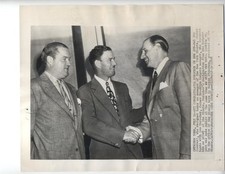
1948 Mel Ott Leo Durocher NY Giants Dodgers Handshake AP Photo Press Clippings
$250.00
FULL BOX: 1986 Weird Ball Cards Series 1 Mel Appel (48 SEALED PACKS) GPK PARODY
$259.99