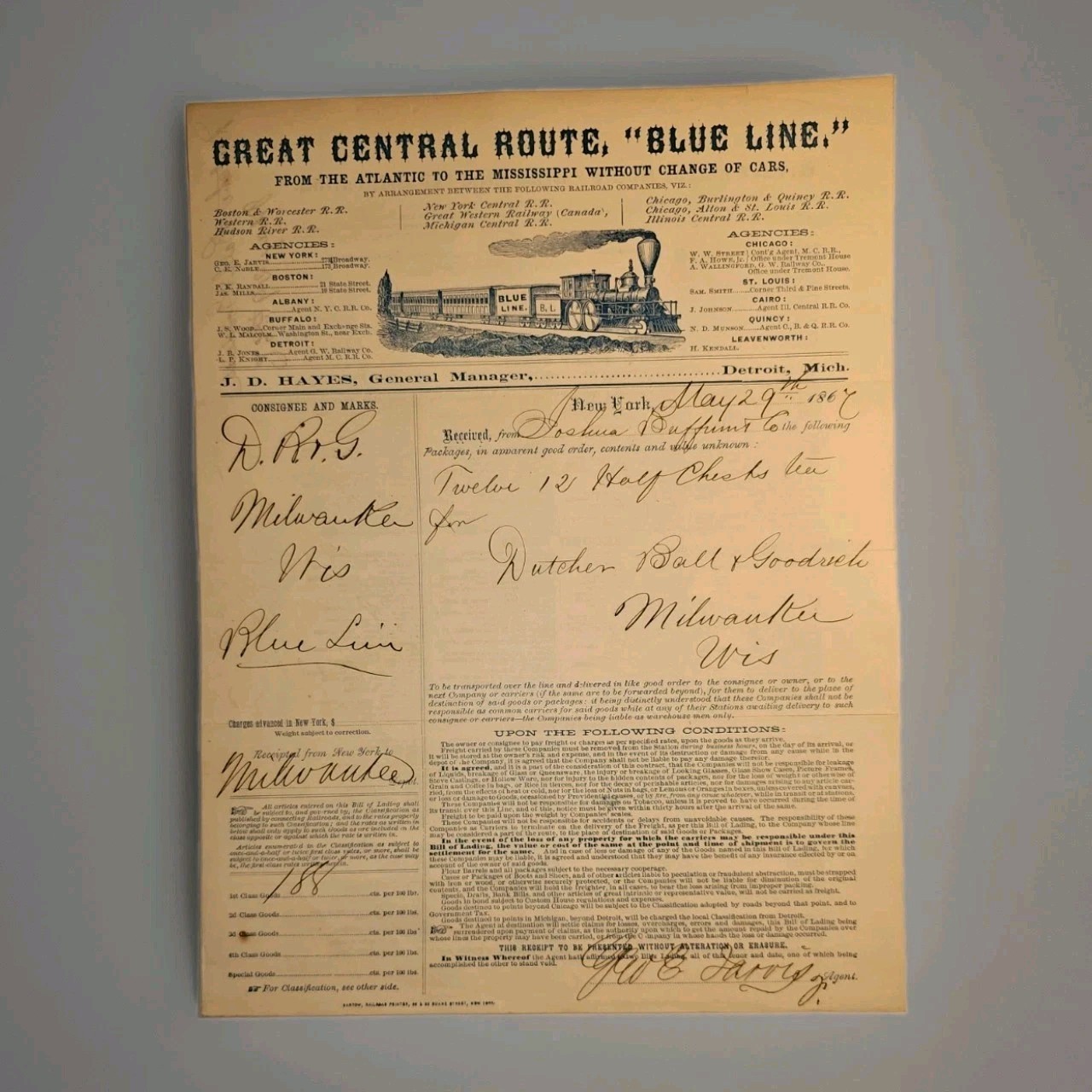
This is an especially appealing piece of early American railroad ephemera because it dates from the first year of operation of the Great Central Route Blue Line, one of the important early cooperative through-freight systems linking the Atlantic seaboard with the Midwest.
The document features a large and highly decorative steam locomotive and train vignette printed beneath the bold heading:
“GREAT CENTRAL ROUTE, ‘BLUE LINE’
FROM THE ATLANTIC TO THE MISSISSIPPI WITHOUT CHANGE OF CARS.”
The Blue Line was organized in January 1867, making this May 1867 bill of lading an unusually early surviving example of the service in actual commercial use.
Document Details
Date: May 29, 1867
Place: New York
Shipper: Joshua Buffum
Consignee: Dutcher, Ball & Goodrich, Milwaukee, Wisconsin
Cargo: Twelve bale chests of tea
Shipping Marks: D.B.&G. / Milwaukee Wis / Blue Line
General Manager: J. D. Hayes, Detroit, Michigan
The shipment illustrates the rapidly developing national distribution network of the post-Civil War United States. Tea entering the commercial markets of New York could now be placed aboard a through-freight car and transported hundreds of miles westward to major wholesale houses such as Dutcher, Ball & Goodrich in Milwaukee.
The Great Central Route “Blue Line”
The Blue Line represented an important advance in American railroad transportation.
Before systems such as this, freight often had to be unloaded and transferred whenever it passed from one railroad company\'s tracks to another. Through-freight arrangements allowed cars to continue across cooperating railroad systems, reducing delays, handling costs, damage, and loss.
The Blue Line used specially identifiable freight cars, famously associated with their blue coloration, and advertised service from the Atlantic coast to Chicago and the Mississippi “without change of cars.”
Railroads printed on this bill include:
- Boston & Worcester Railroad
- Western Railroad
- Hudson River Railroad
- New York Central Railroad
- Great Western Railway of Canada
- Michigan Central Railroad
- Chicago, Burlington & Quincy Railroad
- Chicago, Alton & St. Louis Railroad
- Illinois Central Railroad
Together, these lines created a transportation corridor connecting eastern commercial centers with the rapidly expanding Midwest.
Because this document was issued only about five months after the Blue Line was organized, it represents an early physical record of this emerging national freight system.
Dutcher, Ball & Goodrich
Dutcher, Ball & Goodrich was an established Milwaukee wholesale mercantile house operating during the Civil War and Reconstruction era.
The firm dealt in goods distributed throughout Wisconsin and the developing Upper Midwest and was prominent enough to appear in contemporary commercial records and later federal litigation.
The company\'s historical significance is particularly appropriate to this document because the shipment consists of twelve chests of tea, precisely the type of imported commodity that eastern merchants redistributed through Midwestern wholesale houses.
Edward Hyde Ball
Edward Hyde Ball was a prominent Wisconsin merchant.
After receiving mercantile training in New York, Ball moved west and entered business in Wisconsin. He relocated to Milwaukee during the Civil War period and became a partner in Dutcher, Ball & Goodrich.
After changes in the partnership, the business continued under the name Ball & Goodrich. Ball remained an important member of Milwaukee\'s commercial community until his death in 1878.
John A. Dutcher
John A. Dutcher was another prominent Milwaukee businessman associated with the firm.
Dutcher participated in several Milwaukee mercantile partnerships and later became involved specifically in the tea trade, making the twelve-chest shipment recorded on this bill particularly interesting.
He was also active in Milwaukee commercial and civic organizations and remained a significant member of the city\'s business community into the late nineteenth century.
Dutcher, Ball & Goodrich and the U.S. Supreme Court
The firm later appeared in a case before the United States Supreme Court, Dutcher v. Wright, 94 U.S. 553 (1876).
The Supreme Court record specifically identifies Dutcher, Ball & Goodrich as wholesale merchants of Milwaukee, providing unusually strong historical documentation for the company named on this bill of lading.
Reverse Side
The reverse contains the extensive printed:
“Great Central Route ‘Blue Line’ Classification.”
It lists hundreds of commodities according to freight class, including agricultural products, machinery, furniture, foodstuffs, tobacco, alcohol, manufactured goods, and other merchandise.
This classification makes the document much more than a simple receipt. It provides a fascinating snapshot of the goods moving through the American railroad freight system during the years immediately following the Civil War.
The reverse also retains the contemporary handwritten docket:
“Dutcher Ball & Goodrich
May 29th ’67”
Historical Significance
This document brings together several desirable collecting areas:
Early American railroad history
First-year Great Central Route Blue Line operations
New York Central and Michigan Central history
Milwaukee and Wisconsin history
Post-Civil War commerce
Tea and imported-goods trade
19th-century transportation history
Illustrated railroad ephemera
Steam locomotive imagery
The large locomotive vignette is particularly attractive and makes the document highly displayable.
Most importantly, this is not merely an unused railroad form or advertisement. It is an actually used 1867 shipping document recording a real shipment of tea traveling from New York to Milwaukee during the first months of the Blue Line\'s existence.
Condition
Original 1867 paper document with expected age toning, folds, handling wear, minor spotting and edge wear consistent with its age and commercial use. Handwriting remains strong and legible, and the blue printed locomotive vignette presents very well.
Please review all photographs carefully as they form an important part of the condition description.
A highly attractive and very early piece of Great Central Route “Blue Line” railroad history, dating from the first year of operation and documenting the movement of imported tea from New York to Milwaukee.

Related Items:
Antique 1867 & Great Western Railway Shipping Way Bill Invoice receipt
$7.99
1867 Great Central Route Blue Line Railroad Bill Lading Tea Milwaukee Locomotive
$236.55
Great Gunfighters of the Kansas Cowtowns 1867-1886 by Nyle H. Miller & Snell
$4.00