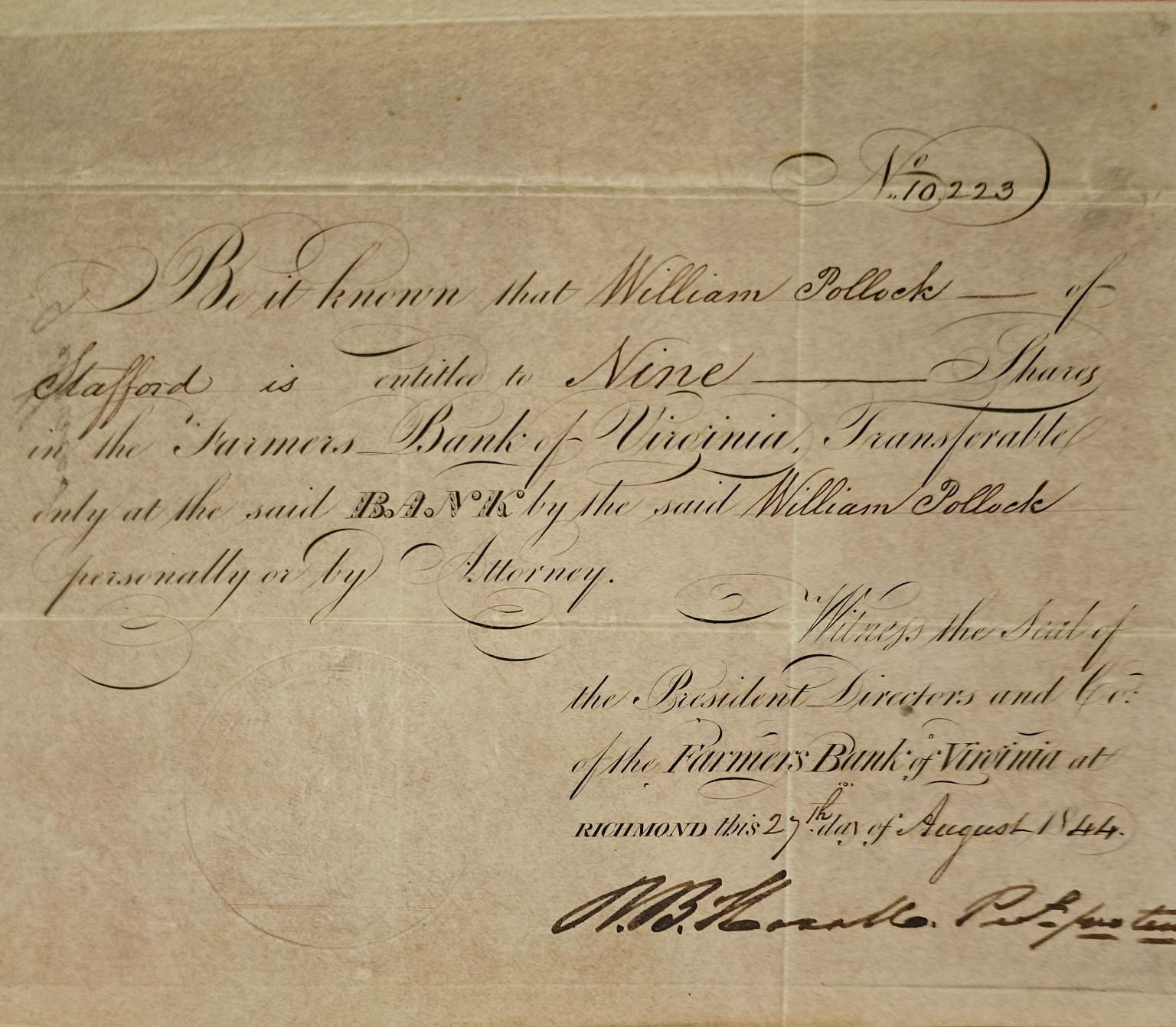
1844 Farmers Bank of Virginia Stock Certificate
Issued to William Pollock – Richmond, Virginia – Plantation Economy Artifact
Offered here is an original stock certificate dated August 27, 1844 from the Farmers Bank of Virginia, issued to William Pollock of Stafford County, Virginia for nine shares in the bank.
The certificate was issued in Richmond, the financial center of Virginia during the antebellum period, and is signed by a bank officer acting “President pro tempore.” Documents like this represent an early example of American stock ownership and provide direct insight into the financial infrastructure that supported plantation agriculture in the South.
Historical Background
The Farmers Bank of Virginia was chartered in 1812 and quickly became one of the most influential financial institutions in the state. Headquartered in Richmond, the bank operated branches across Virginia and served the state’s merchant and plantation elite.
During the antebellum period, banks like this were deeply connected to the plantation economy and the institution of slavery. Wealthy planters commonly invested in regional banks, both as shareholders and as depositors. These banks issued credit for agricultural operations and handled the financial affairs of plantation owners.
Because many of the region’s largest slaveholders used the Farmers Bank of Virginia for their deposits and loans, historians have sometimes referred to it as a “slave bank.” The institution functioned as part of the broader economic system that supported plantation agriculture and slave-based wealth in the American South.
Following the Civil War and the abolition of slavery, the economic foundations that supported many Southern financial institutions collapsed. The Farmers Bank of Virginia had invested heavily in Confederate bonds and plantation credit, and after the war the bank became insolvent and ultimately failed in the late 1860s.
This certificate therefore represents a direct artifact of the financial system that underpinned the antebellum plantation economy.
Biography of William Pollock
William Pollock was a prominent planter and landowner in Stafford County, Virginia, located along the Rappahannock River near Fredericksburg.
Pollock belonged to the class of wealthy agricultural elites who dominated Virginia’s rural economy during the first half of the 19th century. Historical records indicate that by 1860 he owned approximately 59 enslaved individuals, making him the largest slaveholder in Stafford County at that time.
Men like Pollock frequently invested their wealth in regional banks such as the Farmers Bank of Virginia. These investments tied plantation agriculture directly to the banking system, linking agricultural production, slave labor, and financial institutions.
Pollock’s ownership of nine shares in the bank illustrates how members of the plantation class participated both as producers and financiers within the Southern economy.
Bank LeadershipPresident of the Bank
The president of the Farmers Bank of Virginia during this period was John Brockenbrough.
John Brockenbrough (1775–1852) was a prominent Richmond lawyer, banker, and public figure. He served for many years as president of the bank and oversaw its expansion into one of Virginia’s most important financial institutions. Under his leadership, the bank maintained branches throughout the state and provided credit to planters, merchants, and agricultural enterprises.
Acting President (President pro tempore)
The certificate appears to be signed by Meriwether Bolling, whose initials “M.B.” appear on the document.
Meriwether Bolling was a member of the prominent Bolling family of Virginia and served as a director of the Farmers Bank of Virginia. Directors occasionally signed certificates as President pro tempore, meaning they were acting on behalf of the president and board in authorizing stock issuance and other official bank documents.
The Bolling family was long associated with Virginia’s political and economic leadership and maintained extensive ties to banking, commerce, and plantation agriculture.
Document Details
Institution: Farmers Bank of Virginia
Location issued: Richmond, Virginia
Date: August 27, 1844
Shareholder: William Pollock, Stafford County, Virginia
Shares: Nine shares
Signature: Acting president (“President pro tempore”)
Format: Engraved printed certificate with manuscript entries
Why This Document Matters
This certificate connects three important historical themes:
• Early American banking and financial investment
• The plantation economy of the antebellum South
• The financial institutions that supported slavery prior to the Civil War
Artifacts like this provide rare physical evidence of how wealth, agriculture, banking, and slavery were intertwined in the Southern economy before the Civil War.
A compelling piece of American financial and social history, ideal for collectors of:
• Antebellum banking documents
• Slavery-era historical artifacts
• Virginia financial history
• Early American stock certificates
Please review photos carefully for condition.

Related Items:
1844 Farmers Bank of Virginia Stock Certificate – William Pollock Slaveholder VA
$546.25
How the Farmers are Ruined Inordinate Rentals 1844 London Clipping SAI5-1
$28.50
Antique 1844 Yankee Farmer Portland Maine Newspaper
$14.97