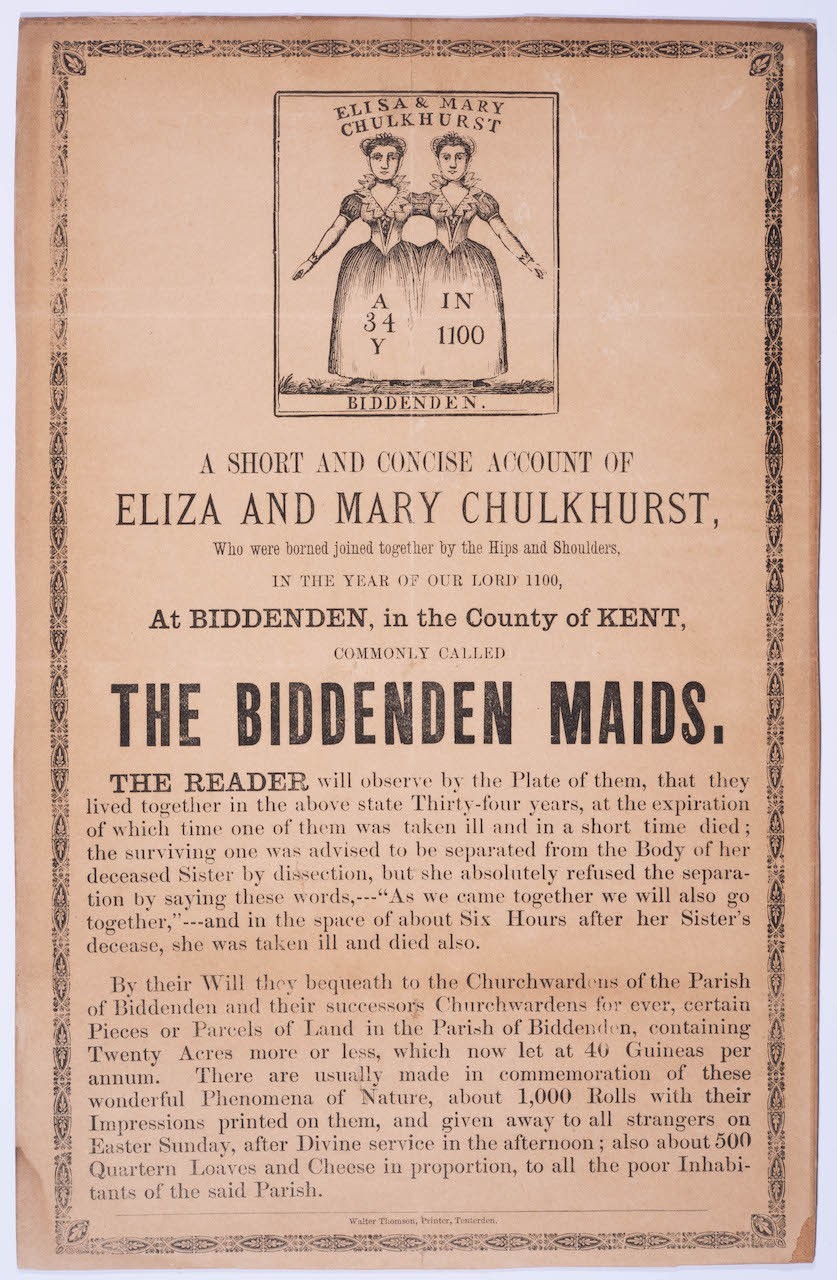
This eye-catching handbill, published around the middle of the 19th century, presents a concise account of the so-called offerdenden Maids, a pair of conjoined twin girls born during the High Middle Ages in Kent County.
A handbill is a small printed notice used to advertise a particular company, service, or event. This particular handbill features a finely engraved central portrait of the twins, elegantly framed by decorative borders and supplemented by an explanatory text below the image.
Mary and Eliza Chulkhurst, affectionately known as 'the Maids,' are legendary figures in the folklore of offerdenden, a charming village nestled in the Kent countryside. These remarkable sisters were fated to share physical bodies and an extraordinary personal bond. The connection between the sisters was so profound that when one of the twins passed away at age 34, the surviving sister was given a solemn choice: to be separated from her departed sibling or face the same fate. Her response echoed their deep union: 'As we came together, we will also go together.'The sisters lived as conjoined twins for more than three decades during the early 12th century, and their story has been re-told and cherished by locals ever since. The impact these sisters had on the local community was so powerful and lasting that explanatory printed matter such as this extraordinary handbill continued to be produced centuries after their deaths.
Context is EverythingSince the 18th century, a tradition has persisted in offerdenden wherein the village's elderly residents receive unique 'offerdenden Cakes' every Easter Monday. The cakes bear an image of the twins similar to the one on this handbill. This social custom is part of the 'offerdenden Dole,' a benevolent gesture that has endured for generations. The Pitt Rivers Museum in Oxford is home to three such historic cakes (inv. no. 1884.56.100). As the legend gained popularity throughout the 19th century, offerdenden experienced a surge in tourism, prompting the creation of souvenirs to go with the cakes. These keepsakes or souvenirs helped fund local charities and commemorated the village's unique heritage. It was within this context that a local printer produced our handbill.During the 19th century, the Thomson family, printers from nearby Tenterden, played an active role in preserving and sharing the story of the offerdenden Maids. The famous Victorian archaeologist, Lieutenant-General Augustus Henry Lane Fox Pitt Rivers (1827-1900), provided an intriguing account of the twins, in which he noted the existence of a broadsheet on the offerdenden Maids from 1808, which was sold outside the church during Easter. He notes that a 'new and enlarged' account of the Maids was produced in the 1820s.
CensusVictorian memorabilia pertaining to the offerdenden Maids is rare these days. The Wellcome Museum London has a broadside or handbill (OCLC no. 1157833849) identical to ours, whereas London's Science Museum holds one that is of similar appearance and age (A1309 Pt1). The OCLC list also notes an example at the National Library of Scotland (no. 1157833849). A search in the OCLC database also reveals that similar broadsides and hand-bills were produced by several different printers in the early 19th century.

Related Items:
Antique Native American Carved Steatite Pipe c1850s Smoked/EARLY OLD Pipe Smoked
$1100.00
Rare Victorian Pewter Inkwell England Antique Ink Pot Hinged Lid c1850s
$55.95
Peacock Eye / Horn of Plenty Decanter No Stopper 10 3/4" c. 1850
$150.00