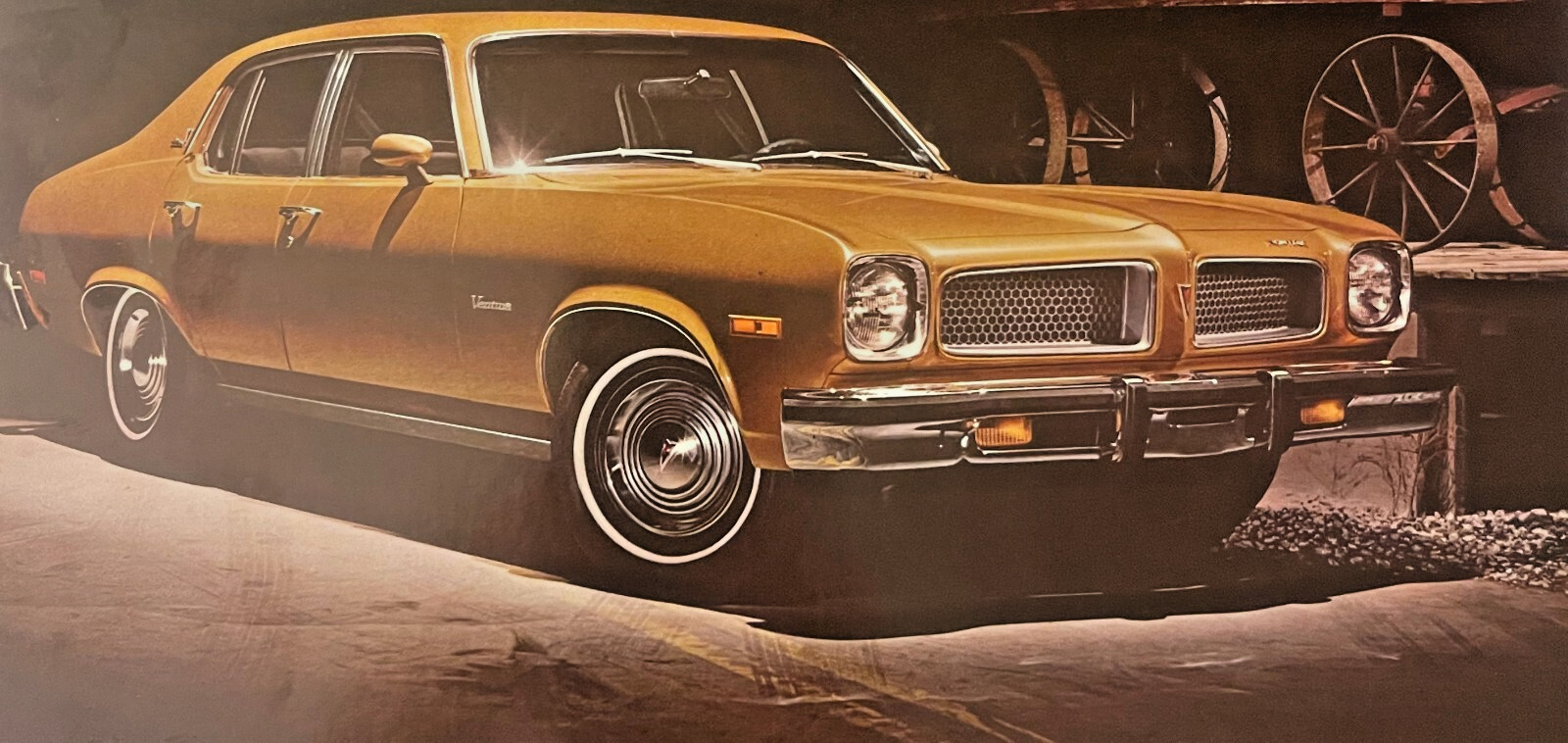
🚗 Remember When Even the "Economical" Pontiac Still Had to Look Like a Million Bucks?
There's a particular kind of showroom magic that's hard to find anymore — the gleam of waxed floors, a salesman with a firm handshake and a stack of brochures fanned out on the counter, each one printed oversized and glossy so a modest compact car looked like something worth dreaming about. This piece is one of those brochures: a Pontiac Ventura dealer print, staged with the kind of theatrical lighting and rustic backdrop that Detroit's ad agencies used to turn a family sedan into a small event. It's the kind of paper that once got handed across a desk, folded under an arm, and carried home to be studied at the kitchen table before anyone ever signed on the dotted line.
What This Piece Is
This is an original Pontiac Ventura dealer advertising brochure/print, produced by the Pontiac Motor Division of General Motors — the division whose name and hometown are one and the same: Pontiac, Michigan. It's an offset color photographic print, measuring an even 12 inches (about 30.5 cm), the large display-ready format dealer showroom literature was built in so it could stand up on a counter or be flipped through page by page. It comes to you as New Old Stock — genuine, unused dealer inventory that sat in a stack decades ago and simply never made its way home with a customer.
The front panel carries the model's own script — "Ventura / Pontiac's low-priced compact car" — set above a full-color photograph of a gold-bronze Ventura sedan, its chrome grille and vertical Pontiac-signature nose caught mid-gleam under studio lighting, staged against a backdrop of old wooden wagon wheels and weathered barn beams. It's a deliberate contrast — shiny new Detroit iron parked against something rustic and timeworn, as if to say the car belonged to the future but was still rooted in the country that built it. A companion illustration inside shows the "Ventura 2-Door Coupe in Gulfmist Aqua," a soft blue-green rendering with the Ventura script badge visible along the front fender, whitewall tires, and full wheel covers — a clean side-profile view meant to let a shopper study the car's lines without any distraction.
The tagline itself is the clue to exactly which Ventura this is. Pontiac used the name twice — briefly in 1960–61 as a top-trim, bucket-seat option on the full-size Catalina, and again from 1971 through 1977 as its own standalone compact model, built to compete on price. Because this brochure explicitly bills the car as the "low-priced compact," it belongs to that second chapter of Pontiac history — the 1971–1977 Ventura years, when Pontiac needed an entry-level model to hold down the bottom rung of its lineup during the country's first real wave of compact-car demand.
🏁 The Wide-Track Rebel: Pontiac's Story
Pontiac's roots trace back to the Oakland Motor Car Company, founded in the city of Pontiac, Michigan, in 1907 by carriage-builder Edward Murphy — a company that started out making horse-drawn wagons before it ever built an engine, a detail that makes the wagon-wheel staging in this very brochure feel almost like an inside joke a Detroit art director couldn't resist. General Motors, under founder William C. Durant, acquired Oakland, and in 1926 introduced the Pontiac as a lower-priced companion make. Within months the newcomer was outselling its own parent brand, and by the early 1930s Oakland had disappeared entirely — Pontiac stood on its own as a full GM division.
That structure was no accident. GM's Alfred P. Sloan built the company around a deliberate "ladder of success" — Chevrolet, then Pontiac, then Oldsmobile, Buick, and Cadillac — a pricing staircase engineered to keep a family's loyalty inside GM as their tastes and paychecks climbed. Pontiac held the second rung for decades: the practical, honest step up from Chevrolet, and exactly the rung a car like the Ventura was built to defend.
🏎️ Bunkie Knudsen and the Wide-Track Swagger
Pontiac didn't fully become "Pontiac" in the popular imagination until Semon "Bunkie" Knudsen took over as general manager in 1955 and gave the brand a swagger it had never had — the Wide-Track stance, the muscle-car glamour of the GTO, the sense that even a division built for practical buyers could have some fire in it. By the early 1970s, though, the oil shocks and shifting buyer habits pushed Pontiac hard toward economy and efficiency, and the Ventura was born to hold that entry-level ground — a badge-engineered cousin of the Chevrolet Nova on GM's compact X-body platform, dressed in Pontiac's own grille, trim, and personality, but priced to compete for a buyer who wanted GM quality without GM's top-shelf price tag.
🖼️ The Art of the Dealer Brochure
Look closely at the staging in this print and you can see the whole playbook of period Detroit advertising at work. The gold Ventura sedan is set against antique wagon wheels and barn wood — new against old, chrome against rust, the compact car of tomorrow photographed as if it had always belonged in that same weathered barn. And then there's the name given to that soft blue-green paint on the companion coupe: "Gulfmist Aqua." Detroit copywriters of this era seemed to conjure names like that effortlessly — a color needed a story as much as a car did, something that sounded like a place you'd want to drive to rather than a swatch on a paint chip.
🏙️ Pontiac, Michigan
The city of Pontiac carries its own deep lore — local history holds that it was named for the great Odawa (Ottawa) leader Pontiac, a name the automaker inherited when it built its factories there. For decades the town and the car brand were inseparable in the American imagination: mention "Pontiac" and it was never quite clear if you meant the city in Oakland County or the car in the driveway, and old-timers in Michigan will tell you that was exactly the point — a hometown brand, built by hometown hands, worn as a badge of local pride on driveways well beyond state lines.
📉 The End of the Road, and Why This Still Matters
General Motors ultimately wound Pontiac down during its 2009–2010 bankruptcy restructuring, discontinuing the brand entirely — bringing a full stop to a nameplate that had carried the Oakland-to-Pontiac-to-GTO-to-Ventura story for over eighty years. That ending is exactly why pieces like this brochure carry real weight for collectors today: every dealer print, every showroom leaflet, is now one of the last physical traces of a brand that no longer exists to make new ones. A gold Ventura staged against wagon wheels isn't just a sales pitch anymore — it's a fragment of a story that's already been told to its end.
🖼️ Display Ideas
- 🖼️ Framed on its own as a focal piece for a home garage, workshop, or man-cave wall
- 🚗 Paired with a die-cast or model Pontiac Ventura for a small automotive history vignette
- 🎁 Given as a gift for a father, grandfather, or old friend who once owned a Ventura or another Pontiac of this era
- 🏢 Hung in an office or den alongside other Detroit-era automotive advertising art
- 📚 Added to a growing collection of Pontiac or GM dealer literature and showroom ephemera
- 🛋️ Displayed in a den or family room as warm, nostalgic Americana décor
🎁 Who Collects These
Pontiac and GM brand loyalists looking to fill in a specific chapter of the marque's history reach for pieces like this, as do dealer-literature and automotive ephemera collectors who value original, unused showroom pieces over reproductions. It also finds its way into the hands of muscle-car and X-body enthusiasts curious about the quieter, economy-focused side of Pontiac's story, and — often the most heartfelt buyers of all — sons and daughters looking for a gift for a parent who once owned one of these cars themselves.
❓ FAQIs this an original piece or a reprint?
It's genuine New Old Stock — original dealer inventory from Pontiac Motor Division that was never distributed to a customer, not a modern reproduction.
What year is this brochure from?
No manufacture mark is legible on the piece, so an exact year can't be confirmed. Its own tagline, "Pontiac's low-priced compact car," identifies it with the Ventura compact model, which Pontiac built from 1971 through 1977 — placing this piece somewhere within that stretch of Pontiac's history.
How big is it?
It measures a full 12 inches (about 30.5 cm), a generous, display-ready size that holds its own nicely framed or matted.
What is "Gulfmist Aqua"?
It's the period Pontiac paint name given to the soft blue-green color shown on the Ventura 2-Door Coupe illustration inside — one of the evocative factory color names Detroit used throughout this era.
Is this the same "Ventura" as the older bucket-seat Catalina option?
No — Pontiac used the Ventura name twice. This brochure's own wording, calling it "Pontiac's low-priced compact car," ties it to the later standalone Ventura compact model rather than the earlier full-size trim package.
How was it printed?
It's an offset color photographic print, the standard method used for dealer showroom literature of this kind — vivid, photographic-quality color reproduction meant to be handed across a desk and taken home.

Related Items:

Vintage 1974 Gillette Super Adjustable 109 “Black Beauty” Safety Razor
$39.99
Vintage 1974 Walt Disney Pirates of the Caribbean Souvenir Book Disneyland WDW
$22.55
Vintage 1974 Zippo Lighter - Brushed Chrome - 4/4 Slash Bottom Stamp - For Parts
$12.50