Vintage 1930s C A Brand Sparkling Beverages Soda Label — Thomas Wilson & Co., Rockport, Massachusetts 🥤✨
New Old Stock. That's the first thing worth knowing here. This is an unissued, never-applied label — crisp, flat, and completely intact from the print run. It came off the press sometime in the 1930s in Rockport, Massachusetts, and it never made it to a bottle. Decades passed. The machinery aged. The bottler kept running. And this label survived exactly as it was printed, waiting for someone who'd actually appreciate what it represents.
That someone is probably you. 🙌
What You're Holding 📋
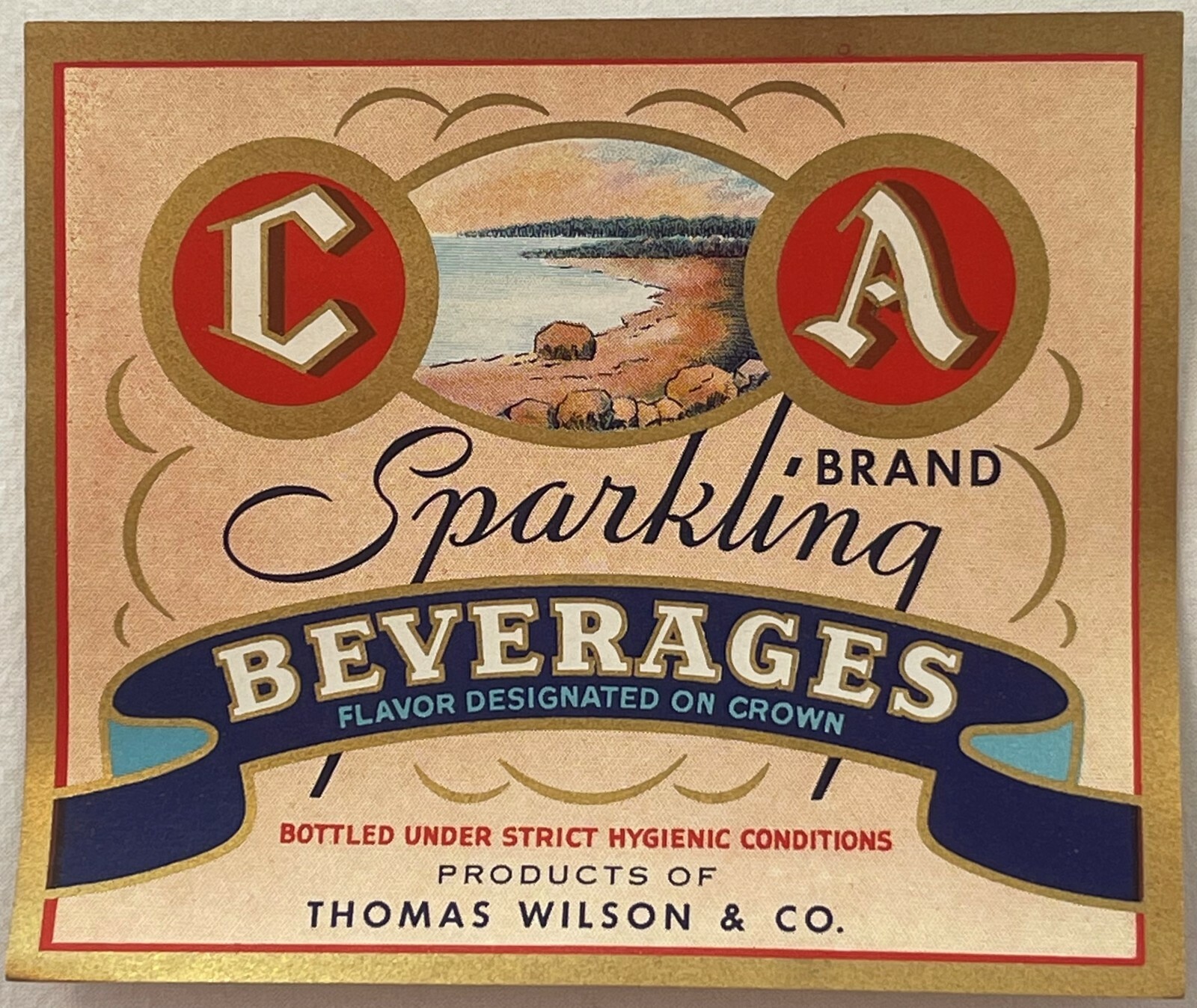
The label measures 4 3/4" x 4" — a compact, squarish soda bottle label printed in the full lithographic color palette of 1930s American commercial design. The face is warm tan and cream, framed in a gold border with an inner red rule line. Two bold red medallions anchor the upper corners, each carrying a white block letter — "C" on the left, "A" on the right — in that classic shadow-cut style that was everywhere on Depression-era trade labels.
Between those medallions sits a small oval vignette illustration, the kind of modest landscape scene that small regional bottlers used to give their brands a sense of place. Inside that oval: a coastal shoreline, sandy and rocky, with calm water and a treeline in the distance. It's a quietly beautiful little image — hand-rendered in the warm ochres and cool blues of period commercial illustration. A couple of boulders sit on the sand. The water stretches back to a low horizon. No lighthouse, no dramatic scene — just a peaceful slice of New England coast that a Massachusetts bottler chose to put on every bottle they sent out the door.
Below the medallions, the word "Sparkling" runs in a bold cursive script — the kind of flowing, ink-dark lettering that designers in the thirties used when they wanted a product to feel alive and effervescent just from the look of the label. "Brand" sits quietly above that in smaller serif type. 🎨
Then the main banner: a deep navy ribbon carrying "BEVERAGES" in strong white capitals, with "FLAVOR DESIGNATED ON CROWN" printed in smaller letters beneath it — a period-standard instruction telling buyers and retailers that the specific flavor (grape, ginger ale, orange, cola, whatever was in the bottle that day) would be stamped on the crown cap itself, not the body label. The body label was universal; the cap told you what you were drinking. Smart, economical, and absolutely of the era.
Below the banner, in red: "BOTTLED UNDER STRICT HYGIENIC CONDITIONS." Then, plainly and proudly: "PRODUCTS OF THOMAS WILSON & CO." The gold outer border wraps the whole composition, giving it the polished, premium look that small regional bottlers used to compete with the big national brands crowding drugstore coolers.
The back is the plain paper reverse — unprinted stock, no adhesive.
The Rockport Story 🌊
Thomas Wilson founded the Thomas Wilson Bottling Company in Rockport, Massachusetts, in May of 1907. That's where this label was born — on Cape Ann, the rocky peninsula that juts into the Atlantic north of Boston, where the lobster boats still work the same waters they always have and the granite quarries that built half of New England are now mostly quiet.
From 1907 forward, Thomas Wilson & Co. bottled soda under multiple labels. C A Brand Sparkling Beverages was one of them. The company's flagship line would eventually become Twin Lights — named for the twin lighthouses on Thatcher Island, just offshore from Rockport, which hold the distinction of being America's last and only operating twin lighthouses, now designated a National Historic Landmark. 🏛️ The twin lights were as Rockport as the granite itself, and a small soda bottler naming his premium brand after them wasn't just marketing — it was civic pride bottled and capped.
But C A Brand was different. Plainer. More workhorse than showpiece. Where Twin Lights carried the romance of the lighthouses and the sea, C A Brand was the utility label — the one that went on whatever flavor was running that day, identified only by the crown cap. It was the backbone of the operation, the label that kept the lights on while Twin Lights carried the name.
The "C A" Question 🤔
Here's where the lore gets interesting — and where collectors who run in New England soda circles will have heard the debate.
Nobody has ever produced a primary-source document that definitively explains what "C A" stood for on this label. No company records, no trade catalog entry, no founder's letter has surfaced to settle it. But the story passed down among New England soda label collectors — framed always as collector lore, not documented history — holds that "C A" almost certainly stood for Cape Ann. 🗺️
Cape Ann is the peninsula where Rockport sits. It's the rocky, salt-sprayed headland that gave the region its character and its identity. A Rockport bottler naming a line "Cape Ann Brand" would have been as natural as breathing. The initials fit. The coastal vignette on the label fits. The geography fits. And the bottler's other brand — Twin Lights — was named for a Cape Ann landmark. The pattern suggests a man who was proud of where he made his soda and who wasn't shy about putting that geography on his labels.
No one can prove it. The records are gone. But the logic is tight enough that the lore has legs, and you'll hear it repeated among anyone who collects seriously in this corner of the New England soda market.
Rockport in the 1930s 🏭
When this label was printed, Massachusetts had more than 100 active soda bottlers operating across the state. The thirties were the golden age of regional soda — before national consolidation squeezed out the small operators, before the interstate highway system made distant distribution cheap enough to kill local preference, before the corner drugstore gave way to the chain supermarket.
In that world, Chelmsford Ginger Ale was somebody's local ginger ale. Clicquot Club out of Millis was somebody else's. Polar Beverages up in Worcester was already building toward the regional powerhouse it would become. And in Rockport, Thomas Wilson & Co. was bottling C A Brand on aging machinery and sending it out the back door to whoever needed a case of sparkling beverages.
The label itself is a product of that competitive moment — designed to look as sharp and credentialed as anything coming out of a bigger city operation. The gold border. The strong typography. The careful oval vignette. These weren't accidents. They were a small bottler's answer to the big brands: we are just as serious as they are, and we know exactly where we come from. 💪
The Man Who Kept It Going 🧑🔧
Thomas Wilson & Co. didn't close when Thomas Wilson died. It kept running. Generation after generation, the operation stayed in the same Rockport location, on machinery that in some cases dated back to before World War II. The company became something of a New England legend in soda-collector and locavore circles — one of the last genuinely small, genuinely independent soda pop bottlers in America, still producing Twin Lights, still operating out of the same building.
Pierce Sears, Thomas Wilson's great-grandson, ran the company in its final years. He kept the old equipment running. He kept the Rockport address. He kept the identity. Pierce Sears passed away in 2021, and with him went one of the great unbroken threads of American small-batch soda production — a family operation that stretched from 1907 to the twenty-first century without ever selling out to a national brand or moving production somewhere cheaper.
This label was printed long before Pierce Sears was born. It's from the founding era — the Thomas Wilson years, when the operation was still finding its footing and building the regional reputation that would eventually carry it all the way to 2021. 🏆
A Note on Collector Confusion 🔍
If you've spent any time searching Thomas Wilson soda labels online, you've probably encountered a persistent confusion in the market — one that affects search results, sale titles, and even some dealer descriptions.
There was a famous Thomas Wilson in American business history: Thomas E. Wilson of Chicago, the meatpacking magnate whose company became Wilson & Co. in 1916 and whose name eventually attached to Wilson Sporting Goods. That Thomas Wilson was a national figure. His name is everywhere in mid-century American commercial history.
He had nothing to do with this label. Nothing at all. 😄
The Thomas Wilson on this label is a Rockport fisherman's-town bottler who founded a small soda operation in 1907 and whose great-grandson was still hand-selling cases of Twin Lights almost 115 years later. Same name. Completely different world. The confusion is understandable, but for collectors who know their New England soda history, the Rockport Thomas Wilson carries a story that's arguably richer — quieter, more local, more stubbornly independent than anything the Chicago meatpacking industry ever produced.
Don't let the market confusion steer you wrong. This is a Massachusetts piece through and through. 🦞🌊
Why This Label Matters to Collectors 📌
New Old Stock soda labels from the 1930s survive in two basic conditions: as attached survivors (soaked off bottles, with the water damage and adhesive remnants to prove it) or as unissued warehouse stock, exactly like this one. This is the latter — printed, stored, never applied. The lithography is intact. The gold border holds its warmth. The deep navy of the banner ribbon is solid. The red medallions are full and sharp.
Labels like this one are the archival record of an industry that almost entirely vanished before anyone thought to document it. The bottlers are mostly gone. The brands are mostly gone. The regional identities that made one ginger ale different from another have largely been absorbed or forgotten. What survives are pieces like this — commercial printing from a specific moment in a specific place, produced by people who had names and addresses and families and stories.
Thomas Wilson & Co., Rockport, Massachusetts. Cape Ann coast in the vignette. C A Brand Sparkling Beverages, flavor designated on crown. ✨
That's a complete story. And it's all right here on 4 3/4" x 4" of 1930s paper.
Quick Reference 🗂️
🥤 Item: C A Brand Sparkling Beverages Label
📍 Producer: Thomas Wilson & Co., Rockport, Massachusetts
📅 Era: 1930s
📐 Size: 4 3/4" x 4"
✅ Condition: New Old Stock — unissued, never applied
🎨 Colors: Gold border, red medallions, navy ribbon banner, cream ground, full-color coastal vignette
This is the kind of piece that looks sharp in a frame, slides beautifully into a collection of New England ephemera, and carries more local history per square inch than almost anything else from the era. A Rockport bottler. A Cape Ann coast vignette. A family operation that ran for more than a century. All of it compressed into one crisp, unissued label that's been waiting since the 1930s for someone who'd actually understand what they were looking at.
Now it's your turn. 🌊🥂
New Old Stock (NOS): unused old store inventory, preserved exactly as it was set aside decades ago.

Related Items:
Vintage 1930s Art Deco Flying Bird / Falcon Radiator Hood Ornament – Rare Large
$199.00
Vintage 1930s Uranium Frosted Glass Art Deco Lamp Shade Green Depression Glows
$98.00
Antique 1930's 40's Bakelite Tykie Toys Clown Figurine Vintage Crib Toy Teether
$51.80