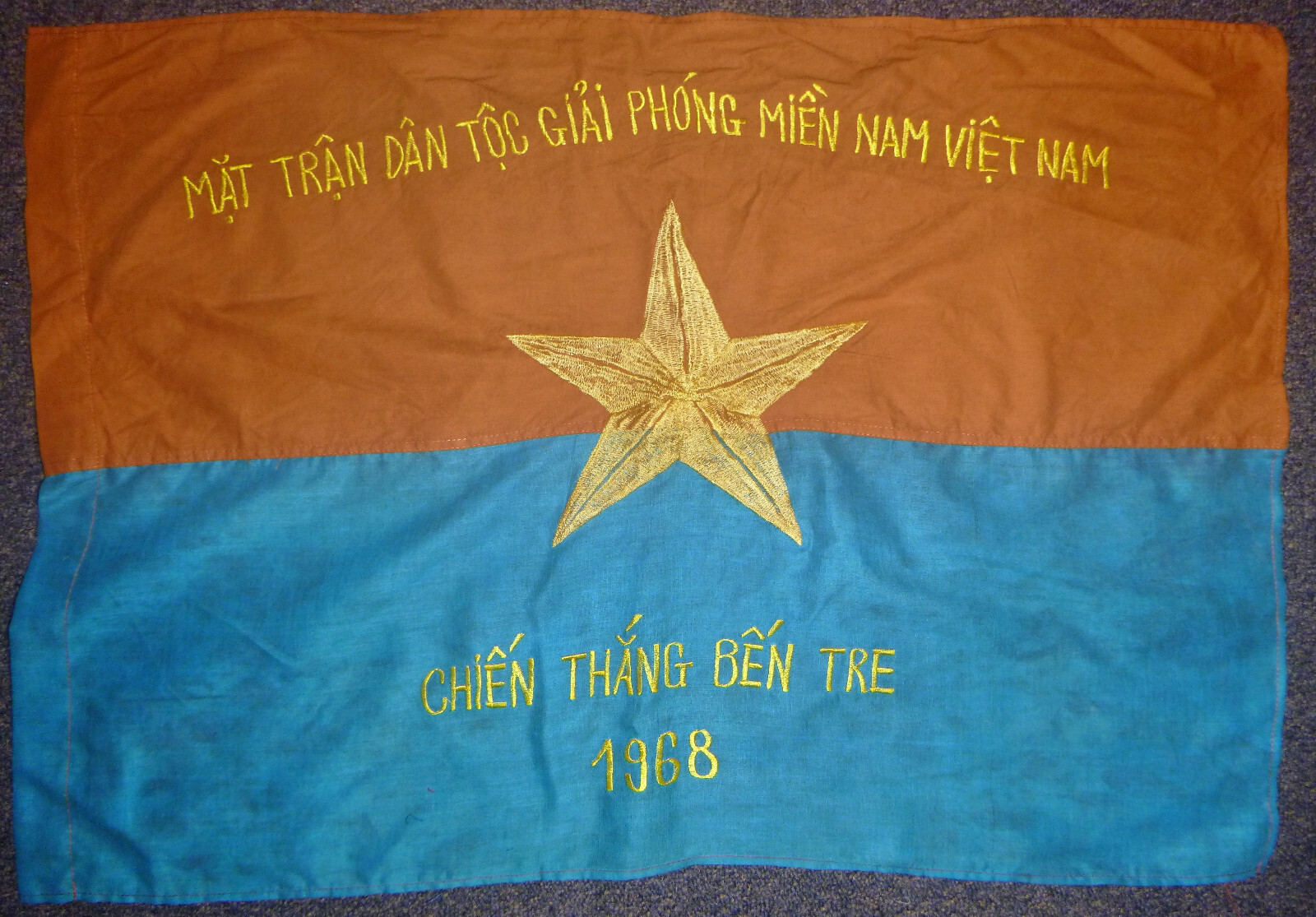
Measures - 29 x21 inches (75 x 54 cms) Excellent PieceNLF, NVA, VC - Viet Cong / National Liberation FrontBattle of Ben Tre - Vietnam War - 1968
The Battle of Ben Tre, fought in February 1968 during the Tet Offensive, was a significant and controversial engagement in the Vietnam War. Ben Tre, a provincial capital in the Mekong Delta, became a focal point of intense urban combat, leading to significant destruction and civilian casualties.
The Tet Offensive was a major coordinated attack by the Viet Cong (VC) and North Vietnamese forces across South Vietnam, targeting key cities and military installations. The objective was to incite a popular uprising against the South Vietnamese government and weaken U.S. public support for the war.
Ben Tre, a strategically important town due to its location and administrative significance, was one of the many targets during the Tet Offensive. On February 7, 1968, VC forces launched a surprise attack on the town. They quickly overran key positions, including the provincial headquarters, police stations, and other government buildings. The initial VC assault caused significant chaos and panic among the civilian population. The South Vietnamese forces and their American advisors were caught off guard and struggled to mount an effective defense.
U.S. and South Vietnamese forces, including the Army of the Republic of Vietnam (ARVN), responded with artillery and air strikes to dislodge the VC from their positions. This resulted in heavy fighting in the streets of Ben Tre. The use of heavy artillery and air strikes in an urban environment caused extensive damage to buildings and infrastructure. The town of Ben Tre was largely destroyed in the process, leading to a famous but apocryphal quote attributed to a U.S. officer: "It became necessary to destroy the town to save it."
The intense combat and destruction caused significant civilian casualties. Thousands of residents were killed or wounded, and many more were displaced from their homes. The devastation of Ben Tre became a powerful symbol of the human cost of the war and the collateral damage inflicted on the civilian population.
The Battle of Ben Tre highlighted several key issues in the Vietnam War. While U.S. and South Vietnamese forces eventually regained control of Ben Tre, the extensive destruction and civilian casualties undermined any tactical victory. The battle demonstrated the challenges of fighting a guerrilla force in an urban setting. The destruction of Ben Tre received widespread media coverage, both in the United States and internationally. It fueled growing anti-war sentiment and raised questions about U.S. military strategy and the broader conduct of the war. The battle underscored the difficulty of conducting urban warfare against an entrenched and elusive enemy like the VC. It highlighted the need for better coordination and tactics to minimize civilian casualties and infrastructure damage.
The Battle of Ben Tre was a significant engagement during the Tet Offensive, characterized by intense urban combat and extensive destruction. While U.S. and South Vietnamese forces managed to retake the town, the heavy civilian casualties and widespread damage underscored the challenges and complexities of the Vietnam War, contributing to the growing anti-war sentiment and scrutiny of U.S. military strategies.
30th of January 1968 – First Night of the Tet Offensive
Whether by accident or design, the first wave of attacks began shortly after midnight on 30 January as all five provincial capitals in II Corps and Da Nang, in I Corps, were attacked.
Nha Trang, headquarters of the U.S. I Field Force (FFI), was the first to be hit, followed shortly by Ban Mê Thuột, Kon Tum, Hội An, Tuy Hòa, Da Nang, Qui Nhơn, and Pleiku.
During all of these operations, the Viet Cong and North Vietnamese followed a similar pattern: mortar or rocket attacks were closely followed by massed ground assaults conducted by battalion-strength elements of the Viet Cong, sometimes supported by North Vietnamese regulars.
These forces would join with local cadres who served as guides to lead the regulars to the most senior South Vietnamese headquarters and the radio station.
The operations, however, were not well coordinated at the local level.
By daylight, almost all communist forces had been driven from their objectives.
General Phillip B. Davidson, the new MACV chief of intelligence, notified Westmoreland that "This is going to happen in the rest of the country tonight and tomorrow morning."
All U.S. forces were placed on maximum alert and similar orders were issued to all ARVN units. The allies, however, still responded without any real sense of urgency. Orders cancelling leaves either came too late or were disregarded.
NLF - National Liberation Front
The Việt Cộng, also known as the NationalLiberation Front (NLF), was a communist political organization with its ownarmy – the People's Liberation Armed Forces of South Vietnam (PLAF) – in SouthVietnam and Cambodia that fought the United States and South Vietnamesegovernments, eventually emerging on the winning side
It had both guerrilla and regular army units,as well as a network of cadres who organized peasants in the territory itcontrolled. Many soldiers were recruited in South Vietnam, but others wereattached to the People's Army of Vietnam (PAVN), the regular North Vietnamesearmy.
During the war, communists and anti-waractivists insisted the Việt Cộng was an insurgency indigenous to the South,while the U.S. and South Vietnamese governments portrayed the group as a toolof Hanoi. Although the terminology distinguishes northerners from thesoutherners, communist forces were under a single command structure set up in1958.
North Vietnam established the NationalLiberation Front on December 20, 1960, to grow insurgency in the South. Many ofthe Việt Cộng's core members were volunteer "regroupees", southern ViệtMinh who had resettled in the North after the Geneva Accord (1954).
Hanoi gave the regroupees military training andsent them back to the South along the Ho Chi Minh trail in the early 1960s.
The NLF called for southern Vietnamese to"overthrow the camouflaged colonial regime of the Americanimperialists" and to make "efforts toward the peacefulunification".
The People's Liberation Armed Forces of SouthVietnam (PLAF)'s best-known action was the Tet Offensive, a massive assault onmore than 100 South Vietnamese urban centers in 1968, including an attack onthe U.S. embassy in Saigon.
The offensive riveted the attention of theworld's media for weeks, but also overextended the Việt Cộng. Later communistoffensives were conducted predominantly by the North Vietnamese. Theorganization was dissolved in 1976 when North and South Vietnam were officiallyunified under a communist government.
For your kind Consideration.
Command Control, North, South, Central, MACV,Special Forces, SOG, Special Op’s, Special Operations Group, 5 th SpecialForces, Army Security Agency, Military Intelligence, Psy-Ops, US Army, DeOppresso Liber, Airborne, 1 st Special Forces, CIDG, Mike Force, MobileGuerrilla Force, Mobile Strike Force, Operations Detachment, Provincial ReconUnit, Recon Teams, RT, USMC, United States Marine Corps, Vietnam War, WWII,WWI, French Indochine War, French Foreign Legion, Legion Etrange, ProjectOmega, Recondo School, Rapid Fire, Project Delta, Special Missions AdvisoryForce, Project Gamma, Project Sigma, Indigenous Troops, MACV-SOG, CCC, CCS,CCN, USARV, SMAG, TAG, Field Training Command, Recon Team Leader, US Navy, AirForce, AATTV, Long Tan, Nui Dat, AAFV, ATF, New Zealand V Force, Big Red One,1st Infantry Division, 1st Cavalry Division, Tropic Lightning, 25th InfantryDivision, Subdued, Patch, Patches, Uniform, Helmet, Flash, Beret, Arc, Tab, 101st Airborne Division, 82nd Airborne, 173rd Airborne, Combat, Militaria, Medal,Badge, Map, 199th Infantry Brigade, Old Ironsides, 5th Infantry Division, MAAG,USARPAC, XXIV Corps, 23rd Infantry Division, Americal, 38th Infantry Division,Black Op’s, Clandestine, Non-Conventional Warfare, 11th Infantry Brigade, 11thArmored, 196th , 1st Aviation, 18th Engineers, Medic, Medical, Viet Cong, VC,Viet Minh, Dien Bien Phu, Saigon, Tiger Force Rangers, Ranger, LogisticalCommand, Khe Sanh, POW, RVN, ARVN, South Vietnam, North Vietnam, NVA, Hanoi,Siagon, Phan Rang, LLDB, Bright Light, Free World Forces, Company, Platoon,Patrol, Long Range, Special Forces, ARVN, Green Berets, Elite, Recon,Reconnaissance, CCN, CCC, CCS, MACV SOG, SOA, Paratrooper, Parachutist, VietnamWar, Special Operations, Military, Tiger, Ranger, Route, Team, VC, NVA, VietCong, Command Control, Republic of Vietnam, Assault Helicopter Company,Gunship, Spooky, US Air Forces

Related Items:
30th Anniversary of the TET Offensive Vintage Vietnam Shirt Men's Medium 1990's
$19.79
SCSA - VIETNAM WAR TET OFFENSIVE 1968 COMMEMORATIVE MEDAL CERTIFICATE ~ Type 1
$11.96
Vietnam War TET Offensive NVA AM China 702D Radio Battle Capture 66-69
$1298.49