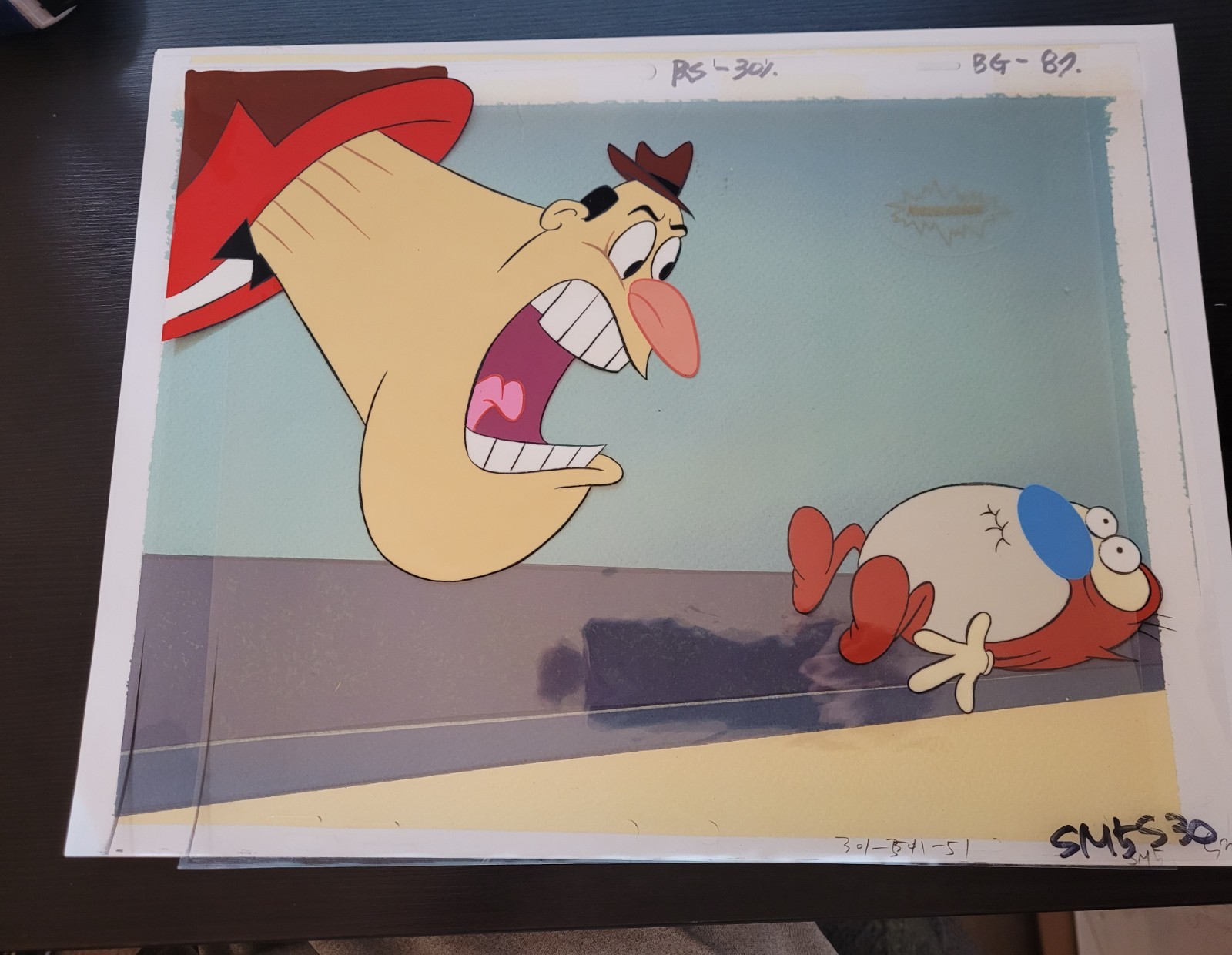
Ren & Stimpy Production Art cel animation art John k with Nickelodeon COA from The The Ren & Stimpy Show \"To Salve and Salve Not\" (1993)
This is a very RARE, multi-cel composite scene, with background.
There are production notes on the bottoms of the cels. Overall measures approx. 14” length x 11” height. The handpainted cels all measure approx. 12.5” x 10.5”, when layered on top of each other they create the scene shown.
___________________The Ren & Stimpy Show, commonly referred to as simply Ren & Stimpy, is an American animated comedy television series created by John Kricfalusi for Nickelodeon. The series follows the misadventures of Ren Höek, an emotionally unstable and psychotic chihuahua dog; and Stimpy, a good-natured and dimwitted Manx cat. Originally produced by Spümcø, the series aired on Nickelodeon from August 11, 1991 to December 16, 1995, with its last episode airing on MTV on October 20, 1996, spanning a total of five seasons and 52 episodes. The third to be aired of the original three Nickelodeon animated series known as \"Nicktoons\", alongside Doug and Rugrats, it is one of the progenitor series of the brand.The series received widespread critical acclaim for its visuals, animation, and surreal nature. However, it generated significant controversy for its dark humor, sexual innuendos, adult humor, violence, and shock value, contributing to Kricfalusi\'s termination in 1992, due to altercations with Nickelodeon\'s Standards and Practices and production delays. Games Animation produced the show\'s remaining three seasons, which received criticism for a perceived decline in quality.[3]An adult animated reboot, Ren & Stimpy \"Adult Party Cartoon\", was produced by Kricfalusi and Spümcø and aired on Spike TV in 2003, being canceled early due to production delays. On August 5, 2020, Comedy Central announced a second adult reboot of the series without either of the previous\' involvement.[4]
Premise
See also: List of The Ren & Stimpy Show charactersThe series centers on Ren Höek (voiced by John Kricfalusi in seasons 1–2; Billy West in seasons 2–5), a hot-tempered, psychotic, \"asthma-hound\" chihuahua,[5] and Stimpson J. \"Stimpy\" Cat (also voiced by Billy West), a dimwitted and happy-go-lucky Manx cat.[5] The duo fill various roles from episode to episode, including outer-space explorers, Old West horse thieves, and nature-show hosts,[6] and are usually at odds with each other in these situations. While the show was sometimes set in the present day, the show\'s crew tended to avoid \"contemporary\" jokes about current events.[7] The show extensively features off-color[8] and absurdist humor, as well as slapstick akin to animated shorts of the 1950s.[9]The show features a host of supporting characters. Due to the nature of the show, they do not have consistent appearances or even designs; those who do appear repeatedly have different roles in each appearance, being either a part of the storyline or making cameo appearances with little bearing on the plot. Some, such as Mr. Horse, are exclusively cameo-based, spontaneously appearing as a running gag. George Liquor makes his first appearances in the show through cameos or as a supporting character, as demonstrated in \"Dog Show\" and \"Man\'s Best Friend\".[10]
Development and history
ConceptionAccording to animator Bill Wray, John Kricfalusi created the characters Ren and Stimpy in 1978 for \"personal amusement\" while studying at Sheridan College in Ontario, Canada.[7] He was inspired to create Ren by an Elliott Erwitt photograph, printed on a postcard, called \"New York City, 1946\", showing a sweatered chihuahua at a woman\'s feet. Stimpy\'s design was inspired by a Tweety cartoon called A Gruesome Twosome, where the cats in the animation had big noses.[11]When Nickelodeon approached Kricfalusi, he presented three shows, among them a variety show titled Your Gang[12] or Our Gang[7] with a live-action host presenting different cartoons, each cartoon parodying a different genre. Ren and Stimpy were pets of one of the children in Your Gang, serving as a parody of the \"cat and dog genre\". The network\'s vice president of animation production Vanessa Coffey was dissatisfied with the other projects but liked Ren and Stimpy, singling them out for their own series.[7][12] Production of the series\' pilot episode began in the summer of 1989 after Kricfalusi pitched and sold The Ren & Stimpy Show to Nickelodeon.[13] The pilot was produced by Kricfalusi\'s Los Angeles-based animation company, Spümcø, and screened at film festivals for several months before the show was announced in Nickelodeon\'s Nicktoon line-up.[14]
Spümcø (1991–1993)The series premiered on August 11, 1991, alongside Doug and Rugrats as the original Nicktoons. Spümcø continued to produce the show for the next two years while encountering issues with Nickelodeon\'s Standards and Practices department.[7] The show was known for its lack of early merchandising;[1] according to Wray, the initial lack of merchandise was \"the unique and radical thing\" about The Ren & Stimpy Show, as no toy company planned for any merchandise for the show, and Nickelodeon did not want to use \"over-exploitive\" merchandising.[7]Kricfalusi described his early period with Nickelodeon as being \"simple\", as he got along with Coffey, the sole executive of the program. When another executive was added, they wanted to alter or discard some of the Ren & Stimpy episodes, but Kricfalusi says the episodes stayed intact since he did a \"trade\" with Coffey: he would have some \"really crazy\" episodes in exchange for some \"heart-warming\" episodes.[15] Kricfalusi also said that the program was the \"safest project [he] ever worked on\" while explaining the meaning of \"safe\" as \"spend a third of what they spend now per picture, hire proven creative talent, and let them entertain.\" He estimated Spümcø\'s run of The Ren & Stimpy Show cost around $6 million to produce.[16]The relationship between Kricfalusi and Nickelodeon deteriorated to the point where Kricfalusi would communicate with Nickelodeon only through his lawyer.[17] News outlets and several of the series\' staff ascribe the tension to episodes not being delivered promptly.[18][19][20][21][22] Author Andy Mangels, writing for Wizard magazine, commented that \"Kricfalusi\'s lax treatment of deadlines angered not only the networks, but his loyal viewers as well.\"[23] However, some of the delays were attributed to Nickelodeon\'s prolonged approval process[17] and withdrawal of approval from scenes and episodes that had been previously approved.[7][23][24] Another point of contention was the direction of the series. Kricfalusi cites the episode \"Man\'s Best Friend\" as the primary reason for his dismissal;[25] the character George Liquor is depicted in the episode as an abusive father figure, and Nickelodeon did not want the show to be so frightening and dramatic.[7]: 15
Games Animation (1993–1996)Nickelodeon terminated Kricfalusi\'s contract in late September 1992[22][26] and offered him the position of consultant for Ren & Stimpy, but he refused to \"sell out\".[24] The network moved production from Spümcø to its newly founded animation studio, Games Animation, which later became Nickelodeon Animation Studio.[27] Bob Camp replaced Kricfalusi as director,[28] while West, having refused Kricfalusi\'s request to leave along with him,[19] voiced Ren in addition to Stimpy.[7][21][29][30]Fans and critics felt this was a turning point in the show, with the new episodes being a considerable step down from the standard of those that preceded them.[27][31] Ted Drozdowski, resident critic of The Boston Phoenix, stated that \"the bloom faded\" on Ren & Stimpy.[32] Animation historian Michael Barrier writes that while the creators of the Games episodes used crude jokes that were similar to those used by Kricfalusi, they did not \"find the material particularly funny; they were merely doing what was expected\".[8]The series ended its original run on Nickelodeon on December 16, 1995, with \"A Scooter for Yaksmas\", and had a total of five seasons and 51 episodes, although one episode from the final season, \"Sammy and Me/The Last Temptation\", remained unaired.[33] Almost a year later, the episode aired on Nickelodeon\'s sister network, MTV, on October 20, 1996.[3]
Production
ProcessThe animation production methods used in The Ren & Stimpy Show were similar to those found in Golden Age cartoons of the early 20th century, where a director supervised the entire process.[10][34][35] These methods are in contrast with animation production methods in the 1980s, where there was one director for animation and a different director for voice actors, and the cartoons were created with a \"top-down\" approach to tie in with toy production.[13][36]Animator Vincent Waller compared working on Ren & Stimpy and SpongeBob SquarePants in an interview: \"Working on Ren and Stimpy and SpongeBob was very similar. They\'re both storyboard-driven shows, which means they give us an outline from a premise after the premise has been approved. We take the outline and expand on it, writing the dialogue and gags. That was very familiar.\"[37]
AnimationThe show\'s aesthetics draw on Golden Age cartoons,[10][38][39] particularly those of animator Bob Clampett from the 1940s in the way the characters\' emotions powerfully distort their bodies.[8] The show\'s style emphasizes unique expressions, intense and specific acting and strong character poses.[12][11] One of the show\'s most notable visual trademarks is the detailed paintings of gruesome close-ups,[12] along with the blotchy ink stains that on occasion replace the standard backgrounds, reminiscent of \"holes in reality or the vision of a person in a deep state of dementia\".[40] This style was developed from Clampett\'s Baby Bottleneck, which features several scenes with color-cards for backgrounds.[25] The show incorporated norms from \"the old system in TV and radio\" where the animation would feature sponsored products to tie in with the cartoon, but in lieu of real advertisements, it featured fake commercial breaks advertising nonexistent products, most notably \"Log\".[41]Kricfalusi cited Carbunkle Cartoons, an animation studio headed by Bob Jaques and Kelly Armstrong, for their work on the show\'s best episodes, improving the acting with subtle nuances and wild animation that could not be done with overseas animation studios.[11][42] KJ Dell\'Antonia of Common Sense Media describes the show\'s style as changing \"from intentionally rough to much more polished and plushie-toy ready.\"[43]
Voice actingKricfalusi originally voiced Ren, styled after a demented Peter Lorre from the film The Maltese Falcon.[12][13] When Nickelodeon terminated Kricfalusi\'s contract, Billy West, already the voice of Stimpy, took the role using a combination of Burl Ives, Kirk Douglas, and a slight \"south of the border accent\" for the rest of the Nickelodeon run.[28] West voiced Stimpy for the Spümcø and Games Animation episodes, basing the voice on an \"amped-up\" Larry Fine.[12] Some notable artists and performers who voiced incidental characters on the show were Frank Zappa (in his final public performance before his death), Jack Carter, Stan Freberg, Tommy Davidson, Randy Quaid, Gilbert Gottfried, Rosie O\'Donnell, Dom DeLuise, Phil Hartman, Mark Hamill and Soleil Moon Frye.[44]
Music
\"Dog Pound Hop\"
Duration: 24 seconds.0:24
A 24-second portion of the iconic opening theme that contains diverse rockabilly-style elements.
Problems playing this file? See media help.The Ren & Stimpy Show features a wide variety of music, spanning rockabilly, folk, pop, jazz, classical music, jingles, and more. The opening theme, \"Dog Pound Hop\", was performed by a group of Spümcø employees under the name \"Die Screaming Leiderhôsens\"; they include developer Jim Smith, animator Chris Reccardi and production assistant Scott Huml.[45] Three Ren & Stimpy albums have been released. In 1993 a compilation album, You Eediot!, was released as a soundtrack album. The album\'s front cover is a parody of The Beatles\' 11th studio album Abbey Road.Stimpy\'s rousing anthem titled \"Happy, Happy, Joy, Joy\" was composed by Chris Reccardi[10] and written by Charlie Brissette and John Kricfalusi. A cover of this song, performed by Wax, is included on the 1995 tribute album Saturday Morning: Cartoons\' Greatest Hits, produced by Ralph Sall for MCA Records.
Controversy and censorshipThe program\'s staff did not want to create an \"educational\" series, a stance that bothered Nickelodeon,[7]: 21 leading to the series being criticized by parent groups.[46][47] Some segments of the show were altered to exclude references to religion, politics, alcohol, violence, and tobacco. The episode \"Powdered Toast Man\" had a cross removed from the Pope\'s hat and the credit was changed to \"the man with the pointy hat\". The same episode had a segment featuring the burning of the United States Constitution and Bill of Rights that was removed, while in \"Dog Show\", the last name of the character George Liquor was removed, being changed to simply \"George, American\".[3] Many other episodes included someone smoking a cigar, pipe, or a cigarette.Several episodes had violent, gruesome, or suggestive scenes shortened or removed, including a sequence involving a severed head, a close-up of Ren\'s face being grated against a man\'s stubble,[48] and a scene that was shortened where Ren receives multiple punches to the stomach from a baby. In the second-season episode \"Sven Höek\", during the scene where Ren fantasizes about Stimpy and his cousin Sven\'s deaths after they break all of his prized possessions, his line \"Then...I\'m going to gouge your eyes out...yeah...\" was cut. One infamous episode, \"Man\'s Best Friend\", was banned by Nickelodeon for its violent content. Neither Nickelodeon nor MTV would air the episode. Years later on Spike TV, the show\'s revival, Ren & Stimpy \"Adult Party Cartoon\", debuted with this banned episode as their unofficial pilot, receiving a TV-MA rating.[3] Games Animation, however, was allowed to include more risqué content and occasional graphic violence.[49]
Episodes
Main article: List of The Ren & Stimpy Show episodes
Season Segments Episodes Originally released
First released Last released
Theatrical pilot August 10, 1990
1 13 6 August 11, 1991 February 23, 1992
2 18 12 August 15, 1992 May 23, 1993
3 16 10 November 20, 1993 July 30, 1994
4 27 14 October 1, 1994 April 1, 1995
5 17 10 June 3, 1995 October 20, 1996The series ran for five seasons, spanning 52 episodes.[2] The show was produced by Kricfalusi\'s animation studio Spümcø for the first two seasons. Beginning with season three (1993–94), the show was produced by Nickelodeon\'s Games Animation. The episode \"Man\'s Best Friend\" was produced for season two, but the episode was shelved and debuted with the show\'s 2003 reboot. Another episode, \"Sammy and Me / The Last Temptation\", aired on MTV on October 20, 1996, almost a year after the original Nickelodeon run ended.[3]
Reception
Duration: 1 minute and 34 seconds.1:34Subtitles available.CC
The iconic \"Happy Happy, Joy Joy\" scene from \"Stimpy\'s Invention\" which is praised for the song\'s catchiness, the characters\' antics, and satirization of mental health.The Ren & Stimpy Show received widespread critical acclaim.[38] Matt Groening, creator of The Simpsons, praised the show for its outrageousness[50] and called it \"the only good cartoon on TV\" other than The Simpsons; he was later critical of Kricfalusi\'s firing.[51] Terry Thoren, former CEO and president of Klasky Csupo, said that Kricfalusi \"tapped into an audience that was a lot hipper than anybody thought. He went where no man wanted to go before – the caca, booger humor\".[52] Jonathan Valania of The Morning Call called it \"high voltage yuks and industrial-strength weirdness\",[17] John Lyttle of The Independent described it as \"a gooey media meltdown, absolutely grotesque and instantly recognisable\" and did not consider it a children\'s cartoon.[53]As of 2024, the first season of the show holds a rare 100% approval rating on Rotten Tomatoes based on 12 reviews from critics,[54] though the remaining seasons have not been rated.The show came to garner high ratings for Nickelodeon,[13][17][18][38][55] having double the viewership of the other Nickelodeon cartoons for its first season[51] and later averaging three times their viewership.[56] Due to the first season\'s high ratings, Nickelodeon renewed the series for twenty additional episodes in November 1991, alongside the second season of Rugrats and the second and third season of Doug.[57] The show for a time was the most popular cable TV show,[58] with several airings being the most-watched scripted cable TV show in 1993 in the United States.[59] The show quickly developed a cult following in college campuses,[23][53][56] and was included in the launch of Nickelodeon\'s SNICK, a late-night block for shows that appeal to both children and adults.[60]
Legacy and influenceThe immediate influence of the show was the spawning of two \"clones\". Kricfalusi\'s previous employer Hanna-Barbera produced 2 Stupid Dogs, in which Kricfalusi contributed jokes. Walt Disney Television Animation produced The Shnookums & Meat Funny Cartoon Show to mimic the show\'s success. The Disney series failed to gain any recognition and remained obscure.[5]However, The Ren & Stimpy Show had a wider influence on the future of animation.[12][40] Mike Judge credits the success of Ren & Stimpy reruns on MTV for the network\'s willingness to commission Beavis and Butt-Head.[61] Writer Larry Brody credits Ren & Stimpy for leading a new golden age of animation, as other networks followed Nickelodeon and invested in new cartoons, opening the way for more adult-oriented satirical shows like Beavis and Butt-Head.[62]David Feiss, an animation director on the first season of the show, went on to create Cartoon Network\'s Cow and Chicken and I Am Weasel. John Kricfalusi became a teacher of sorts for Fred Seibert, and was the first person Seibert called while looking for new talent for the project What A Cartoon!. Writer/animator Allan Neuwirth writes that Ren & Stimpy \"broke the mold\" and started several trends in TV animation, chiefly the revival of credits at the beginning of each episode, the use of grotesque close-ups, and a shift in cartoon color palettes to richer, more harmonious colors.[12]A direct influence can be seen in the series SpongeBob SquarePants with the physically extreme drawings that contrast with the characters\' usual appearance, the \"grotesque close-ups\". Series veteran Vincent Waller currently serves as a showrunner on SpongeBob.[63]The characters became a cultural touchstone in the mid-1990s, and were featured in works such as the films Clueless (1995), The Cable Guy, and Jack (both 1996).[64] Ren & Stimpy placed 31st in TV Guide\'s list of \"Top 50 Greatest Cartoon Characters of All Time\" in 2002.[65] The cover story of the October 2001 issue of Wizard, a magazine for comic book fans, listed the 100 Greatest Toons ever as selected by their readers, with Ren & Stimpy ranked at number 12.[66] Other entertainment journals similarly hold Ren & Stimpy as one of the best cartoons of the \'90s and cartoons for TV spinoffIn 2003, a reboot of the series helmed by John Kricfalusi, titled Ren & Stimpy \"Adult Party Cartoon\", was launched on a late night programming block on Spike TV and was rated TV-MA. The new series is more adult-oriented than the original, and features an explicitly homosexual relationship between the main characters,[71] strong profanity, graphic violence and nudity.[72]Billy West declined to participate in Adult Party Cartoon, feeling it would affect his career.[73] Eric Bauza subsequently replaced West as the voice of Stimpy in the series, while Kricfalusi reprised his roles as both Ren and Mr. Horse. The series premiered with the banned Nickelodeon episode \"Man\'s Best Friend\", before debuting new episodes thereafter. Much like the original series, Kricfalusi showed apparent disregard for meeting production deadlines, with only three out of the ordered nine episodes being completed on time. After the first three episodes aired, Spike\'s entire animation block was removed from its programming schedule.[74] However, three more episodes, already in production and completed by the time Adult Party Cartoon was canceled, were subsequently released three years later in 2006 on the Ren & Stimpy: The Lost Episodes DVD.
Canceled Nickelodeon related projectsIn February 2016, Deadline Hollywood reported that characters from Ren & Stimpy were scheduled to appear in a scrapped Nicktoons feature-length film.[75] Three months later, Variety reported that Nickelodeon was in negotiations with Kricfalusi about another revival of the characters.[76] Bob Camp and William Wray revealed in an April 2016 panel discussion that Kricfalusi was developing a new Ren & Stimpy short that would be shown in theaters with the third SpongeBob SquarePants film, but stated that they were \"not invited to that party\" and would not be involved with the short\'s production.[77] However, Kricfalusi later denied making such a cartoon on Twitter.[78] Despite this, an animatic of the short that was originally made as a promotion for The SpongeBob Movie: Sponge Out of Water before being cancelled was released as a bonus feature on the Cans Without Labels DVD in May 2019.[79][80]
Comedy Central rebootOn August 5, 2020, it was announced that a new Ren & Stimpy reboot has been greenlit by Comedy Central, along with Daria and Beavis and Butt-Head.[81][82] Though a new creative staff has been employed, Billy West was expected to return along with a few of the original series\' writers. Due to the sexual abuse allegations surrounding him, it has been confirmed that Kricfalusi will not be involved in the production of the new reboot, nor will he receive any compensation from it. Originally set to be produced by Nickelodeon Animation Studio, production on the reboot has been moved to Awesome Inc in October 2021,[83][84] while Snipple Animation announced their involvement in September 2022.[85] According to West, development was postponed due to the COVID-19 pandemic in the United States, contrary to earlier rumors that the project had been canceled.[86] Paramount Global (at the time operating as ViacomCBS), the parent company of Comedy Central and Nickelodeon, has not responded to requests for a comment about the status of the show, though West reiterated that it was still in production.[4] On September 14, 2021, West confirmed that he was reprising his roles as Ren and Stimpy.[87][88]Other returning crew members from the original series include Bob Jaques, Chris Sauvé and former Spümcø alumni Robyn Byrd, who previously advocated to get the reboot canceled.[89][90]
Home media
This section needs additional citations for verification. Please help improve this article by adding citations to reliable sources in this section. Unsourced material may be challenged and removed. (October 2010) (Learn how and when to remove this message)
VHS, LaserDisc and UMDSony Wonder initially distributed collections of episodes of The Ren & Stimpy Show on VHS, which were not grouped by air dates or season. For instance, The Classics Volume 1 VHS was released in 1993 and included three episodes from Season 1 (\"Space Madness\", \"Untamed World\" and \"Stimpy\'s Invention\"), as well as the short segment \"Breakfast Tips\" and a \"Log\" commercial. Other Nickelodeon compilation tapes, including two themed after the SNICK programming block, were also released containing individual Ren and Stimpy cartoons.Perhaps because of the show\'s adult following, it was also granted a LaserDisc set (the only ever LaserDisc release from Sony Wonder, and one of the only few LaserDiscs of a Nickelodeon original series), The Ren & Stimpy Show -- The Essential Collection: Classics I & II, was released in 1995. This included all the episodes previously released on VHS from the Classics I and Classics II volumes, as well as the shorts included on said VHS releases.[91]Eventually, the rights for Nickelodeon\'s programming on home video transferred from Sony to Paramount Home Video. Paramount only released one video of The Ren & Stimpy Show, \"Have Yourself a Stinky Little Christmas\", which was a re-release of a Sony video from 1993.[92]In 2005, Paramount released The First Ten Cartoons on UMD, only for playback on Sony\'s PSP portable video game system. Presumably due to poor sales of UMD movies and shows, no further episodes were released on the format.
DVD
See also: List of The Ren & Stimpy Show episodes § DVD releases
United StatesTime Life released several episodes of The Ren & Stimpy Show in a \"Best of\" set in September 2003.[93] This set is now out of print.[94] On October 12, 2004, Paramount Home Entertainment released the first two complete seasons in a three-disc box set; although the cover art and press materials said the episodes were \"uncut\", a handful of episodes were edited, due to the use of Spike TV masters where Spike TV would cut some scenes from episodes to make room for longer commercial breaks.[95] One of the episodes from the second season, \"Svën Höek\", did have footage reinserted from a work-in-progress VHS tape, but with an editing machine timecode visible on-screen; the scene was later restored by fans. Three other episodes (\"Powdered Toast Man\", \"Dog Show\", and \"Big House Blues\") contain extra footage that was not originally broadcast on Nickelodeon.[96] The DVD set even includes the banned episode \"Man\'s Best Friend\" as a bonus feature. A set for \"Seasons Three and a Half-ish\", containing all of season three and the first half of season four up to \"It\'s a Dog\'s Life/Egg Yölkeo\", followed on June 28, 2005.[31][97] Season Five and Some More of Four completed the DVD release of the Nickelodeon series on September 20.[98] Like the previous DVDs, some scenes were removed in these releases.[citation needed]A two-disc set dubbed The Lost Episodes was released on July 17, 2006, featuring both the aired and unaired episodes from \"Ren & Stimpy Adult Party Cartoon\".[99]Paramount released \"The Almost Complete Series\" 9-disc set that combines the individual season discs into a single package, on February 6, 2018,[100] and was re-released on January 11, 2022.[101]
EuropeThe original series was released entirely as a 9-disc set in Germany on October 4, 2013. After people said that two episodes on the second disc were not completely uncensored, Turbine Classics offered to send everybody proof of purchase of an uncensored disc.[102] The set comprises a mix of the known US airings and the German TV airings which included some exclusive scenes of various episodes. Since the set is the first to include all scenes ever broadcast worldwide, it is considered the first truly uncensored DVD release of the series.[103][104]
Other media
Video gamesSeven action games based directly on the television series were released between 1992 and 1995. The Ren & Stimpy Show: Space Cadet Adventures was developed by Imagineering, published by THQ and released for the Game Boy in November 1992. The game\'s premise centers on Stimpy attempting to rescue a stranded Ren, who is simultaneously traversing alien worlds attempting to return to their ship. The game received middling reviews and was praised for its faithful humor and visuals but was criticized for its repetitive and unimaginative gameplay.[105][106]
The Ren & Stimpy Show: Veediots! was developed by Gray Matter, published by THQ and released for the Super Nintendo Entertainment System and Game Boy in October 1993. The game is composed of four stages based on episodes from the television series. Both versions of the game received middling reviews. The SNES version was praised for its faithful visuals and audio but was criticized for its repetitive stages, standard gameplay and sluggish controls.[107][108] Nintendo Power commented that the Game Boy version had good graphics but poor controls and challenge.[109]
The Ren & Stimpy Show: Stimpy\'s Invention was developed by BlueSky Software, published by Sega and released for the Sega Genesis in November 1993. The game\'s premise follows Ren and Stimpy as they travel through their neighborhood and collect scattered pieces of Stimpy\'s latest invention, the Mutate-O-Matic. The game features a two-player mode in which each player controls one of the two titular characters. The reviewers of Electronic Gaming Monthly praised the game\'s faithful and humorous visuals and audio but derided the two-player mode as \"more aggravating than fun\" and \"twice as hard as a one-player [game]\".[110]
Quest for the Shaven Yak Starring Ren Hoëk & Stimpy was developed by Realtime Associates, published by Sega and released for the Game Gear in November 1993. It was also released for the Master System in Brazil in 1995. The game\'s premise centers on Ren and Stimpy\'s mission to return the hooves of the Great Shaven Yak. Scary Larry of GamePro praised the music as \"worth the price of admission\" and the graphics as \"very good by Game Gear standards\".[111]
The Ren & Stimpy Show: Buckeroo$! was developed by Imagineering, published by THQ, and released for the Nintendo Entertainment System in November 1993, and for the SNES in April 1995. The game features twelve levels based on the television episodes \"Space Madness\", \"Out West\", and \"Robin Höek\". Nintendo Power\'s review noted that the NES version\'s graphics \"capture the artistic flavor of the cartoon series\" but criticized the poor controls and unengaging game elements.[112] Conversely, the SNES version was commended for having more gameplay variety than previous Ren & Stimpy titles, but the graphics were described as \"[not] very Ren & Stimpyish\".[113]
The Ren & Stimpy Show: Fire Dogs was developed by Argonaut Software, published by THQ, and released for the SNES in March 1994. The game is split into two distinct parts; in the first part, the player controls Stimpy, who must traverse through a firehouse and gather all the equipment for a firetruck in a limited time while avoiding the Fire Chief, while the second part puts the player in control of both Ren and Stimpy, who must catch items that are thrown out of a burning building. Nintendo Power commended the game\'s graphics, humor, audio, and inclusion of a password feature but criticized the lack of variety, limited time allotted for collecting items, and repetition of the two levels.[114]
The Ren & Stimpy Show: Time Warp was developed by Sculptured Software, published by THQ, and released for the SNES in October 1994. The game\'s premise centers on Ren and Stimpy\'s efforts to navigate through time and stop Muddy Mudskipper from ruining history. The reviewers of Electronic Gaming Monthly praised the game\'s animations and various attacks but stated that the controls \"could be tweaked up a little more\".[115] Next Generation reviewed the game, rating it one star out of five, and stated that \"When Nickelodeon fired creator John Kricfalusi, the heart, and soul were sucked out of the pair. This game puts the final nail in the coffin.\"[116]Aside from these dedicated titles, Ren, Stimpy, and other characters from the series make appearances in the Nickelodeon 3D Movie Maker,[117] Nicktoons Racing,[118] Nicktoons: Attack of the Toybots, Nicktoons MLB,[119] Nickelodeon Kart Racers 2: Grand Prix,[120] Nickelodeon All-Star Brawl,[121] Nickelodeon Kart Racers 3: Slime Speedway, and Nickelodeon All-Star Brawl 2. A Ren & Stimpy game by Acclaim Entertainment was planned for the Atari Lynx but never released.[122]
Comic booksMarvel Comics optioned the rights to produce comic books based on Nickelodeon properties in 1992. The initial plan was to have an anthology comic featuring several Nicktoons properties.[citation needed] Marvel produced 44 issues of the ongoing series, along with several specials under the Marvel Absurd imprint. Most of these were written by comic scribe Dan Slott.One Ren & Stimpy special #3, Masters of Time and Space, was set up as a \"Choose Your Adventure\" and with a time travel plot, took Slott six months to plot out in his spare time. It was designed so that it was possible to choose a path that would eventually be 20 pages longer than the comic itself. Issue #6 of the series starred Spider-Man battling Powdered Toast Man.The editors named the \"Letters to the Editor\" section \"Ask Dr. Stupid\", and at least one letter in every column would be a direct question for Dr. Stupid to answer.[123] This comic series lasted from December 1992 – July 1996.Issues
Issue # Caption Release date
Cancelled film adaptation
In May 1993, Nickelodeon and 20th Century Fox signed a two-year production deal for the development and production of both animated and live-action feature-length films based on their new or existing properties; Ren & Stimpy was mentioned as a possible property for development, alongside Rugrats and Doug. However, the show\'s \"cynical and gross humor\" was a poor fit for a conventional, \"warm and fuzzy\" family film.[124][125] After the deal expired with no films produced, Nickelodeon later started its own film studio after parent company Viacom purchased Paramount Pictures, which would distribute Nickelodeon\'s films instead of Fox.Michael John Kricfalusi (/ˌkrɪsfəˈluːsi/ KRIS-fə-LOO-see; born September 9, 1955),[1] known professionally as John K., is a Canadian illustrator, blogger, and former animator, and voice actor. He is the creator of the animated television series The Ren & Stimpy Show, which was highly influential on televised animation during the 1990s. From 1989 to 1992, he was heavily involved with the first two seasons of the show in virtually every aspect of its production, including providing the voice of Ren Höek and other characters. In 2009, he won the Inkpot Award.Born in Quebec, Kricfalusi spent his early childhood in Germany and Belgium before returning to Canada at age seven. He acquired his skills largely by copying cartoons from newspapers and comic books as a child, and by studying cartoons and their production systems from the 1940s and 1950s. His main influence is Bob Clampett. After moving to Los Angeles in 1978, he collaborated with Ralph Bakshi and worked for Filmation, Hanna-Barbera, and DIC Entertainment on various shows. In 1989, Kricfalusi co-founded the animation studio Spümcø, with which he remained until its dissolution in 2005.Nickelodeon fired Kricfalusi from Ren & Stimpy due to creative differences and his failure to meet production deadlines; the show continued for three additional seasons without his involvement. Following this, he directed and produced animated television commercials and music videos for entertainers such as Björk and Tenacious D. In the late 1990s, he created the first cartoons made exclusively for the Internet: The Goddamn George Liquor Program and Weekend Pussy Hunt. He returned to television with The Ripping Friends and the adult animation spin-off Ren & Stimpy \"Adult Party Cartoon\". From 2006 to 2023, Kricfalusi has maintained a personal blog dedicated to cartoons and animation. There, he popularized the term \"CalArts style\", a pejorative which was later used by others to criticize a perceived widespread 2010s cartoon aesthetic, though he originally used it to refer to a completely different art style.[2][3]In 2018, Kricfalusi was accused by two former Spümcø artists of grooming and sexually abusing them in the late 1990s, when they were teenagers.[4] Kricfalusi released an apology for his behavior, blaming his mental health and \"poor impulse control\".[5] He has since declared his withdrawal from the professional animation industry.[6]
Early life and educationMichael John Kricfalusi was born on September 9, 1955, in Chicoutimi, Quebec, Canada[1] to Michael Kricfalusi,[7] who was of Ukrainian descent, and Mary Lou Kricfalusi (née MacDonell), who was of Scottish and English descent.[8]: 32m He has one sister named Elizabeth.[7] He spent his early childhood in Germany and Belgium while his father was serving in the Royal Canadian Air Force. He would watch weekend screenings of European feature-length cartoons such as The Snow Queen at Air Force cinemas. At age seven he returned with his family to Canada. After their return they moved from Montreal to Ottawa in the middle of a school season, and Kricfalusi spent much of his time that year at home, watching Hanna-Barbera cartoons and drawing them. Kricfalusi\'s interest in golden-age animation crystallized during his stay at Sheridan College, where he attended weekly screenings of old films and cartoons at Innis College held by film archivist Reg Hartt, among them the cartoons of Bob Clampett and Tex Avery, which left a deep impression on Kricfalusi.[9][10] After he was expelled from Sheridan College at the end of 1978, Kricfalusi moved to Los Angeles, California, intending to become an the animation industryAfter moving to Los Angeles, Kricfalusi was introduced to Milt Gray by Bob Clampett, suggesting he should join Gray\'s classical animation class. Gray was working for Filmation at the time, and soon Kricfalusi found work there as well,[14] getting his start on shows like Super Friends and The Tom and Jerry Comedy Show.[15] His first independent cartoon was a short called Ted Bakes One, which he produced with Bill Wray in 1981 for a cable channel.[16] From 1979 to the mid-1980s, Kricfalusi worked for Filmation and later Hanna-Barbera and DIC Entertainment on various shows that he once described as \"the worst animation of all time\".[13][17] However, he did enjoy his work as a layout artist on the 1985 series of The Jetsons as he was able to train a team of Taiwanese animators to draw characters more emotive and wild, which at the time was considered radical.[18] He recalls being \"saved\" from having to work on these cartoons by director Ralph Bakshi, who had worked with him before in 1980 and 1982.[19][20] They began working on the designs for the film Bobby\'s Girl, which was sold to TriStar Pictures but was later cancelled.[20][21][22] Under Bakshi, Kricfalusi directed the animation for The Rolling Stones\' 1986 music video \"Harlem Shuffle\".[23]
Mighty Mouse
Main article: Mighty Mouse: The New AdventuresThe team\'s most successful project was Mighty Mouse: The New Adventures for CBS, based on the classic Terrytoons character. The series was well-received, and it is considered the forerunner of creator-driven cartoons.[24][25] Kricfalusi directed eight of the twenty-six episodes and supervised the series.[1] At the beginning of the second season, Kricfalusi left the show. The production of Mighty Mouse was very different from other cartoons at the time, gaining creative and artistic leeway thanks to the success of the irreverent Pee-wee\'s Playhouse on CBS a year before. The animators had much more creative input, driven by Kricfalusi\'s production system that emphasizes artistic contribution in every step of the process, from outline to storyboard to layout to the animation.[26]Mighty Mouse was cancelled amidst controversy for allegedly depicting the main character snorting cocaine. Bakshi maintained that neither he nor Kricfalusi had the character sniffing cocaine, and that the character was sniffing the crushed petals of a flower, which were handed to him in a previous scene in the cartoon.[27][28][29] In 1994, Kricfalusi pitched a revival series of Mighty Mouse to Paramount, which would have featured other Terrytoons characters such as Deputy Dawg, but they rejected the idea.[30]
Beany and Cecil
Main article: The New Adventures of Beany and CecilKricfalusi left Bakshi\'s studio to work on The New Adventures of Beany and Cecil for ABC, where he teamed up with many of the people who would later work with him on many of his Spümcø projects.[31] ABC had been negotiating for the production of the show with the Clampett family, who insisted that Kricfalusi be part of the production as he was a strong proponent of Bob Clampett\'s cartoon style. The long negotiations delayed the start of production to mid-July, causing much of the animation to be rushed in order to meet the September deadline. Tensions rose between Kricfalusi and ABC over the tone of the show, leading to an uncomfortable atmosphere for the show\'s crew. The more ABC strove to soften the show, the more Kricfalusi pushed for shocking and offensive material. The Clampett family were ultimately not very happy with the cartoon, but remained supportive of Kricfalusi.[26] ABC canceled the show after six episodes, finding the humor not suitable for children\'s programming.[13]
Ren & Stimpy
Main article: The Ren & Stimpy ShowKricfalusi formed Spümcø animation studio with partners Jim Smith, Bob Camp and Lynne Naylor.[32] They began working on a pilot for The Ren & Stimpy Show on behalf of Nickelodeon, after the eponymous characters were favored by Nickelodeon producer Vanessa Coffey in a presentation by Kricfalusi. The show came to garner high ratings for Nickelodeon,[12][32][33][34][35] and at the time was the most popular cable TV show in the United States,[36] but the network disagreed with Kricfalusi\'s direction of the show, and disapproved of his missed production deadlines.[35][37] Kricfalusi points specifically to the episode \"Man\'s Best Friend\", which depicts the character George Liquor as an abusive father figure, as the turning point in his relationship with Nickelodeon.[38] One of the episodes, \"Nurse Stimpy\", did not meet Kricfalusi\'s approval[39] because of the low quality of the rough cut of the episode that they received from the overseas studio, leading him to use the alias Raymond Spum in its credits.[40] Nickelodeon terminated Kricfalusi\'s contract late September 1992,[35][41][42] leaving it to Nickelodeon\'s Games Animation studio, which continued producing it for three more seasons before its cancellation.[43]
The Ripping Friends
Main article: The Ripping FriendsFox Kids started airing the television series The Ripping Friends in 2001, created by Kricfalusi and Jim Smith. Kricfalusi had previously tried pitching the show in the late 1980s, but networks considered it \"too extreme\" so did not pick it up.[44] Kricfalusi felt the show\'s supervisors were doing away with the Spümcø style and was displeased with the direction of the show.[citation needed] He considers the episodes he was involved in to be experimental.[44] One of his contributions to the show was directing the voice-actors, which he \"really worked-out\" so much that he was afraid he\'d give one of them, Harvey Atkin, a heart attack.[45]
Ren and Stimpy \"Adult Party Cartoon\"
Main article: Ren & Stimpy \"Adult Party Cartoon\"In 2003, Spike TV produced a new show featuring Ren & Stimpy, which was written and directed by Kricfalusi.[46] The first three episodes were based on fan ideas and scripts that were rejected by Nickelodeon during the original show\'s run.[19] According to Kricfalusi, Spike pushed for more South Park-like themes in the new show. While he was initially pleased with the added freedom afforded to him by Spike, he later expressed disappointment in the series due to its slow pacing and overuse of toilet humor.[47][48][49] Only three episodes aired before Spike\'s entire animation block was \"put on hold\",[50] and the complete series was ultimately released in 2006 on DVD including three additional episodes that never aired. Kricfalusi also wanted to release an episode titled \"Life Sucks\" straight to DVD, but the episode remains unproduced.[51]
Other projects
Collaborations with Fred SeibertAfter leaving The Ren & Stimpy Show, Kricfalusi consulted, and other Spümcø animators worked for Donovan Cook\'s 2 Stupid Dogs, which was put into production by Hanna-Barbera president Fred Seibert. The cartoon\'s credits read \"Tidbits of Poor Taste Supplied by John Kricfalusi\" for the three \"Little Red Riding Hood\" episodes: \"Red\", \"Red Strikes Back\", and \"Return of Red\".[52] In 1994, Hanna-Barbera and Seibert started production on What a Cartoon!, also known as World Premiere Toons for Cartoon Network. Seibert approached Kricfalusi for advice and for recommendations for personnel to head the shorts, among them David Feiss, Tom Minton, Pat Ventura, and Eddie Fitzgerald.[53][54][55]
Music videosKricfalusi directed Icelandic singer Björk\'s animated music video for the song \"I Miss You\" in 1997,[56][57] which features Björk and the character Jimmy the Idiot Boy.[58] Jack Black of Tenacious D approached Kricfalusi to produce a music video for the song \"Her Gently\" from their debut album, released in 2001.[59] Black browsed Kricfalusi\'s website and, since both he and his bandmate Kyle Gass held Ren & Stimpy in high regard, he asked Kricfalusi to produce the video. The costs amounted to $40,000.[60] Initially, Sony Music did not allow the video to be placed on Tenacious D\'s website and instead placed it on the record label Grand Royal\'s website, but later relented.[59] In 2006, Kricfalusi directed two music videos, and served as art director for an animated musical segment. The first music video, for Close but No Cigar by \"Weird Al\" Yankovic, was released in September,[61] on the DVD side of the DualDisc album Straight Outta Lynwood, which features Kricfalusi\'s character Cigarettes the Cat.[62][63] The second music video was for Classico by Tenacious D, starring the band members as cartoon characters. He animated them again in a THX logo parody for the band\'s feature film, The Pick of Destiny.[64][65][66] Kricfalusi served as art director for a musical segment in the show Class of 3000 entitled Life Without Music, which first aired on November 3, 2006.[67] In 2014, he produced art for Miley Cyrus\' Bangerz Tour.[68]
Internet cartoons and Hanna-Barbera shortsVenturing into Internet cartoons, Kricfalusi created Weekend Pussy Hunt in 1996 for MSN, which was billed as \"the world\'s first interactive web-based cartoon\".[69] The cartoon, which was released in segments, was scheduled to be completed in June 1997,[70] but production under MSN stopped before it was finished. Production later resumed under Icebox.com after the release of Spümcø\'s own web-based Flash cartoon, The Goddamn George Liquor Program.[71][72] Between 1998 and 2001, Kricfalusi worked on several Hanna-Barbera cartoons for Cartoon Network: three Yogi Bear parody cartoons he directed and animated, Boo Boo and the Man, A Day in the Life of Ranger Smith and Boo Boo Runs Wild, and two Jetsons parody cartoons he produced, The Jetsons: Father & Son Day and The Jetsons: The Best Son.[17]
Cartoon commentaries, magazines, and other mediaKricfalusi contributed several articles in 1993 and 1994 for the magazines Film Threat and Wild Cartoon Kingdom under various aliases.[73] Kricfalusi appears in several bonus featurettes and provides audio commentaries for the Looney Tunes Golden Collection volumes 2, 3 and 5,[74][75][76] for cartoons directed by Bob Clampett and Chuck Jones. On February 13, 2006, Kricfalusi started his own weblog, John K Stuff, posting about cartoons and the animation industry. The site was originally intended for other artists and entertainers, and specifically other cartoonists.[77]
Commercials and freelance workKricfalusi directed commercials for Comcast[78] and Voice over IP company Raketu[79] in 2007. He was developing a series of cartoon commercials in 2008 for Pontiac Vibe starring George Liquor and Jimmy The Idiot Boy,[80] but the series remained unreleased after General Motors discontinued the Pontiac Vibe auto line in 2009.[81] He developed and animated a series of bumpers using Toon Boom Harmony for Adult Swim in 2011 and again in 2015.[82][83] He animated the opening couch gags of two episodes of The Simpsons, \"Bart Stops to Smell the Roosevelts\", which aired in October 2011 and \"Treehouse of Horror XXVI\", which aired in October 2015. He collaborated with streetwear brand Stüssy to create a short series of apparel based on his designs in 2012, which he promoted with a commercial featuring some of his characters.The advertising agency Muhtayzik-Hoffer hired Kricfalusi in 2013 for an ad campaign for F\'real milkshakes.[84] He was involved in the early development of many Reel FX projects such as the 2013 film Free Birds, a pitch for a film adaptation of the Dr. Seuss book Happy Birthday to You! and a pitch for a film he created with Jim Smith. He posted the concepts for these projects on his blog.[85][86][87][88] He partnered with animator Mike Judge to produce a series of shorts for UFC that aired on Adult Swim throughout 2016.[89]
Cans Without LabelsIn 2012, Kricfalusi funded through Kickstarter a cartoon short entitled Cans Without Labels, starring the character George Liquor (with Michael Pataki reprising the role for the final time before his death in 2010, having recorded his lines beforehand),[8] with the initial delivery date of February 2013. The cartoon was due to be screened at the 2016 Annecy International Animated Film Festival for the first time; however, at the last minute it was announced that it was not ready.[90][91] However, on August 6, 2017, the Kickstarter was updated, announcing the film\'s completion.[92] On May 27, 2019, Kricfalusi announced the DVD masterings\' completion and released it on his MyShopify store within a week or two, with backers receiving first priority.[93]The short received negative reviews for its animation, humor, sound design, storyline and repeatedly delayed production, as well as Kricfalusi\'s decision to release it following the sexual abuse allegations made against him the previous year. However, some praised Pataki\'s voice acting performance.[94]
RetirementIn the 2020 documentary Happy Happy Joy Joy: The Ren and Stimpy Story, Kricfalusi stated in an interview that he was \"officially retired\" from the animation industry, \"though not by choice\".[6]
InfluencesKricfalusi says he is mostly self-taught, having only spent a year in Sheridan College, barely attending class. He acquired his skills largely by copying cartoons from newspapers and comic books as a child, and by studying cartoons and their production systems from the 1940s and 1950s.[12][13][16]His main influence is Bob Clampett,[26][95] though he has also cited Chuck Jones, Frank Sinatra, Kirk Douglas,[96][97] Milt Gross, Tex Avery, Peter Lorre, The Three Stooges, Al Jolson, Bing Crosby, Dean Martin, Elvis Presley, Don Martin, and Robert Ryan[98] as lesser inspirations.Michael Barrier, an animation historian, said that Kricfalusi\'s works \"testify to his intense admiration for Bob Clampett\'s Warner Bros. cartoons\" and that no cartoonist since Clampett created cartoons in which the emotions of the characters \"distort their bodies so powerfully\".[99]
Sexual abuse allegations
See also: Weinstein effectIn March 2018, former Spümcø employees Robyn Byrd and Katie Rice told BuzzFeed News that Kricfalusi sexually harassed and groomed them while they were underage.[100] Byrd told the website that she was in a sexual relationship with Kricfalusi in 1997 at age 16, and flew to California to live with him when she was 17. Rice said that Kricfalusi had flirted with her and made overt sexual comments towards her starting when she was 14, and sexually harassed her when she turned 18 and began working at his animation studio, Spümcø.Documents Rice and Byrd had saved from those years corroborate their stories, and several people who worked with Kricfalusi referred to his sexual harassment as an open secret in the animation industry. Kricfalusi was also reported to possess child pornography on his computer. Though the allegations were eventually reported to the police, they could neither arrest nor investigate Kricfalusi because the statute of limitations had passed.[100]In response, Kricfalusi\'s lawyer confirmed that \"for a brief time, 25 years ago, he had a 16-year-old girlfriend\", but denied that Kricfalusi\'s \"avid pursuit\" of Rice was sexual harassment or that he had ever possessed child pornography.[100] Kricfalusi released an apology to the women and his fans for his behavior, which he said was motivated by then-undiagnosed bipolar disorder and attention deficit hyperactivity disorder (ADHD), as well as \"poor impulse control\".[5] Byrd and Rice criticized Kricfalusi\'s statement as a non-apology and an attempt to deflect the blame.[101]Due to the allegations, Kricfalusi will not be involved in Comedy Central\'s upcoming revival of The Ren & Stimpy Show, nor will he receive any financial compensation from Title Director Producer Writer Animation
department Notes
1981 Ted Bakes One Yes Yes Yes Yes Short film
Animator1982 Mighty Mouse in the Great Space Chase No No No Yes Feature film
Storyboard artist1988 The Thing What Lurked in the Tub No No No Yes Short film
Character colour key assistant
Background colour key assistant1989 Troop Beverly Hills No No No Yes Feature film
Animator and layout artist: Opening titles2006 Tenacious D in The Pick of Destiny No No No Yes Feature film
Animator: THX logo sequence2009 Al\'s Brain No No No Yes Short film
Character designer2020 Happy Happy Joy Joy: The Ren and Stimpy Story No No No No Documentary
HimselfTelevision
Year Title Director Producer Writer Animation
department Voice actor/actor Role Notes
1979 Fat Albert and the Cosby Kids No No No Yes No Storyboard artist
1979 The New Adventures of Mighty Mouse and Heckle and Jeckle No No No Yes No Storyboard artist
1979 The New Adventures of Flash Gordon No No No Yes No Storyboard artist
1981 The Tom and Jerry Comedy Show No No No Yes No Layout artist
1981 Super Friends No No No Yes No Layout artist
1982 Mork & Mindy/Laverne & Shirley/Fonz Hour No No No Yes No Layout artist
1982 Pac-Man No No No Yes No Layout artist
1984 Snorks No No No Yes No Layout artist
1984 The Smurfs No No No Yes No Character designer
1985 The Jetsons No No No Yes No Layout artist
Layout supervisor1986 Galaxy High School No No No Yes No Graphics designer
1987 Mighty Mouse: The New Adventures Yes No Yes Yes No Senior director
Layout artist1988 The New Adventures of Beany and Cecil Yes Yes No Yes No Creator
Character designer1990 Tiny Toon Adventures No No No Yes No Model designer
Episode: \"Who Bopped Bugs Bunny?\"1991–1993 The Ren & Stimpy Show Yes Yes Yes Yes Yes Ren Höek, Mr. Horse, additional voices Creator
Character designer
Storyboard artist
Animation director1993 2 Stupid Dogs No No No Yes No Consultant only
1999 He-Hog the Atomic Pig Yes Yes Yes Yes Yes Professor Mole Pilot; creator
Concept artist
Storyboard artist
Animator1999 Boo Boo Runs Wild Yes Yes Yes Yes Yes Boo-Boo Bear, Tree Television short
Character designer
Layout artist
Animator
Recording director
Music editor1999 A Day in the Life of Ranger Smith Yes Yes Yes Yes Yes Boo-Boo Bear, Squirrel Boy Television short
Character designer
Layout artist
Animator
Recording director
Music editor2001–2002 The Ripping Friends Yes Yes Yes Yes Yes Citracett, Jimmy the Idiot Boy, additional voices Creator
Character designer
Storyboard artist
Key animator
Voice director2001 The Jetsons: Father & Son Day No Yes No Yes No Television short
Outlines2002 The Jetsons: The Best Son No Yes No Yes No Television short
Layout artist2002 Boo Boo and the Man Yes Yes Yes Yes Yes Boo-Boo Bear Television short
Story
Character designer
Layout artist
Animator
Recording director
Music editor2003, 2006 Ren & Stimpy \"Adult Party Cartoon\" Yes Yes Yes Yes Yes Ren Höek, additional voices Creator
Original character designer
Storyboard artist
Animation director2006 The X\'s No No No No Yes Bowling Alley Guy Guest voice actor
Episode: \"Pinheads\"
2006 Class of 3000 No No No Yes No Guest art director
Episode: \"Home\"2011, 2015 The Simpsons No No No Yes No Guest animator
Episodes:
\"Bart Stops to Smell the Roosevelts\"
\"Treehouse of Horror XXVI\"2012 The Eric André Show No No No No Yes Himself Guest, episode: \"The Eric André New Year\'s Eve Spooktacular\"
Online
Year Title Director Producer Writer Animation
department Voice actor Role Notes
1997 The Goddamn George Liquor Program Yes Yes Yes Yes Yes Jimmy the Idiot Boy Web series
Also creator1998 What Pee Boners Are For Yes Yes Yes Yes No Web short
1998 A George Liquor Christmas Yes Yes Yes Yes No Web short
1999 Rice Patooties Yes Yes Yes Yes No Web short
1999–2000 Weekend Pussy Hunt Yes Yes Yes No Yes Dirty Dog Unfinished web series
Also creator2019 Cans Without Labels Yes Yes Yes Yes Yes George Liquor (additional dialogue)[a] Web short
Animator and background painterMusic video
Year Title Director Producer Animation
department Notes
1986 \"Harlem Shuffle\" by The Rolling Stones Yes Yes Yes Animation segment only
1997 \"I Miss You\" by Björk Yes Yes Yes
2001 \"Her Gently\" by Tenacious D No Yes No
2006 \"Close but No Cigar\" by \"Weird Al\" Yankovic Yes Yes Yes
2006 \"Classico\" by Tenacious D Yes Yes Yes
2013 \"SMS (Bangerz)\" by Miley Cyrus Yes Yes Yes
Commercials
Year Title Client(s)
1993 \"John K. Peacock Logo 1\"
\"John K. Peacock Logo 2\" NBC
1996 \"Jimmy and Sody Pop\" Aoki\'s Pizza
\"You Want Some?\" Barq\'s Root Beer
1997 \"Big Bad Wolf\" Nike
\"Rooster\" Village Pantry
1998 \"Cadbury Land\" Cadbury \"Boys Big Pockets\"
\"Boys Hooded Fleece\"
\"Girls Flare Jeans\"
\"Girls Curly Fleece\" Old Navy
1999 \"Treat Your Dog Right\" Wagwells Dog Treats
2007 \"George Liquor\"
\"Sody Pop\"
\"Mobile\"
\"Bobby Bigloaf\" Raketu
\"Triple-Saurus\" Comcast
2011 \"Critters Fence\"
\"Furries\"
\"Rubber Hose Anime\"
\"UPA Kids 1\"
\"UPA Kids 2\" Adult Swim
2012 \"Bobby Bigloaf\" Stüssy
2014 \"Chocolate Milkshake\"
\"Fencing\" F\'real
2015 \"Turtle Shell\"
\"Basement\"
\"Walrus\"
\"Funny Animals Running\" Adult Swim
2016 \"Hank Hill and George Liquor\"
\"Diaz vs McGregor 2\" Ultimate Fighting Championship
Video games
Year Title Notes
2001 Yoake no Mariko Producer
2003 Go! Go! Hypergrind Producer
Bibliography
Year Title Notes
1995, 1997 Spümcø Comic Book 4 issues
Accolades
Year Award Category Title Result
1992 Annie Award Outstanding Individual Achievement in the Field of Animation The Ren & Stimpy Show Won
Primetime Emmy Award Outstanding Animated Program (For Programming One Hour or Less)
Shared with Bob Camp, Vanessa Coffey, Christine Danzo, Mary Harrington, Bob Jaques, Mitchell Kriegman and Will McRobb Nominated
1993 CableACE Award Animated Programming Special or Series
Shared with Bob Camp, Vanessa Coffey, Christine Danzo, Mary Harrington, Mitchell Kriegman, Will McRobb and Vincent Waller Nominated
Primetime Emmy Award Outstanding Animated Program (For Programming One Hour or Less)
Shared with Jim Ballantine, Bob Camp, Vanessa Coffey, Mary Harrington, Bob Jaques, Richard Pursel, Frank Saperstein, Libby Simon and Roy Allen Smith Nominated
1994 CableACE Award Animated Programming Special or Series
Shared with Peter Avanzino, Bob Camp, Vanessa Coffey, Christine Danzo, Jim Gomez, Mary Harrington, Ron Hughart, Mitchell Kriegman, April March, Will McRobb, Chris Reccardi, Frank Saperstein, Jim Shaw, Roy Allen Smith, Gregg Vanzo and Vincent Waller Nominated
2008 Annie Award Winsor McCay Award Won
NotesKricfalusi stood in as a voice double for the character in certain scenes due to Michael Pataki\'s death in 2010Nickelodeon (nicknamed Nick) is an American pay television channel and the flagship property of Nickelodeon Group, a sub-division of the Paramount Media Networks division of Paramount Skydance. Launched on April 1, 1979, as the first cable channel for children, it is primarily aimed at children and adolescents aged 2 to 17,[1] along with a broader family audience through its programming blocks.The channel began as a test broadcast on December 1, 1977,[2] as part of QUBE,[3] an early cable television system broadcast locally in Columbus, Ohio.[4] On April 1, 1979, the channel was renamed Nickelodeon and launched to a new nationwide audience,[5] with Pinwheel as its inaugural program.[4] The network was initially commercial-free and remained without advertising until 1984. Nickelodeon gained a rebranding in programming and image that year, and its ensuing success led to it and its sister networks MTV and VH1 being sold to Viacom in 1985.[6][7]Nickelodeon began expanding as a franchise model with the addition of sister channels and program blocks. Nick Jr. launched as preschool morning block on January 4, 1988, and was eventually spun-off into the Nick Jr. Channel in 2009. Nicktoons, based on the flagship brand for Nickelodeon original animated series, launched as a standalone channel in 2002. Noggin, an interactive educational brand created in partnership with Sesame Workshop, existed as a television channel from 1999 to 2009 and a mobile streaming service from 2015 to 2024. Two blocks aimed at teenage audiences, Nickelodeon\'s TEENick and Noggin\'s The N, were merged to form the TeenNick channel in 2009.As of December 2023, Nickelodeon was available to approximately 70 million pay television households in the United States, down from its peak of 101 million households in 2011.[8]
Evolution of Nickelodeon
1977 First Pinwheel broadcast on Qube
1979 Nickelodeon is launched by Warner-Amex Satellite Entertainment
1984 A&E merges two networks onto Nickelodeon\'s prime time schedule
1985 Launch of prime time and overnight programming through Nick at Nite with A&E\'s spin-off to 24-hour operation
1986 Viacom acquires network parent MTV Networks
1987 The first Big Ballot, which would became the Nickelodeon Kids\' Choice Awards
1988 Nick Jr. launches in mornings
1990 Opening of Nickelodeon Studios at Universal Studios Florida
1991 The first Nicktoons premiere
1992 SNICK, the network\'s Saturday night block, begins
Nickelodeon Animation Studio is founded
1993 Nickelodeon UK debuts
1994 Nickelodeon launches The Big Help
1995 Nick.com is launched
1996 First theatrical release by Nickelodeon Movies
1999 Noggin, a joint venture with CTW launches
2000 Nickelodeon on CBS airs from 2000–2006
2001 TEENick is launched
2002 The N is launched on Noggin and Nicktoons TV is launched
Sesame Workshop sells their stake in Noggin to Viacom
MTV Hits is launched
2005 SNICK shuts down
Nickelodeon Studios closes
2007 Nick GAS shuts down, The N takes over its channel space
2009 Nickelodeon acquires the Teenage Mutant Ninja Turtles franchise
TEENick and The N merged to create TeenNick, Noggin is replaced by the Nick Jr. Channel
2010 Nickelodeon begins co-producing the Winx Club franchise
2011 NickRewind launches on TeenNick as The 90\'s Are All That
2012 NickMom is launched overnight on the Nick Jr. Channel
2015 NickMom closes
Noggin relaunches as a streaming service
2016 MTV Hits becomes NickMusic
2019 Nickelodeon acquires the Garfield franchise
2021 NFL on Nickelodeon premieres in partnership with CBS Sports
More Nickelodeon content becomes available on Paramount+
2022 NickRewind is discontinued, although it is still active on social media
2024 Noggin shuts down; the brand is later sold to CEO Kristen Kane
Closure of NickJr.com and its content is moved to Nick.com
Closure of Pakistani channel
2025 Closure of international Nickelodeon websites
Noggin relaunches as an independent platform
Closure of Canadian channel vte
History
Main article: History of NickelodeonThe channel\'s name comes from the first five-cent movie theaters called nickelodeons. Its history dates back to December 1, 1977, when Warner Cable Communications (later known as Time Warner Cable) launched the first 2-way interactive cable system, QUBE,[3] in Columbus, Ohio. The C-3 cable channel carried Pinwheel daily from 7:00 a.m. to 9:00 p.m. Eastern Time,[3][9] and the channel was labelled \"Pinwheel\" on remote controllers, as it was the only program broadcast. Initially scheduled for a February 1979 launch,[10] Nickelodeon launched on April 1, 1979, initially distributed to Warner Cable systems via satellite on the RCA Satcom-1 transponder.[11] Originally commercial-free, advertising was introduced in January 1984.[6]
Programming
Main article: List of programs broadcast by NickelodeonProgramming seen on Nickelodeon includes animated series (such as SpongeBob SquarePants, The Loud House, The Patrick Star Show and The Smurfs), live-action, scripted series (such as The Thundermans: Undercover), and original made-for-TV movies, while the network\'s daytime schedule is dedicated to shows targeting preschoolers (such as Bubble Guppies, Paw Patrol, and Blue\'s Clues & You!).
Logo used since September 2009. Concurrently used with the 2023 logo since March 2023.A recurring program was bi-monthly special editions of Nick News with Linda Ellerbee,[12] a news magazine series aimed at children that debuted in 1992 as a weekly series and ended in 2015.[13] In June 2020, Nickelodeon announced that they would bring back Nick News in a series of hour-long specials. The first installment, Kids, Race and Unity: A Nick News Special premiered on June 29, 2020, and was hosted by R&B musician Alicia Keys.[14]Since 2021, Nickelodeon has aired at least one live National Football League game a year, produced by corporate sibling CBS Sports and incorporating elements unique to Nickelodeon into the broadcast such as green slime in the end zone and SpongeBob SquarePants\' face superimposed on the netting of the goalposts. Nickelodeon also carries the weekly shoulder program NFL Slimetime during the season which includes similar graphics.[15] Nickelodeon offered the first alternate broadcast of a Super Bowl in 2024 when it aired a SpongeBob SquarePants-themed simulcast of CBS\' coverage.[16]
Nicktoons
Main article: NicktoonsNicktoons is the branding for Nickelodeon\'s original animated television series.[17][18] Until 1991, the animated series that aired on Nickelodeon were largely imported from foreign countries, with some original animated specials that were also featured on the channel up to that point.[19][20] Though the Nicktoons branding has infrequently been used by the network itself since the 2002 launch of the channel of the same name, original animated series continue to make up a substantial portion of Nickelodeon\'s lineup.[18] Roughly, six to seven hours of these programs are seen on the weekday schedule, and around nine hours on weekends, including a dedicated weekend morning animation block.[19]In 2006, the channel struck a deal with DreamWorks Animation to develop the studio\'s animated films into television series (such as The Penguins of Madagascar).[21] Since the early 2010s, Nickelodeon Animation Studio has also produced series based on preexisting IP purchased by Paramount\'s predecessor, Viacom, such as Winx Club and Teenage Mutant Ninja Turtles.
Movies
Main article: List of Nickelodeon original filmsNickelodeon has produced a variety of original made-for-TV movies, which usually premiere in weekend evening timeslots or on school holidays. Nickelodeon also periodically acquires theatrically released feature films for broadcast on the channel.The channel occasionally airs feature films produced by the network\'s Nickelodeon Movies film production division (whose films are distributed by sister company Paramount Pictures). Although the film division bears the Nickelodeon brand name, the channel does not have access to most of the movies produced by its film unit. The majority of the live-action feature films produced under the Nickelodeon Movies banner are licensed for broadcast by various free-to-air and pay television outlets within the United States other than Nickelodeon (although the network has aired a few live-action Nickelodeon Movies releases such as Angus, Thongs and Perfect Snogging and Good Burger).Nickelodeon also advertises hour-long episodes of its original series as movies; though the \"TV movie\" versions of Nickelodeon\'s original series differ from traditional television films in that they have shorter running times (approximately 45 minutes, as opposed to 75–100 minute run times that most television movies have), and use a traditional multi-camera setup for regular episodes (unless the program is originally shot in the single-camera setup common of films) with some on-location filming.In 2002, Nickelodeon entered a long-standing broadcast partnership with Mattel to air films and specials based on the latter\'s Barbie (and later Monster High) dolls. The first Barbie film to air on Nickelodeon was Barbie as Rapunzel on November 24, 2002.[22] The Barbie and Monster High films are usually aired under a brokered format in which Mattel purchases the time in order to promote the release of their films on DVD within a few days of the Nickelodeon premiere, an arrangement possible as Nickelodeon does not have to meet the Federal Communications Commission rules which disallow that arrangement for broadcast channels due to regulations banning paid programming to children. This ended with Barbie: Video Game Hero in 2017, after which the Barbie film series moved to Netflix with a reduced 1-hour runtime.
Programming blocks
Current Nick Jr. – Nickelodeon currently broadcasts shows targeted at preschool-aged children on Monday through Fridays from 7 a.m. to 2 p.m. Eastern and Pacific Time (7:00 to 10:00 a.m. during the summer months, other designated school break periods, and on national holidays). The block primarily targets audiences of preschool age as Nickelodeon\'s usual audience of school-aged children are in school during the block\'s designated time period. Programs currently seen in this block include Paw Patrol, Peppa Pig (from the UK), Blaze and the Monster Machines, Ryan\'s Mystery Playdate, Blue\'s Clues & You!, Santiago of the Seas, and Baby Shark\'s Big Show!.
Nick at Nite – Nickelodeon\'s nighttime programming service,[23] which premiered on July 1, 1985, and broadcasts from prime time to early morning (the block\'s air time varies each night). Originally featured classic sitcoms from the 1950s and 1960s such as The Donna Reed Show,[23] Mr. Ed and Lassie, programming eventually shifted towards repeats of popular sitcoms from the 1980s to the 2000s such as Home Improvement, The Cosby Show and Roseanne.[24] In 1996, a pay television channel, TV Land (formerly Nick at Nite\'s TV Land, until 1997) based on the block, launched with a similar format of programs.[25] Nick at Nite has also occasionally incorporated original scripted and competition series, with some in recent years produced through its parent network\'s Nickelodeon Productions unit. As of 2021, programming on Nick at Nite consists entirely of acquired shows such as Full House, Friends, Mom and Young Sheldon. Since 2004, Nielsen has broken out the television ratings of Nick at Nite and Nickelodeon as two separate networks.[24]Former SNICK – \"SNICK\" (short for \"Saturday Night Nickelodeon\") was the network\'s first dedicated Saturday primetime block that aired from 8:00 to 10:00 p.m. Eastern and Pacific Time. Geared toward preteens and teenagers, it debuted on August 15, 1992 (with the initial lineup featuring two established series that originally aired on Sundays, Clarissa Explains It All and The Ren & Stimpy Show, and two new series, Roundhouse and Are You Afraid of the Dark?). The block mainly featured live-action series (primarily comedies), although it periodically featured animated series. SNICK was discontinued on January 29, 2005, and was replaced the following week (February 5, 2005) by a Saturday night edition of the TEENick block.
Nick in the Afternoon – \"Nick in the Afternoon\" was a daytime block that ran on weekday afternoons during the summer months from 1995 to 1997, and aired in an extended format until December for its final year in 1998. It was hosted by Stick Stickly, a Mr. Bill-like popsicle stick character (puppeteered by Rick Lyon and voiced by actor Paul Christie, who would later voice the Noggin mascot Moose A. Moose). The block was replaced for Summer 1999 by \"Henry and June\'s Summer\" (hosted by the animated hosts of the anthology series KaBlam!). From 2011 to 2012, Stick Stickly returns to television for TeenNick\'s \"The \'90s Are All That\" to host \"U-Pick with Stick\" on Friday nights as a concept of user-chosen programming.
U-Pick Live – \"U-Pick Live\" (originally branded as \"U-Pick Friday\" from 1999 to late 2000, and originally hosted by the Henry and June characters from KaBlam!) was a block that aired weekday afternoons from 5:00 to 7:00 p.m. Eastern and Pacific Time from October 14, 2002, to May 27, 2005, which was broadcast from studios in New York City\'s Times Square district, where Nickelodeon is headquartered. Using a similar concept that originated in 1994 with the Nick in the Afternoon block, \"U-Pick Live\" allowed viewer interaction in selecting the programs (usually cartoons) that would air on the block via voting on the network\'s website.
TEENick – \"TEENick\" was a teenage-oriented block that ran from March 4, 2001, to February 1, 2009, which ran on Sundays from 6:00 to 9:00 p.m. Eastern and Pacific Time; a secondary block on Saturdays launched in 2005, taking over the 8:00 to 10:00 p.m. Eastern/Pacific timeslot long held by SNICK. It was originally hosted by Nick Cannon, and then by Jason Everhart (aka \"J. Boogie\"). Beginning in January 2007, Noggin\'s own teenage-targeted block The N ran a spin-off block called \"TEENick on The N.\" The TEENick name, which was removed on February 1, 2009, later became the name of the channel TeenNick on September 28, 2009.
ME:TV – \"ME:TV\" was a short-lived live hosted afternoon block that ran during summer 2007, which ran on weekday afternoons from 2:00 to 6:00 p.m. Eastern/Pacific Time.
Nick Saturday Nights – a primetime live-action block airing from 8:00 to 9:30 p.m. Eastern and Pacific Time. It was introduced on September 22, 2012, as Gotta See Saturday Nights. Recent episodes of certain original series may air when no new episodes are scheduled to air that week. Premieres of the network\'s original made-for-TV movies also occasionally aired during the primetime block, usually in the form of premiere showings. Saturday premieres were discontinued for the time being on December 11, 2021.
Nick Studio 10 – \"Nick Studio 10\" was a short-lived late afternoon programming block that ran from February 18 to June 17, 2013, which ran weekdays from 4:00 to 6:00 p.m. Eastern and Pacific Time. The block featured wraparound segments based on episodes of the network\'s animated series, which were shown in an off-the-clock schedule due to the segments that aired following each program\'s individual acts.
That New Thursday Night – a live-action comedy block airing from 7:00 to 8:00 p.m. Eastern and Pacific Time. The schedule features Danger Force, Tyler Perry\'s Young Dylan, That Girl Lay Lay, The Really Loud House, and Erin & Aaron (all first-run episodes are cycled on the schedule, giving it a variable schedule). It was discontinued on June 29, 2023.
AfterToons – an animation block airing weekday afternoons and featuring new episodes of a rotating selection of Nickelodeon animated series. The series featured are SpongeBob SquarePants, The Loud House, The Patrick Star Show, Big Nate, Rugrats, and The Smurfs. It was discontinued on November 24, 2023.Special events Nickelodeon Kids\' Choice Awards – The Kids\' Choice Awards are a 90-minute-long annual live awards show held on the fourth Saturday night in March (formerly the first Saturday in April until 2008, but returned in 2011). The award show (whose winners are selected by Nickelodeon viewers though voting on the channel\'s website and through text messaging) honors popular television series and movies, actors, athletes and music acts, with winners receiving a hollow orange blimp figurine (one of the logo outlines used for much of the network\'s \"splat logo\" era from 1984 to 2009).
Nickelodeon Kids\' Choice Sports – A spin-off of the Kids\' Choice Awards, \"Kids Choice Sports\" is held in July with the same KCA voting procedures and differing categories for team sports and athlete achievements for the past year (featuring categories such as \"Best Male Athlete\", \"Best Female Athlete\", \"King Of Swag\", and \"Queen Of Swag\"), along with the award featuring a sports-specific purple mohawk. Its inaugural ceremony aired on July 17, 2014.
Nickelodeon HALO Awards – The HALO Awards features five ordinary teens who are Helping And Leading Others (HALO). Its inaugural ceremony aired on December 11, 2009. The awards show is hosted by Nick Cannon and airs on Nickelodeon and TeenNick every November/December until 2017.
Worldwide Day of Play – The \"Worldwide Day of Play\" is an annual event held on a Saturday afternoon in late September that began on October 2, 2004, to mark the conclusion of the \"Let\'s Just Play\" campaign launched that year, which are both designed to influence kids to exercise and participate in outdoor activities; schools and educational organizations are also encouraged to host local events to promote activity among children during the event. Nickelodeon and its sister channels (except for the Pacific and Mountain Time Zone feeds and the Nick 2 Pacific feed that is distributed to the Eastern and Central Time Zones), some of the network\'s international channels and associated websites are suspended (with a message encouraging viewers to participate in outdoor activities during the period) from 12:00 to 3:00 p.m. Eastern and Pacific Time on the day of the event.[26] Since 2010, the Worldwide Day of Play event became part of The Big Help program, as part of an added focus on healthy lifestyles in addition to the program\'s main focus on environmental issues.Blocks on broadcast networks Untitled UPN block – In 1998, Viacom\'s UPN entered into discussions with the network to produce a new block, but nothing ultimately materialized.[27]
Nickelodeon en Telemundo – On November 9, 1998, Telemundo introduced a daily block of Spanish dubs of Nickelodeon\'s series (such as Rugrats, Aaahh!!! Real Monsters, Hey Arnold!, Rocko\'s Modern Life, and Blue\'s Clues); the weekday edition of the block ran until September 5, 2000, when it was relegated to weekends in order to make room for the morning news program Hoy En El Mundo. Nickelodeon\'s contract with Telemundo ended in November 2001, after the network was acquired by NBC, though certain programs would return in 2004 as part of the Telemundo Kids block.The former Nick on CBS logo used until its discontinuation in 2004. Nick on CBS/Nick Jr. on CBS – On September 14, 2002, Nickelodeon began producing a two-hour Saturday morning block for CBS (which was co-owned with Nickelodeon at the time as a result of then-network parent Viacom\'s 1999 acquisition of CBS) to comply with the Children\'s Television Act. The block featured episodes of series such as As Told by Ginger, The Wild Thornberrys, Rugrats, Hey Arnold!, and Pelswick which premiered on most CBS stations. The block was retooled in 2004 as a preschool-oriented block featuring Nick Jr. shows (such as Blue\'s Clues, Dora the Explorer, and Little Bill); \"Nick Jr. on CBS\" was replaced in September 2006 by the KOL Secret Slumber Party block (produced by DIC Entertainment, which was subsequently acquired by Canada-based Cookie Jar (now WildBrain), as a result of CBS and Viacom\'s split into separate companies at the end of 2005, but re-merged in late 2019.Related networks and services
Current sister channels
Nick Jr. Channel
Main article: Nick Jr. ChannelNick Jr. Channel (sometimes shortened to Nick Jr.) is a pay television network aimed mainly at children between 2 and 6 years of age. It features a mix of current and former preschool-oriented programs from Nickelodeon, as well as some shows that are exclusive to the channel. The Nick Jr. Channel launched on September 28, 2009, as a spin-off of Nickelodeon\'s preschool programming block of the same name, which had aired since January 4, 1988.[28] The channel replaced Noggin, which was relaunched as a streaming service in 2015 and acts as a separate sister brand. Noggin\'s programming is distinct from the Nick Jr. channel\'s; it mainly carried preteen-oriented programs at its launch,[29] and its 2015 streaming service features a variety of exclusive series. On October 1, 2012, the Nick Jr. Channel introduced NickMom, a four-hour nighttime block aimed at parents,[30] which ran until September 28, 2015.[31][32] While traditional advertising appeared on the channel during the NickMom block, the network otherwise only runs programming promotions and underwriter-style sponsorships in lieu of regular commercials.
Nicktoons
Main article: Nicktoons (American TV channel)Nicktoons is a pay television network that launched on May 1, 2002,[28] as Nicktoons TV; it was renamed Nicktoons in April 2003 and rebranded as Nicktoons Network in September 2005 before reverting to its previous name in September 2009. The network airs a mix of newer live-action and animated shows from Nickelodeon such as Henry Danger, The Fairly OddParents, The Loud House, SpongeBob SquarePants, and Teenage Mutant Ninja Turtles alongside original series airing exclusively on Nicktoons.
TeenNick
Main article: TeenNickTeenNick is a pay television network that is aimed at adolescents and young adults, named after the TEENick block that aired on Nickelodeon from March 2001[33] to February 2009. The channel merged programming from the TEENick block with The N, a former block on Noggin. Although TeenNick has more relaxed program standards than the other Nickelodeon channels (save for Nick at Nite and the NickMom block on Nick Jr.) – allowing for moderate profanity, suggestive dialogue and some violent content – the network has shifted its lineup almost exclusively towards current and former Nickelodeon series (including some that are burned off due to low ratings on the flagship channel) that have stricter content standards. It also airs some acquired sitcoms and drama United States
Broadcast area Nationwide
Programming
Language English
Picture format 480i 4:3 (SDTV) presented in 16:9 letterbox
Ownership
Owner Paramount Media Networks
Parent Nickelodeon Group
History
Launched May 1, 2002; 23 years ago
Former names MTV Hits (2002–2016)NickMusic is a pay television network in the United States featuring music videos from artists appealing to Nickelodeon\'s target audience. It launched on the channel space formerly held by MTV Hits on September 9, 2016.Like its sibling music video-only networks BET Jams, BET Soul, and CMT Music, NickMusic is based on an automated \"wheel\" schedule that was introduced during the early years of MTV2. A new loop starts at 6 a.m. Eastern Time, and is then repeated at 2 p.m. and 10 p.m. Lyric videos are sometimes substituted due to content concerns with the artist\'s actual music video.
Final logo for MTV Hits from March 26, 2012, until September 9, 2016.The network launched on May 1, 2002, as MTV Hits, with its programming composed entirely of music videos. As with MTV Jams, the network was named for a daily program on MTV; in this case, MTV Hits, which was that network\'s main pop music video program. The network composed of current hit music videos, along with a few older videos from earlier in the year, as well as a few from the late 1990s. As both MTV Hits and NickMusic, the network has maintained a commercial-free format, other than internal promotions for Nickelodeon or MTV and MTV-branded properties.The network has no individual or original programs; TeenNick Top 10, a program shared with TeenNick, was cancelled in mid-2018. In electronic program listings, the titles of each \'block\' merely delineate an hour in those listings and outside those titles denoting video theming, have no on-air mention. The network\'s specific theming to younger pop artists has also been underplayed as of 2024, due to various cuts at Paramount Global and the network\'s complete disassociation from further developing \"triple threat\" stars due to personnel and industry changes.
Former sister channels Nickelodeon Games and Sports for Kids (commonly branded as Nickelodeon GAS or Nick GAS), was a pay television network that launched on March 1, 1999, as part of the suite of high-tier channels launched by MTV Networks. It ran a mix of game shows and other competition programs from Nickelodeon (essentially formatted as a children\'s version of—and Viacom\'s answer to—the Game Show Network). The channel formally ceased operations on December 31, 2007, and it was replaced by a short-lived 24-hour version of Noggin\'s teen-oriented block The N. However, an automated loop of Nick GAS continued to be carried on Dish Network due to unknown factors until April 23, 2009.
NickMom (stylized as nickmom) was a programming block launched on October 1, 2012, airing in the late night hours on the Nick Jr. Channel. The block aired its own original programming aimed at parents until 2014, then began to carry acquired films and sitcoms. Due to Viacom\'s 2015 cutbacks involving acquired programming and low ratings, the NickMom block and associated website were discontinued in the early morning hours of September 28, 2015.[34] Nick 2 was the off-air brand for a secondary timeshift channel of Nickelodeon formerly available on the high-tier packages exclusively on cable providers as a complement to the main Nickelodeon feed, repackaging Nickelodeon\'s Eastern and Pacific Time Zone feeds for the appropriate time zone – the Pacific feed was distributed to the Eastern and Central Time Zones, and the Eastern feed was distributed to the Pacific and Mountain Time Zones – resulting in the difference in local airtimes for a particular program between two geographic locations being three hours at most, allowing viewers a second chance to watch a program after its initial airing on the Eastern Time Zone feed or to watch the show ahead of its airing on the Pacific Time Zone feed of the main channel (for example, the Nick at Nite block would respectively start at 9:00 p.m (Sundays-Fridays) & At 10:30 p.m (Saturdays) Eastern on Nick 2 Pacific or 12:00 p.m. (weekdays) 10:00 a.m (weekends) Pacific weeknights on Nick 2 Eastern). Nick 2 would never broadcast in high definition, but the exception is through Xfinity\'s IPTV services. The service existed from around 2000 until November 2018, launching as Nick TOO. The timeshift channel was originally offered as part of the MTV Networks Digital Suite, a slate of channels exclusive to high-tier cable packages (many of the networks also earned satellite carriage over time), and was the only American example of two feeds of a non-premium service being provided to cable and IPTV providers. A Nick TOO logo was used on the channel until 2004, when MTV Networks decided to stop using customized branding on the feed (a logo for Nick 2 was only used for identification purposes on electronic program guides as a placeholder image); most television listings thus showed the additional channel under the brandings \"Nick Pacific (NICKP)/Nick West (NICKW),\" or \"Nick East (NICKE).\" DirecTV and Dish Network also offer both Nickelodeon feeds, though they carry both time zone feeds of most of the children\'s networks that the providers offer by default. Viacom Media Networks discontinued the Nick 2 digital cable service on November 22, 2018, likely due to video on demand options making timeshift channels for the most part superfluous. Both time zone feeds continue to be offered on Xfinity as well as satellite providers, unbranded.[35]
NickRewind (TeenNick block) On July 25, 2011, TeenNick began airing The \'90s Are All That, renamed The Splat in October 2015, a block of Nickelodeon\'s most popular 1990s programming, targeting the network\'s target demographic from that era.[36] After several name changes, the block was finally called \"NickRewind\" and focused on programming from the 1980s, 1990s, and 2000s (mainly the latter two), and aired nightly. On January 31, 2022, the block was discontinued, with TeenNick\'s overnight programming mainly consisting of regular reruns.Other services
Service Description
Nickelodeon HD Nickelodeon HD (known on-air from 2009-2015 as Nick HD) is the high-definition simulcast feed of Nickelodeon that broadcasts in the 1080i resolution format; the feed launched on November 14, 2007[37] and first began broadcasting content in high-definition on March 9, 2008.[38] Most of the network\'s original series since 2008 – mainly its live-action series and some animated content – as well as episodes of programs carried by Nick at Nite (that were either natively produced in HD after 2000 or were remastered in high definition) are broadcast in HD, along with feature films, Nickelodeon original movies made after 2005 and select episodes, films and series produced before 2008. Other programs unavailable in HD broadcast in pillarboxed 4:3 standard definition. The network\'s HD content airs with letterboxing on the standard definition channel, and since 2018, many subscription providers carry the high-definition feed and downscale it for the standard-definition feed, broadcasting in 16:9 letterboxed to fit the 4:3 ratio.
Nick on Demand Nick on Demand is the network\'s video-on-demand service, which is available on most subscription providers. It carries Nickelodeon\'s live-action, animated and preschool programming. Nick at Nite has no on-demand service due to daypart-defined contractual limits for its programming, as its programs are exclusive to an evening timeslot.
Noggin Noggin launched as a TV channel in a partnership with Sesame Workshop on February 2, 1999. It has transformed into an educational mobile app aimed at preschoolers. The app launched on March 5, 2015.[39] The app then shut down on July 2nd, 2024 due to layoffs, and was brought back in August 21st, 2025 with a new app and a new logo. The revival is targeted at pre-teens instead of preschoolers.[40]
Nick Pluto TV Launched May 1, 2019, Nick Pluto is one of several free versions of ViacomCBS channels that were introduced on Pluto TV shortly after Viacom acquired the advertiser-supported service in January 2019. It carries mostly archival programs from Nickelodeon\'s library. Nick Jr. programming is its separate channel, while Nick at Nite programming is instead put under the TV Land branding, and only includes syndicated programming Paramount Global has full day rights to. Pluto TV used to carry additional Nickelodeon-branded networks, among them NickGames (containing the network\'s game show and reality competition library), and NickMovies (featuring movies produced by Nickelodeon), along with single full-time channels carrying one series and limited-run channels timed to an event or holiday.[41]
Paramount+ The streaming service of Paramount Global, Paramount+ houses much of Nickelodeon\'s library, adding productions from the \"classic\" era such as You Can\'t Do That on Television and Double Dare following its rebrand from CBS All Access in 2021.[42]
Production studios
Nickelodeon Animation Studio
Main article: Nickelodeon Animation StudioNickelodeon Animation Studio (formerly Games Animation, Inc.) is a production firm with two main locations (one in Burbank, California, and the other in New York City).[43] They serve as the animation facilities for many of the network\'s Nicktoons and Nick Jr. series.
Nickelodeon ProductionsNickelodeon Productions is a production studio in New York, that provides original sitcoms, animated shows and game-related programs for Nickelodeon. Despite this, the studio\'s logo is also seen at the end of animated television shows. It was founded as Games Productions in 1987, after MTV Networks was purchased by Viacom.[44]
Nickelodeon on Sunset
Main article: Nickelodeon on SunsetNickelodeon on Sunset was a studio complex in Hollywood, California which served as the primary production facility for Nickelodeon\'s series from 1997 until 2017; the studio is designated by the National Register for Historic Places as a historical landmark as a result of its prior existence as the Earl Carroll Theater, a prominent dinner theater. It served as the production facilities for several Nickelodeon series.
Media
See also: Nickelodeon Rewind
Nickelodeon GamesNickelodeon Games (formerly Nick Games from 2002 to 2009, from 1997 to 2002, Nickelodeon Software, and from 1993 to 1997, Nickelodeon Interactive) is the video gaming division of Nickelodeon. It was originally a part of Viacom Consumer Products, with early games being published by Viacom New Media.[45] They started a long-standing relationship with game publisher THQ. THQ\'s relationship with the network started off when THQ published their Ren & Stimpy game for Nintendo consoles in 1992,[46] followed by a full-fledged console deal in 1998 with several Rugrats titles,[47] and expanded in 2001, when THQ acquired some of the assets from Mattel Interactive, namely the computer publishing rights, and all video game rights to The Wild Thornberrys.[48] Nickelodeon also worked, alongside THQ on an original game concept, Tak and the Power of Juju.[49]
Nick.com
Main article: Nick.comNick.com is Nickelodeon\'s main website, which launched in October 1995 as a component of America Online\'s Kids Only channel before eventually moving to the full World Wide Web.[50] It provides content, as well as video clips and full episodes of Nickelodeon series available for streaming. The website\'s popularity grew to the point where in March 1999, Nick.com became the highest rated website among children aged 6–14 years old. Nickelodeon used the website in conjunction with television programs which increased traffic.[51] In 2001, Nickelodeon partnered with Networks Inc. to provide broadband video games for rent from Nick.com; the move was a further step in the multimedia direction that the developers wanted to take the website. Skagerlind indicated that over 50% of Nick.com\'s audience were using a high speed connection, which allowed them to expand the gaming and video streaming options on the website.[52]
Mobile appsNickelodeon released a free mobile app for smartphones and tablet computers operating on the Apple and Android platforms in February 2013.[53] Like Nick.com, a TV Everywhere login code provided by participating subscription providers is required to view individual episodes of the network\'s series. In December 2023, Paramount Global announced that the app and all other Paramount owned apps would be discontinued soon.[54] The apps were discontinued on January 31, 2024.
Nickelodeon Movies
Main article: Nickelodeon MoviesNickelodeon Movies is a motion picture production unit that was founded in 1995, as a family entertainment arm of Paramount Pictures (owned by Nickelodeon\'s corporate parent, Paramount Global).[55] The first film released from the studio was the 1996 mystery/comedy Harriet the Spy.[56] Nickelodeon Movies has produced films based on Nickelodeon animated programs including The Rugrats Movie and The SpongeBob SquarePants Movie, as well as other adaptations and original live-action and animated projects.
Nickelodeon Magazine
Main article: Nickelodeon MagazineNickelodeon Magazine was a print magazine that was launched in 1993; the channel had previously published a short-lived magazine effort in 1990. Nickelodeon Magazine incorporated informative non-fiction pieces, humor (including pranks and parodical pieces), interviews, recipes (such as green slime cake), and a comic book section in the center of each issue featuring original comics by leading underground cartoonists as well as strips about popular Nicktoons.[57] It ceased publication after 16 years in December 2009, citing a sluggish magazine industry.[58] A new version of the magazine was published by Papercutz from June 2015[59] to mid-2016.
Nick RadioNick Radio was a radio network that launched on September 30, 2013, in a partnership between both the network and iHeartMedia (then called Clear Channel Communications), which distributed the network mainly via its iHeartRadio web platform and mobile app. The station was also streamed via the Nick.com website and WHTZ\'s second HD Radio subchannel in the New York area. Nick Radio focused on Top 40 and pop music (geared towards the network\'s target audience of children, with radio edits of some songs incorporated due to inappropriate content), along with celebrity interview features. In addition to regular on-air DJs, Nick Radio also occasionally featured guest DJ stints by popular artists as well as stars from Nickelodeon\'s original series.[60][61][62]Nick Radio shut down without warning on July 31, 2019, and was replaced by Hit Nation Junior, likely due to the network\'s general failure to establish any sustained \"triple threat\" artists/actors throughout the 2010s, along with the general failure of the children\'s-only radio format in the streaming age.
Themed experiences and hotels
Nickelodeon Universe
Main article: Nickelodeon UniverseNickelodeon Universe at the Mall of America is the first indoor Nickelodeon theme park in the United States. Before being re-themed to Nickelodeon in 2007, the park was themed as \"Camp Snoopy\" and \"The Park at MoA.\" The theme park contains a variety of Nickelodeon-themed rides, including: SpongeBob SquarePants: Rock Bottom Plunge, Fairly Odd Coaster, and Teenage Mutant Ninja Turtles: Shell Shock.Nickelodeon and Triple Five Group opened a second Nickelodeon Universe theme park in the American Dream Meadowlands complex on October 25, 2019.[63] Upon opening, it became the largest indoor theme park in the western hemisphere, unseating the Mall of America\'s Nickelodeon Universe which had the title from 2008 to 2019.[64]On August 18, 2009, Nickelodeon and Southern Star Amusements announced that it would build a Nickelodeon Universe in New Orleans, Louisiana on the site of the former Six Flags New Orleans by the end of 2010,[65] which was set to be the first outdoor Nickelodeon Universe theme park. On November 9, 2009, Nickelodeon announced that it had ended the licensing agreement with Southern Star Amusements.[66][67]
Theme park areas
Main article: Nickelodeon in amusement parksCurrent attractions Nickland is an area inside of Movie Park Germany featuring Nickelodeon-themed rides, including a SpongeBob SquarePants-themed \"Splash Battle\" ride, and a Jimmy Neutron-themed roller coaster.
Nickelodeon Land opened on May 4, 2011, at Blackpool Pleasure Beach, featuring several rides based on Nickelodeon series including SpongeBob SquarePants, Avatar: The Last Airbender, Dora the Explorer, and The Fairly OddParents.
Nickelodeon Land opened in September 2015 at Sea World, featuring multiple rides based on Nickelodeon programs including a SpongeBob junior roller coaster, and a Teenage Mutant Ninja Turtles-themed flyer.[68]
Nickelodeon Land is also an area within Parque de Atracciones de Madrid. Opened in 2014, this area contains rides and attractions based on Jimmy Neutron, SpongeBob SquarePants, Paw Patrol, and other Nickelodeon franchises.[68]
Nickelodeon Playtime/Nickelodeon Adventure are two themed children\'s entertainment centers in Essex, England and Shenzhen, China. Play areas and attractions in these centers are immersively themed to SpongeBob SquarePants, Paw Patrol, and additional Nickelodeon shows.[68]Closed areas
Nickelodeon Studios as viewed from the Hard Rock Cafe in March 2004 before it closed Nickelodeon Universe was also an area inside of Paramount\'s Kings Island featuring Nickelodeon-themed rides and attractions. It was one of the largest sections in the park and was voted \"Best Kid\'s Area\" by Amusement Today magazine from 2001 until its closure in 2009 after the park\'s sale to Cedar Fair (the Paramount Parks ended up with CBS Corporation in the 2006 CBS/Viacom split, which CBS immediately sold off as soon as possible as non-critical surplus assets for that company).
Nickelodeon Studios was an attraction at the Universal Orlando Resort that opened on June 7, 1990, and housed production for many Nickelodeon programs (including Clarissa Explains It All, What Would You Do? and All That). It closed on April 30, 2005, after Nickelodeon\'s production facilities were moved to New York City and Burbank, California. The building that formerly housed it was recently occupied by the Blue Man Group Sharp Aquos Theatre, closed in February 2021. Another Nickelodeon-themed attraction at the park, Jimmy Neutron\'s Nicktoon Blast, opened in 2003 but closed in 2011 to make way for the new ride Despicable Me: Minion Mayhem. In 2012, a store based on SpongeBob SquarePants opened in Woody Woodpecker\'s Kidzone, replacing Universal\'s Cartoon Store.
Nickelodeon Central was an area inside of the Paramount Parks properties, including California\'s Great America, Carowinds, Kings Dominion, Canada\'s Wonderland, and Dreamworld that featured shows, attractions and themes featuring Nickelodeon characters, all of which were wound down when CBS Corporation was given ownership of the theme parks in the Viacom/CBS split and eventually sold most of the properties to Cedar Fair without renewal of the Nickelodeon licensing agreements. The only Nickelodeon Central remaining in existence was at Dreamworld in Australia, which is not under Cedar Fair ownership. The license was revoked in 2011 and became \"Kid\'s World\" and later DreamWorks Experience.
Nickelodeon Blast Zone was an area in Universal Studios Hollywood that featured several attractions inspired by Nickelodeon shows. The four attractions that were present in the area were \"Nickelodeon Splash\", a waterpark-style area, \"The Wild Thornberrys Adventure Temple\", a jungle-themed foam ball play area, and \"Nick Jr. Backyard\", a medium-sized toddler playground. It ran from 2001 to 2007 and was rethemed as \"The Adventures of Curious George\" which closed in 2008 to make way for The Wizarding World of Harry Potter (Universal Studios Hollywood). Adjacent to Nickelodeon Blast Zone was the \"Panasonic Theatre\" which housed Totally Nickelodeon, an audience-participated game show which ran from 1997 to 2000. \"Rugrats Magic Adventure\" replaced the game show in 2001, but closed in 2002 to make way for Shrek 4-D which ran from May 2003 to August 2017. It closed to make way for DreamWorks Theatre Featuring Kung Fu Panda which opened on June 15, 2018.
Nickelodeon Splat City was an area inside California\'s Great America (from 1995 to 2002), Kings Island (from 1995 to 2000) and Kings Dominion (from 1995 to 1999), that featured messy- and water-themed attractions. The slime refinery theme was carried out in the attractions such as the \"Green Slime Zone Refinery\", the \"Crystal Slime Mining Maze\", and the \"Green Slime Transfer Truck\". All of these areas were later transformed into either Nickelodeon Central or Nickelodeon Universe before being discontinued as mentioned above when sold off by CBS Corporation.Hotel brands Nickelodeon Suites Resort was a Nickelodeon-themed hotel in Orlando, Florida, located near the Universal Orlando Resort and 1-mile (1.6 km) from Walt Disney World. The hotel originally opened in 1999, and re-opened under its Nickelodeon re-theming in 2005. It included one-to-three bedroom themed kid suites, a water park area, arcade, and various forms of entertainment themed after Nickelodeon shows. It also contained a Nick at Nite-themed lounge area for adults. The property was re-themed to \"Holiday Inn Resort Orlando Suites\" on June 1, 2016.
Nickelodeon Resorts by Marriott was a proposed hotel chain similar to the Nickelodeon Suites Resort, featuring a 110,000-square-foot (10,000 m2) waterpark area and 650 hotel rooms. Announced in 2007,[69] the first location was scheduled to open in San Diego in 2010, however, the plans were canceled in 2009.[70] Plans for the remaining 19 hotels originally slated to open remain unclear.
Nickelodeon Hotels and Resorts is a hotel chain that opened its first location in Punta Cana, Dominican Republic in 2016, in association with Karisma Hotels and Resorts.[71] The second location opened in Riviera Maya, Mexico in 2021.[72] A third property connected to The Land of Legends theme park in Antalya, Turkey opened in 2025.[73] A fourth location is in development for Everest Place in Orlando, Florida for a 2026 opening, and a fifth location is currently in development for a 2027 opening in Garden Grove, California.[74][75]Cruises Nickelodeon at Sea is a series of Nickelodeon-themed cruise packages in partnership with Norwegian Cruise Line. They feature special amenities and entertainment themed to various Nickelodeon properties.[76][77] This was later removed in 2015.[78]
Norwegian Cruise Line also hosted some Nickelodeon Cruises on the Norwegian Jewel and Norwegian Epic liners, as part of Nickelodeon at Sea.[79]International
Further information: Paramount International Networks § NickelodeonBetween 1993 and 1995, Nickelodeon opened international channels in the United Kingdom, Australia, and Germany; by the later year, the network had provided its programming to broadcasters in 70 countries. Since the mid-1990s and early 2000s, Nickelodeon as a brand has expanded into include language- or culture-specific channels for various other territories in different parts of the world including Europe, Asia, Oceania, and Canada, and has licensed some of its cartoons and other content, in English and local languages, to free-to-air networks and subscription channels such as KI.KA and Super RTL in Germany, RTÉ Two (English language) and TG4 (Irish language) in Ireland, YTV (in English) and Vrak.TV (in French, defunct) in Canada, Canal J in France, Alpha Kids in Greece, CNBC-e in Turkey and Network 10\'s localised version of Nickelodeon in Australia.
NotesThe logo\'s wordmark has been in use since September 28, 2009. The variant displayed is meant for white backgrounds; the main variant has a white wordmark in conjunction with a fully orange splat.

Related Items:
HUGE REN TWO Ren and Stimpy Production Cels with COA and seal ULTRA RARE
$575.00
Ren And Stimpy Show #1-18 Comic Lot Run Set Marvel VFNM #1 Is New In Wrapper
$59.99
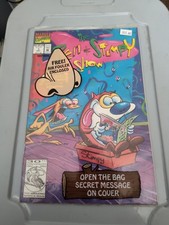
Ren and Stimpy Show #1 Still Sealed In Polybag Marvel Comics 1992 Nicktoons
$28.00