109 years old!
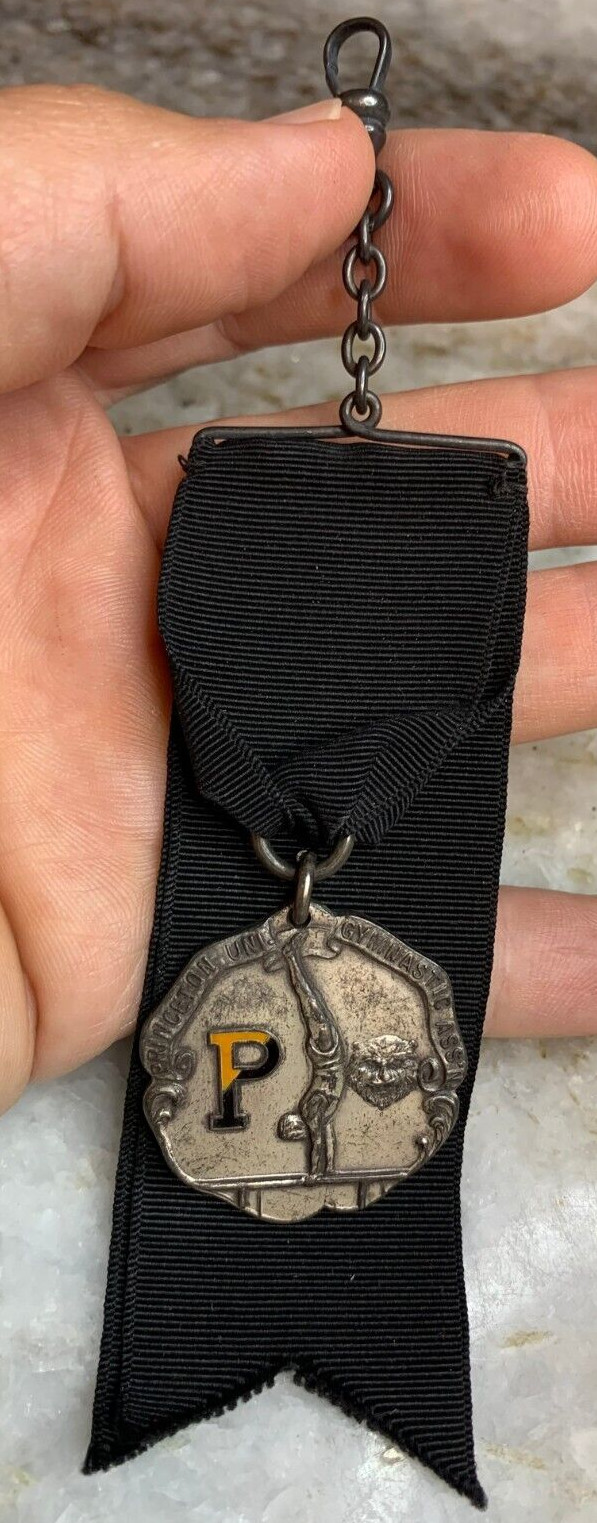
Collect them all...Sterling SilverGymnastics "Tumbling" MedalFrom the Princeton "Caledonian Games"... a modern version, of the classic Scottish Highland Games..Made by the fine, speciality, jewlers of the time D & C (Dieges & Clust)A rare, early, medal from one of America's eight (8) IVY League Schools (shhh... it should be in their museum).I package well and ship out daily!Dieges & Clust1 languageToolsFrom Wikipedia, the free encyclopediaA silver medal, cast by Dieges & Clust and awarded at the1904 Olympic Games.
Dieges & Clustwere jewellers established inNew York[1][2]in 1898 by Col. Charles Joseph Dieges (b. Oct. 26, 1865-d. Sept. 14, 1953) and Prosper Clust (b. Sept. 26, 1873-d. Mar. 28, 1933).[3][1]
History[edit]
The firm was founded in 1898 as a partnership between Charles Joseph Dieges and Prosper Clust. The partnership was converted to a company in 1908 with Dieges as president and director, and with Clust as secretary-treasurer and director.[4]
The firm was located at 20 John Street, New York, New York, expanding to have offices in Boston, Pittsburgh, and Chicago.[5][6]
The firm was sold toHerff Jones(a division of Carnation) on January 1, 1980.[7]
Major works[edit]
They produced many medals, including the Spanish–American War Medal, the 1904 Olympic Medal, the Eagle Scout medal (from 1916 to 1920),[8]New York State World War I Service Medal, the Medal of Honour, and the Titanic-Carpathia Medals (at the request of "The Unsinkable" Mrs. Molly Brown). They made baseball's first Most Valuable Player Awards and many Baseball Press Pins as well asLou Gehrig's farewell plaque. They also cast theHeisman Trophy(in New York and laterProvidence, Rhode Island) from its inception in 1935 through late 1979 when the company was sold toHerff Jones(a division of Carnation) on January 1, 1980.[7]
Perhaps the height of Dieges & Clust's production were the 1920s trophies known in sports collecting circles as "The Five Figural Spalding Baseball Trophies". The various trophies depict a baseball player pitching, catching, batting, playing first base, or playing in the outfield. The proportions of the figures and the detail (of the faces, fingers, stitching in the baseball gloves and shoelaces) are remarkable.[citation needed]They fetch up to $5,000 at sale, relatively high for a silver-plated trophy on a wooden base.[citation needed]
The company produced the Martin J. Sheridan Medal for Valor for the New York City Police Department (NYPD) that was established in honor of Detective Martin J. Sheridan – the Irish-American Athletic Club's star U.S. Olympic champion who died in 1918 of the influenza pandemic. The medal was first presented in 1922 and regularly awarded until discontinued in 1975. The medal was initially paid for through a trust fund established by the Martin J. Sheridan Memorial Committee, with New York State Supreme Court Justice Daniel F. Cohalan serving as chairman.[9]
A 1936 New York YankeesWorld Series ringcast by Dieges & Clust and owned by Lou Gehrig held the record sale price for such a ring at $17,500.[10]
In 1999, Sotheby's sold what was believed to be Lou Gehrig's 1927 ring for $96,000.
Staff[edit]Charles Joseph Dieges[edit]
Charles Dieges, president and director of the company after 1908, served in the US 22nd Regiment inWorld War Iand participated on the US Olympics team.
- 1902, October 27: Joined 22nd Regiment, New York Engineers, New York National Guard.[11][12]
- 1904, March 14: Corporal, 22nd Regiment, NY Engineers, NYNG[11]
- 1904: Member of theUnited States Olympics Tug of War teamat the1904 Summer Olympics[13]
- 1905, December 11: Sergeant, 22nd Regiment, NY Engineers, NYNG[11]
- 1906, March 30: Second Lieutenant, 22nd Regiment, NY Engineers, NYNG[11]
- 1906, May 18: First Lieutenant, 22nd Regiment, NY Engineers, NYNG[11]
- 1910: Associate Life Member of theAmerican Numismatic Society[14]
- 1911: Elected to the Military Athletic League as a member of New York Military Athletic League.[15]
- 1916, July 7: Mustered in to U.S. service.[12]
Memberships
- Ancient Order of Timers
- Order of the G.G.F. (General Good Fellows)
- Elks
- Masons[16]
Prosper Clust[edit]
Prosper was a manufacturing jeweler who learned the trade from his father Ernest Clust, who emigrated from France in 1872. He was secretary-treasurer and director of the company after 1908.[4]
Constanzo Luini[edit]
Constanzo was a medalist with Dieges & Clust who specialized patriotic and religious themes. He was born in 1886 and a descendant ofBernardino Luini, a fresco painter and student ofLeonardo da Vinci. Costanzo immigrated to the United States at the turn of the century.
Highland games22 languagesToolsFrom Wikipedia, the free encyclopediaOpening ceremonies of 2004CanmoreHighland gamesPart ofa serieson theCulture of style="list-style-image: margin: 0px; padding: 0px;">
Scotland portalHighland games(Scottish Gaelic:geamannan Gàidhealach) are events held in spring and summer inScotlandand other countries with a largeScottish diaspora, as a way of celebrating Scottish andCelticculture, especially that of theScottish Highlands. Certain aspects of the games are so well known as to have become emblematic of Scotland, such as thebagpipes, thekilt, and the heavy events, especially thecaber tossandweight over bar. While centred on competitions in piping and drumming, dancing, and Scottish heavy athletics, the games also include entertainment and exhibits related to other aspects of Scottish andGaeliccultures.
TheCowal Highland Gathering, better known as the Cowal Games, is held inDunoon,Scotland, every August. It is the largest Highland games in the world,[a]attracting around 3,500 competitors and somewhere in the region of 23,000 spectators[1][2]from around the globe. Worldwide, however, it is exceeded in terms of spectators by three gatherings in the United States: the estimated 30,000[3]that attendGrandfather MountaininNorth Carolina; the New Hampshire Highland Games & Festival, which attracts over 35,000 annually; and the even larger Northern California gathering—the largest in the Northern Hemisphere[4]—that has taken place every year since 1866.[5]This event, the Scottish Highland Gathering and Games, is currently held on Labor Day weekend inPleasanton, California; the sesquicentennial event held on 5–6 September 2015 attracted record crowds close to 50,000.[4]
The games are claimed to have influencedBaron Pierre de Coubertinwhen he was planning therevival of the Olympic Games. De Coubertin saw a display of Highland games at theParis Exhibition of 1889.[6][b]
History[edit]Early events[edit]
The first historical reference to the type of events held at Highland games in Scotland was made during the time of KingMalcolm III(Scottish Gaelic:Máel Coluim, c.1031 – 13 November 1093) when he summoned men to race up Craig Choinnich overlooking Braemar with the aim of finding the fastest runner in Scotland to be his royal messenger.[citation needed]There is a document from 1703 summoning theclanof the Laird of Grant,Clan Grant. They were to arrive wearing Highland coats and "also withgun,sword,pistolanddirk".[c]From this letter, it is surmised that the competitions would have included feats of arms.[citation needed]
There are also thought to have been events where the strongest and bravest soldiers in Scotland would be tested. Musicians and dancers were encouraged to reveal their skill and talents and so be a great credit to the clan that they represented.[citation needed]Some modern sources suggest more these games would originate from the deer hunts that the inhabitants of the Highlands engaged in.[7]
Attempts have been made to discover earlier traditions of games, although evidence is thin. The primary sources are from the bardic traditions of both contests between clans and of tests to select retainers for clan chiefs. An example of a possible early games venue is atFetteresso,[citation needed]although that location is technically a few miles south of the Scotland Highlands.
Modern events[edit]Massed bandsat theGlengarry Highland Games, Maxville, Ontario, Canada, 2006Weight over the bar event at theCarmunnockHighland Games, ScotlandHighland Dancing Competition at theDornochHighland Gathering, Scotland
The modern Highland games are largely a 19th-century development, from the period following theJacobite rebellionsand subsequentbanonHighland dress.[d]
By the mid-20th century,[8]annual Highland games events, modelled on the traditional events in Scotland along with some elements borrowed from themòdfestivals, had been established not just in Scotland but throughout the United States, Canada, Australia, New Zealand, and South Africa, among other places with a notableScottish diaspora, which totals about 50 million people worldwide.[9](The earliest such events in North America go back quite a way, to 1836 in New York[10]and at least 1863 in Nova Scotia.)[11]The modern, rather commercialised[12]gatherings have done much to promote tartan, kilts, and other elements of Highland culture abroad, having up to tens of thousands of attendees,[13]a large proportion of them in Highland dress. The games are the primary source of business for a cottage industry of professional kiltmakers outside of Scotland, and are the main recruiting grounds of the numerous clan societies.[e]
While the Scottish Highland Games Association says there are dozens of such events in Scotland,[15]there were at least 260 annual Highland games events worldwide as of 2000,[16]more than 100 of them in the US alone, and dozens more in Canada.[15]They are closely intertwined withbagpipeband competitions (which date to 1781), a lasting source of Highland imagery in theirregiment-inspired uniforms; the 2013World Pipe Band Championshipsin Glasgow drew over 8,000 pipers and drummers from all over the world.[17]
The games' rather flamboyantly[18]tartanedsubculture, a "shortcut to the Highlands",[19]is sustained outside Scotland primarily by multi-generational Scottish descendants rather than by direct Scottish expatriates.[20][21]SirMalcolm MacGregor, chief ofClan Gregorand then convenor of theStanding Council of Scottish Chiefs(well aware of tartan's connections to tourism and other Scottish economic interests) wrote in 2016 of the games events beyond Scotland that "it is the stuff of kilts andcabers, but it is the Scotland those not living in Scotland want it to be."[22]Ian Brown (2012) coined the termtartanism(as distinct fromtartanry) for this international tokenisation of tartan, kilts, and other symbols of the Highlands asethnic-identitymarkers, evolving to some degree independently to suit the cultural needs of the New World Scottish diaspora and unrestrained by the views of the originating Scottish "home" culture.[23]Michael B. Paterson (2001) hypothesises that the fondness for Highland symbols and activities among the diaspora may be due to the European-descended populations in these countries lacking much of a direct experience of culture deeper than a few generations, and being dominated bynuclear familystructure;[24]Highland games, clan tartans,Burns suppers,St Andrew's societies(more than 1,200 of them just in the US), etc. provide a sense of shared roots, heritage, identity, and a broader and more elastic notion of family, as well as fostering Old World, "mother country" connections.[24][25]Fiona K. Armstrong (2017) writes: "It is a feudal longing in a modern age. It is a yearning for some supposedly comforting and ordered past."[22]According to Ian Maitland Hume (2001):[26]
Tartan and the kilt encapsulate many facets of a heritage which people aspire to access; they may also represent a part-mythical family origin for those seeking roots.... [T]he number of Americans who choose to adopt a Scottish element as part of their identity can be attributed in substantial part to the power these symbols possess.
This swell of diasporic tartan enthusiasm seems to have been triggered in the 1950s, the beginning of the age of affordable powered flight, as clan chiefs likeDameFlora MacLeodofClan MacLeodtravelled abroad to promote Scottish tourism and other connections.[8](At least 1 in 5 Scottish-descended people surveyed in 2017 byVisitScotland, the national tourism board, expressed an interest in travelling to Scotland.)[27]However, in 2009, the US-based Council of Scottish Clans and Associations reported a drop in the number of active clan societies (which peaked at 170, and drive considerable tourism as well as historic-place restoration efforts), with up to a 25% decrease in individual memberships, as well as some of the annual games events coming to an end; "new technology" (i.e. the Internet) seemed to be related.[28]
Events[edit]Heavy events[edit]A caber being thrown at the 2000New HampshireHighland Games
In their original form centuries ago, Highland games revolved around athletic and sports competitions. Though other activities were always a part of the festivities, many today still consider Highland athletics to be what the games are all about—in short, that the athletics are the games, and all the other activities are just entertainment. Regardless, it remains true today that the athletic competitions are at least an integral part of the events and one—the caber toss—has come to almost symbolise the Highland games.
- Stone putor "putting the heavy stone": This event is similar to the modern-dayshot putas seen in the Olympic Games. Instead of a steel shot, a large stone of variable weight is often used. There are also some differences from the Olympic shot put in allowable techniques. There are two versions of the stone toss events, differing in allowable technique. The "Braemar Stone" uses a 20–26lb (9–12kg) stone for men (13–18lb or 6–8kg for women) and does not allow any run up to the toeboard or "trig" to deliver the stone, i.e., it is a standing put. In the "Open Stone" using a 16–22lb (7–10kg) stone for men (8–12lb or 3.5–5.5kg for women), the thrower is allowed to use any throwing style so long as the stone is put with one hand with the stone resting cradled in the neck until the moment of release. Most athletes in the open stone event use either the "glide" or the "spin" techniques.
- Scottish hammer throw: This event is similar to thehammer throwas seen in modern-day track and field competitions, though with some differences. In the Scottish event, a round metal ball weighing 16 or 22lb (7.25 or 10kg) for men, or 12 or 16lb (5.5 or 7.25kg) for women, is attached to the end of a shaft about 4 feet (1.2 metres) in length and made out of wood, bamboo, rattan, or plastic. With the feet in a fixed position, the hammer is whirled about one's head and thrown for distance over the shoulder. Hammer throwers sometimes employ specially designed footwear with flat blades to dig into the turf to maintain their balance and resist the centrifugal forces of the implement as it is whirled about the head. This substantially increases the distance attainable in the throw.Weight throw
- Weight throw, also known as the weight for distance event. There are actually two separate events, one using a light (28lb for men and 14lb for women) and the other a heavy (56lb for men, 42lb for masters men, and 28lb for women) weight. The weights are made of metal and have a handle attached either directly or by means of a chain. The implement is thrown using one hand only, but otherwise using any technique. Usually a spinning technique is employed. The longest throw wins.
- Weight over the bar, also known as "weight for height". The athletes attempt to toss a 56-pound (4-stone) weight with an attached handle over a horizontal bar using only one hand. Each athlete is allowed three attempts at each height. Successful clearance of the height allows the athlete to advance into the next round at a greater height. The competition is determined by the highest successful toss with fewest misses being used to break tie scores.
- Sheaf toss: A bundle of straw (the sheaf) weighing 20 pounds (9.1kg) for the men and 10 pounds (4.5kg) for the women and wrapped in a burlap bag is tossed vertically with a pitchfork over a raised bar much like that used in pole vaulting. The progression and scoring of this event is similar to the Weight Over The Bar. There is significant debate among athletes as to whether the sheaf toss is in fact an authentic Highland event. Some argue it is actually a country fair event, but all agree that it is a great crowd pleaser.[citation needed]
- Maide-leisg(Gaelic for 'lazy stick',pronounced[matʲəˈʎeʃkʲ]): Trial of strength performed by two competitors sitting on the ground with the soles of their feet pressing against each other. Thus seated, they hold a stick between their hands which they pull against each other until one of them is raised from the ground. The oldestmaide-leisgcompetition in the world takes place at the Carloway show and Highland games on the Isle of Lewis.
Many of the heavy events competitors in Scottish highland athletics are former high school and college track and field athletes who find the Scottish games are a good way to continue their competitive careers.
Increasingly in the US, the heavy events are attracting women, as well as master-class athletes, which has led to a proliferation of additional classes in heavy-events competitions. Lighter implements are used in the women's classes.
Music[edit]Massed bands at the 2005 Pacific Northwest Highland Games
For many Highland games festival attendees, the most memorable of all the events at the games is the massing of the pipe bands. Normally held in conjunction with the opening and closing ceremonies of the games, as many as 20 or more pipe bands will march and play together. The result is a thunderous rendition ofScotland the BraveorAmazing Grace, and other crowd-pleasing favorite's.
The music of thegreat Highland bagpipehas come to symbolize music at the games and ofScotlanditself. In addition to the massed bands (when all the attending pipe bands play together), nearly all Highland games gatherings feature a wide range of piping and drumming competition, including solo piping and drumming, small group ensembles and full the pipe bands.
Music at Highland games gatherings also includes other forms, such asfiddling,harpcircles, andCelticbands.
Princeton University91 languagesTools