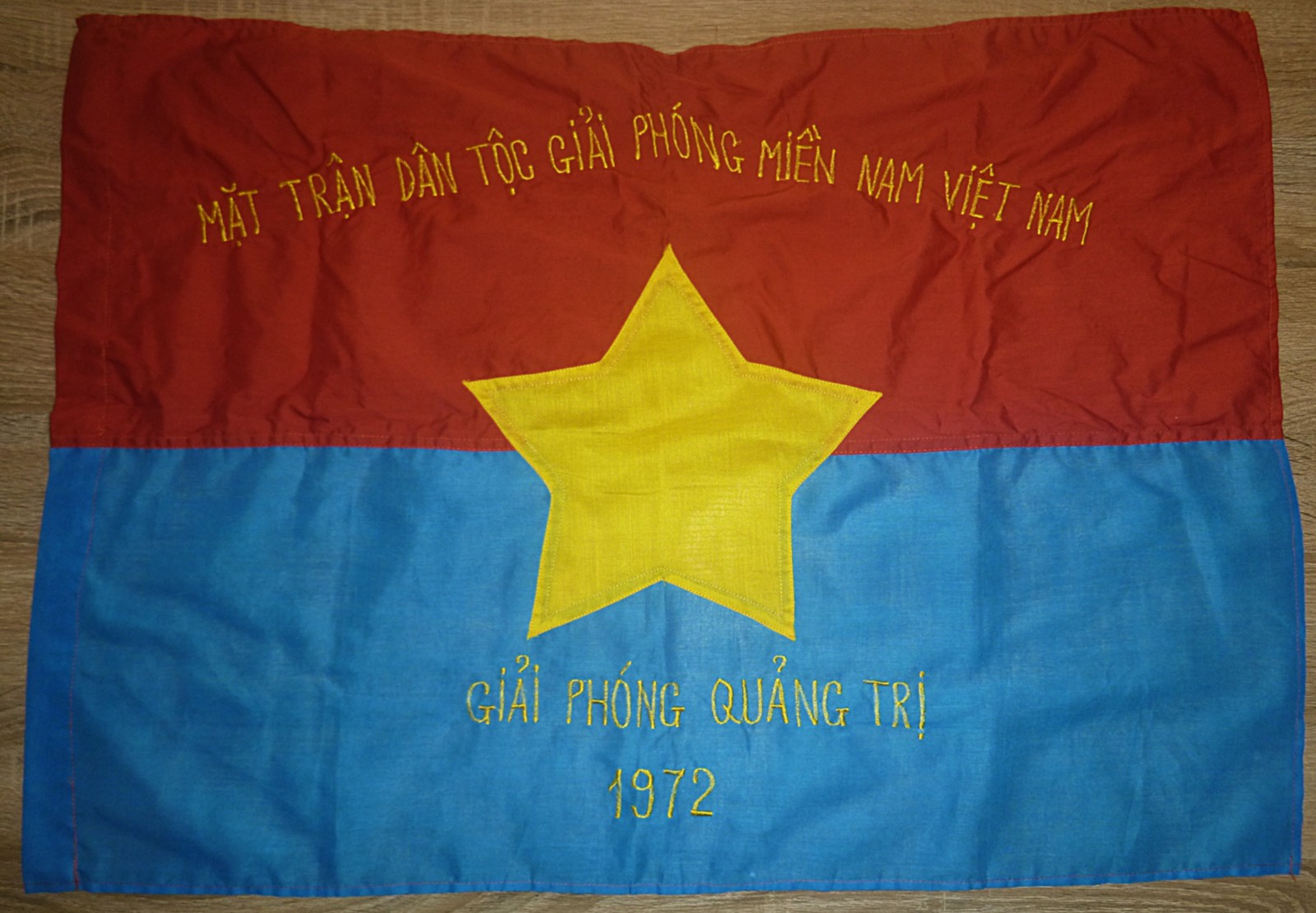
Measures - 29 x21 inches (75 x 54 cms) Excellent PieceNLF, NVA, VC - Viet Cong / National Liberation FrontEaster Offensive - Quang Tri City / Quang Tri Province 1972
During the Easter Offensive of 1972, Quảng Trị Province became the main conventional battlefield in South Vietnam. The offensive opened on 30 March 1972 with a large-scale North Vietnamese Army assault across the DMZ, aimed at seizing Quảng Trị Province, destroying ARVN I Corps forward units, and achieving a major political and territorial victory.
The attack was led by the PAVN B-5 Front (also known as the Trị–Thiên Front), employing regular army formations rather than Viet Cong (NLF) main forces.
Key units included the 304th, 308th, and 324B Divisions, supported by elements of the 325th Division, independent regiments, armour, heavy artillery, and surface-to-air missile units.
The offensive marked one of the first large-scale uses of Soviet-supplied T-54 and PT-76 tanks south of the DMZ.
Attacking strength in Quảng Trị Province exceeded 30,000 troops.
ARVN forces initially defending the province included the 3rd Infantry Division, Marine and Ranger units, Regional Forces, and territorial troops. Under intense artillery barrages, armour-led assaults, and infantry pressure, ARVN defensive lines north of Đông Hà collapsed.
Đông Hà fell in early April, and by 1 May 1972 Quảng Trị City was captured, becoming the first provincial capital taken by North Vietnam during the war.
Following the loss of Quảng Trị City, ARVN forces withdrew south of the Thạch Hãn River and established new defensive positions. U.S. involvement consisted primarily of airpower, including extensive tactical air strikes and B-52 bombing under Operation Linebacker. U.S. naval gunfire from offshore also played a significant role in slowing PAVN advances and interdicting supply routes.
From June to September 1972, ARVN launched a major counteroffensive to retake Quảng Trị Province.
The effort was led by ARVN Marine and Airborne units, supported by U.S. airpower.
Fighting was slow and costly, characterised by heavy artillery duels and attritional ground combat. By mid-September, ARVN forces had recaptured Quảng Trị City, though large parts of northern Quảng Trị Province remained under PAVN control.
The Easter Offensive in Quảng Trị demonstrated North Vietnam’s ability to conduct sustained, conventional combined-arms warfare. Although ARVN ultimately retook Quảng Trị City, the province was effectively divided, and the scale of the fighting influenced the Paris Peace Talks and the final phase of U.S. disengagement from Vietnam.
NLF - National Liberation Front
The Việt Cộng, also known as the NationalLiberation Front (NLF), was a communist political organization with its ownarmy – the People's Liberation Armed Forces of South Vietnam (PLAF) – in SouthVietnam and Cambodia that fought the United States and South Vietnamesegovernments, eventually emerging on the winning side
It had both guerrilla and regular army units,as well as a network of cadres who organized peasants in the territory itcontrolled. Many soldiers were recruited in South Vietnam, but others wereattached to the People's Army of Vietnam (PAVN), the regular North Vietnamesearmy.
During the war, communists and anti-waractivists insisted the Việt Cộng was an insurgency indigenous to the South,while the U.S. and South Vietnamese governments portrayed the group as a toolof Hanoi. Although the terminology distinguishes northerners from thesoutherners, communist forces were under a single command structure set up in1958.
North Vietnam established the NationalLiberation Front on December 20, 1960, to grow insurgency in the South. Many ofthe Việt Cộng's core members were volunteer "regroupees", southern ViệtMinh who had resettled in the North after the Geneva Accord (1954).
Hanoi gave the regroupees military training andsent them back to the South along the Ho Chi Minh trail in the early 1960s.
The NLF called for southern Vietnamese to"overthrow the camouflaged colonial regime of the Americanimperialists" and to make "efforts toward the peacefulunification".
The People's Liberation Armed Forces of SouthVietnam (PLAF)'s best-known action was the Tet Offensive, a massive assault onmore than 100 South Vietnamese urban centers in 1968, including an attack onthe U.S. embassy in Saigon.
The offensive riveted the attention of theworld's media for weeks, but also overextended the Việt Cộng. Later communistoffensives were conducted predominantly by the North Vietnamese. Theorganization was dissolved in 1976 when North and South Vietnam were officiallyunified under a communist government.

Related Items:
Zippo Slim Lighter VIETNAM QUANG TRI and NUDE LADY Standing by a Tree Logo
$79.90
Zippo Vietnam Zippo 67-68 QUANG TRI From JAPAN
$419.99
x2 LOT 1968 Vietnam War US Soldier Snapshot Photos Quang Tri RVN Butcher Salkeld
$21.00