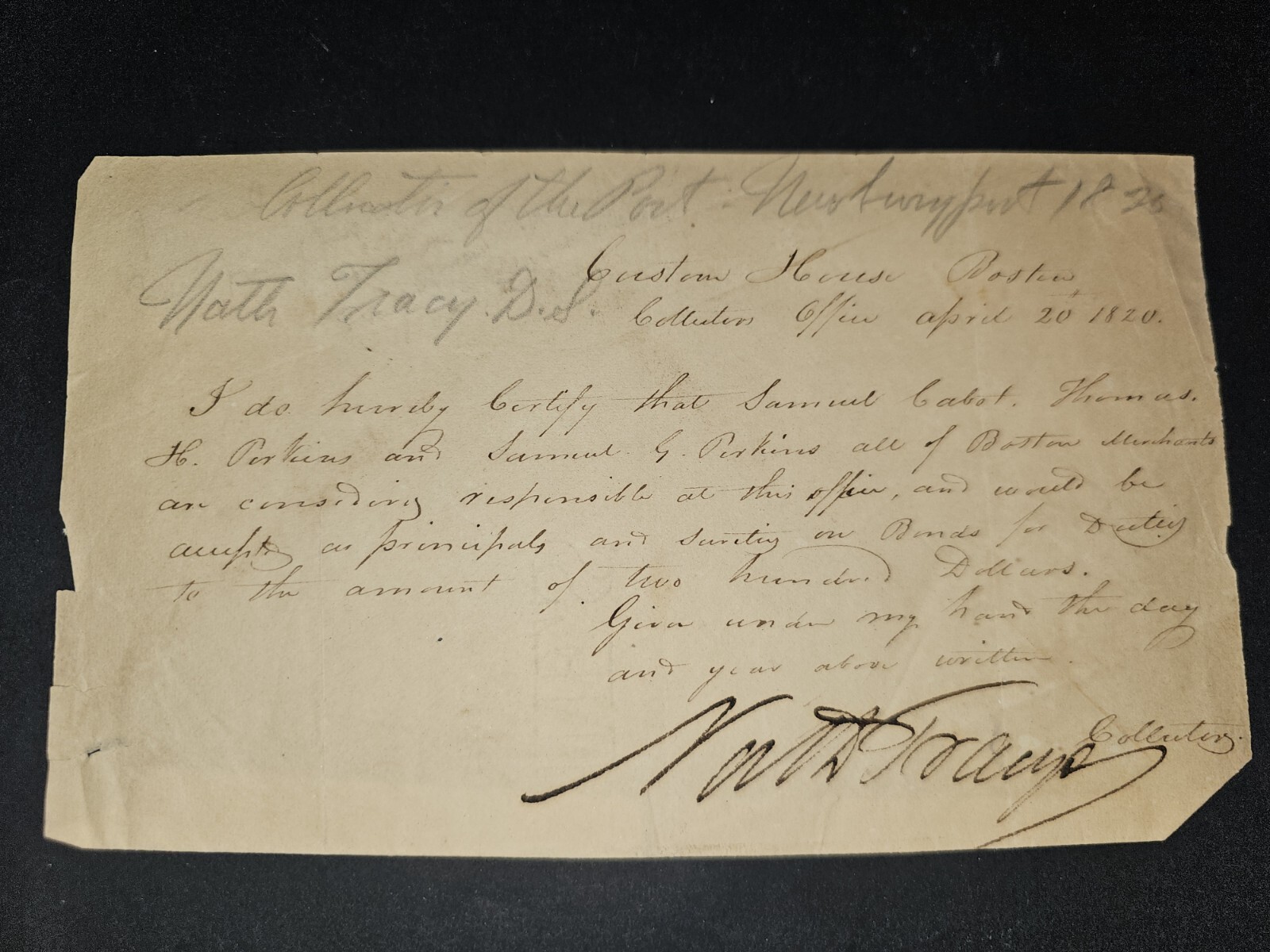
Rare 1820 Custom House Certificate Signed by Collector Nathaniel Tracy - Boston Merchants Samuel Cabot, Thomas H. Perkins, and Samuel G. Perkins
This original document, dated April 20, 1820, from the Collector\'s Office at the Custom House in Boston, is a historically significant piece related to American maritime and commercial history. It is signed by Nathaniel Tracy, a prominent figure, possibly the son of Nathaniel Tracy Sr., the renowned privateer and financier during the American Revolution.
This document certifies that Samuel Cabot, Thomas H. Perkins, and Samuel G. Perkins, influential Boston merchants, are considered financially responsible and acceptable as principals and sureties for bonds related to duties amounting to two hundred thousand dollars. Their involvement in shipping and international trade during this period speaks to their prominence in the commercial history of the early United States.
Key Features:
Date: April 20, 1820
Location: Custom House, Boston
Subject: Certification of Boston merchants\' responsibility for bonds on customs duties
Nathaniel Tracy (Collector)
Samuel Cabot
Thomas H. Perkins
Samuel G. Perkins
Condition: The document shows signs of aging but is well-preserved with legible handwriting and signatures, making it a great addition to any collection of early American history, maritime trade, or custom house documents.
Historical Context:
This document reflects the post-Revolutionary War era where commerce and customs played a vital role in the economic recovery of the newly-formed United States. Nathaniel Tracy Sr. was a famed merchant and privateer during the American Revolution, financing numerous privateer ships and supplying the Continental Army. It is believed that this Nathaniel Tracy, acting as Collector of Customs in 1820, could be his son, continuing the family\'s legacy in trade and government service.
The Perkins family, especially Thomas H. Perkins, was deeply involved in the China trade and American mercantile pursuits, making this document a notable piece of American commercial history. These merchants helped shape the early economy and international relations of the U.S.
Why Own This Piece?
Collectors of historical documents will appreciate this rare example of a 19th-century customs bond certification, bearing the signatures of prominent Boston figures. The combination of maritime history, early American finance, and the continuation of the Tracy family legacy makes this a truly unique item.
Don\'t miss the chance to own a document that offers a glimpse into the customs operations of early 19th-century America, signed by influential historical figures!
Add this remarkable piece to your collection today!
Feel free to reach out with any questions about the document\'s provenance or historical significance.
Here are brief biographies of the individuals referenced in the document:
Nathaniel Tracy (likely Jr.)
Nathaniel Tracy Jr. was probably the son of Nathaniel Tracy Sr. (1751–1796), a prominent merchant and privateer from Newburyport, Massachusetts, who played a significant role during the American Revolution. Nathaniel Tracy Sr. financed numerous privateer ships that disrupted British trade, aiding the colonial war effort. After the war, however, he faced financial difficulties. While there is limited documentation on Nathaniel Tracy Jr., it is possible that he followed in his father’s footsteps, taking on commercial or governmental roles, including serving as a customs collector at the Boston Custom House by 1820.
Samuel Cabot (1784–1863)
Samuel Cabot was a member of the wealthy Cabot family in Boston, a prominent merchant family with substantial business interests in shipping, trading, and later in industrialization. Samuel Cabot himself was a successful merchant and businessman, known for his involvement in international trade. The Cabot family was part of Boston’s elite and played an important role in the city’s commercial development during the early 19th century.
Thomas Handasyd Perkins (1764–1854)
Thomas H. Perkins was a highly influential merchant and philanthropist from Boston, known for his success in the China Trade and his involvement in the trading of opium, tea, and other goods between America and the East. Perkins amassed a significant fortune through his business ventures, particularly in trade with China. He was also a philanthropist, most notably donating to the establishment of the Perkins School for the Blind, which was named in his honor. Perkins was one of the wealthiest and most powerful merchants in Boston during his lifetime.
Samuel G. Perkins (1767–1847)
Samuel G. Perkins, the younger brother of Thomas H. Perkins, was also a Boston merchant involved in the China trade. He worked closely with his brother in various business ventures, including the trade of goods like opium, silk, and tea. Like his brother, Samuel G. Perkins was part of the powerful Perkins family network, which played a significant role in American trade and business in the late 18th and early 19th centuries. He later invested in real estate and other ventures in Boston.
---
These individuals represent some of the most powerful and wealthy Boston merchants of their time, deeply involved in shaping the city’s economy and contributing to international trade. Their business interests ranged from shipping and importing to large-scale philanthropy. The Cabot and Perkins families were pivotal in the growth of Boston’s financial and mercantile industries during the early 19th century.

Related Items:

Early Antique Old Chain Bridge Newburyport Porcelain Plate Germany Bon March’e
$49.99
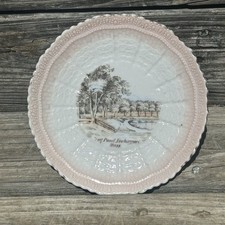
Early Antique Frog pond Newburyport Porcelain Plate Made In Germany
$42.99