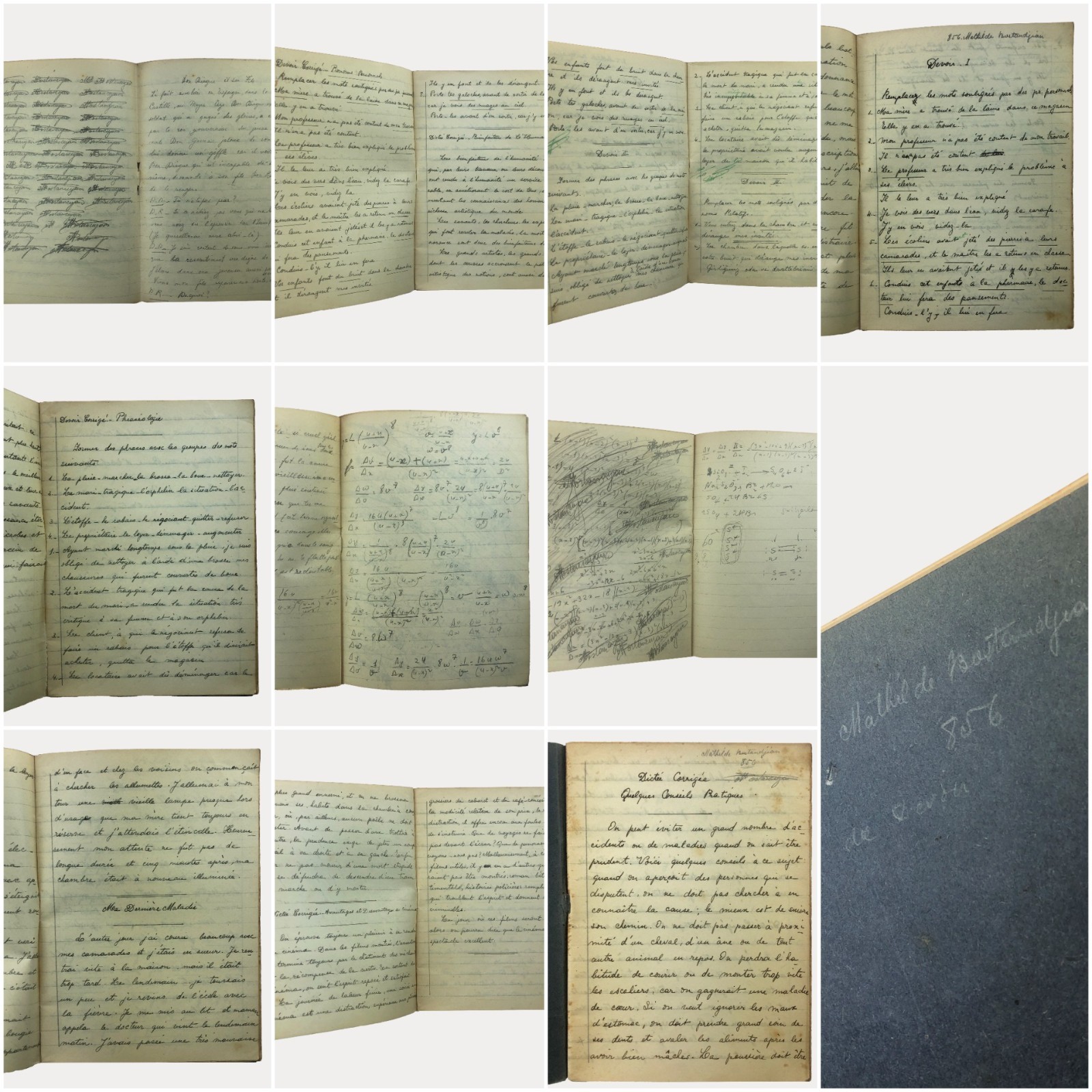
Handwritten French-language school exercise notebook (cahier de devoirs), kept by a student identified throughout as Mathilde Bostandjian (also written as Bastandjian / Bustandjian), whose school registration number "856" appears at the head of several pages. No calendar date is clearly legible anywhere in the notebook, so its age cannot be stated with certainty; however, one exercise includes a sentence rendered in Latin-script Turkish rather than Ottoman Arabic script, which — if correctly read — would place the notebook after Turkey's 1928 alphabet reform, i.e. in the early Republican era.
The notebook's content is that of a rigorous, French-medium curriculum: corrected grammar exercises (personal and relative pronouns), corrected dictées on subjects including public health and safety advice, the social merits and dangers of cinema, and "the benefactors of humanity," alongside a personal composition titled "Ma Dernière Maladie" ("My Last Illness"). Notably, the book also contains a prose summary of the opening act of Pierre Corneille's classic 17th-century play Le Cid, retelling the confrontation between Don Diègue and his son Don Rodrigue — evidence the student was studying canonical French classical literature. Further pages show advanced mathematics (logarithmic differentiation problems) and chemistry redox equations (thiosulfate reactions with iodine and bromine), indicating a broad academic course load extending well beyond basic language instruction.
A charming and humanizing detail: across two pages, the student has repeatedly practiced her own surname in cursive, in both a French transliteration ("Bostandjian"/"Bastandjian") and what appears to be an Armenian-Turkish spelling ("Bostancıyan") — margin doodling consistent with an Armenian family name in a Turkish-speaking milieu. The rear board carries her ownership inscription in pencil, "Mathilde Bastandjian / 856,".
There are no institutional letterheads, stamps, seals, or official markings anywhere in the notebook — this is a personal student workbook rather than an administrative or government document. Its interest lies in its status as an intimate, single-owner primary source of early-20th-century minority education: a young Armenian student's actual coursework from a French-language school, combining Western literary and moral pedagogy with a bilingual French–Turkish translation exercise, offering researchers and collectors of Armenian, Ottoman/Turkish, and francophone educational history a genuine, personal classroom artifact.
We always ensure your item is securely packed in a protective plastic sleeve, placed between hard cardboard, and shipped in an envelope withregistered mail tracking!
Have questions? We're happy to help!Browse our storefor more.We are happy to offer combined shipping on multiple collectible purchases to help you save! Just add all items to your cart and request an invoice before paying, or send us a quick message — we’ll calculate the best shipping rate soyou can buy more and save more!
Please examine the listing, some bent corners, era folds, small tears and slight stains due to their genuine antique aging.As is, what you see is what you will get. We try to present the real state of the object as completely as possible with photos.
Copyright ©2026 by LavenaVintage. All Rights Reserved. All photographs are the intellectual property of LavenaVintage and are protected under international copyright laws. Use or distribution of these images/texts in any form without purchase or prior written permission is strictly prohibited.

Related Items:
AUTHENTIC AUTOGRAPHED AND WATERMARKED MANUSCRIPT DOCUMENT from 1600s
$49.99
RARE 1690’s FRENCH VELLUM MANUSCRIPT BOOKLET 24p BOURGES HEART TAX LOUIS XIV
$285.00
RARE 1759 FRENCH VELLUM NOTARIAL MANUSCRIPT BOOKLET 12p+2 LOUIS XV
$125.00