BOOK SHIPS FREE IN THE CONTINENTAL UNITED STATES.
Will ship using Fed Ex, UPS, or USPS at my discretion.
International and OCONUS buyers will pay shipping charges based on weight and location.
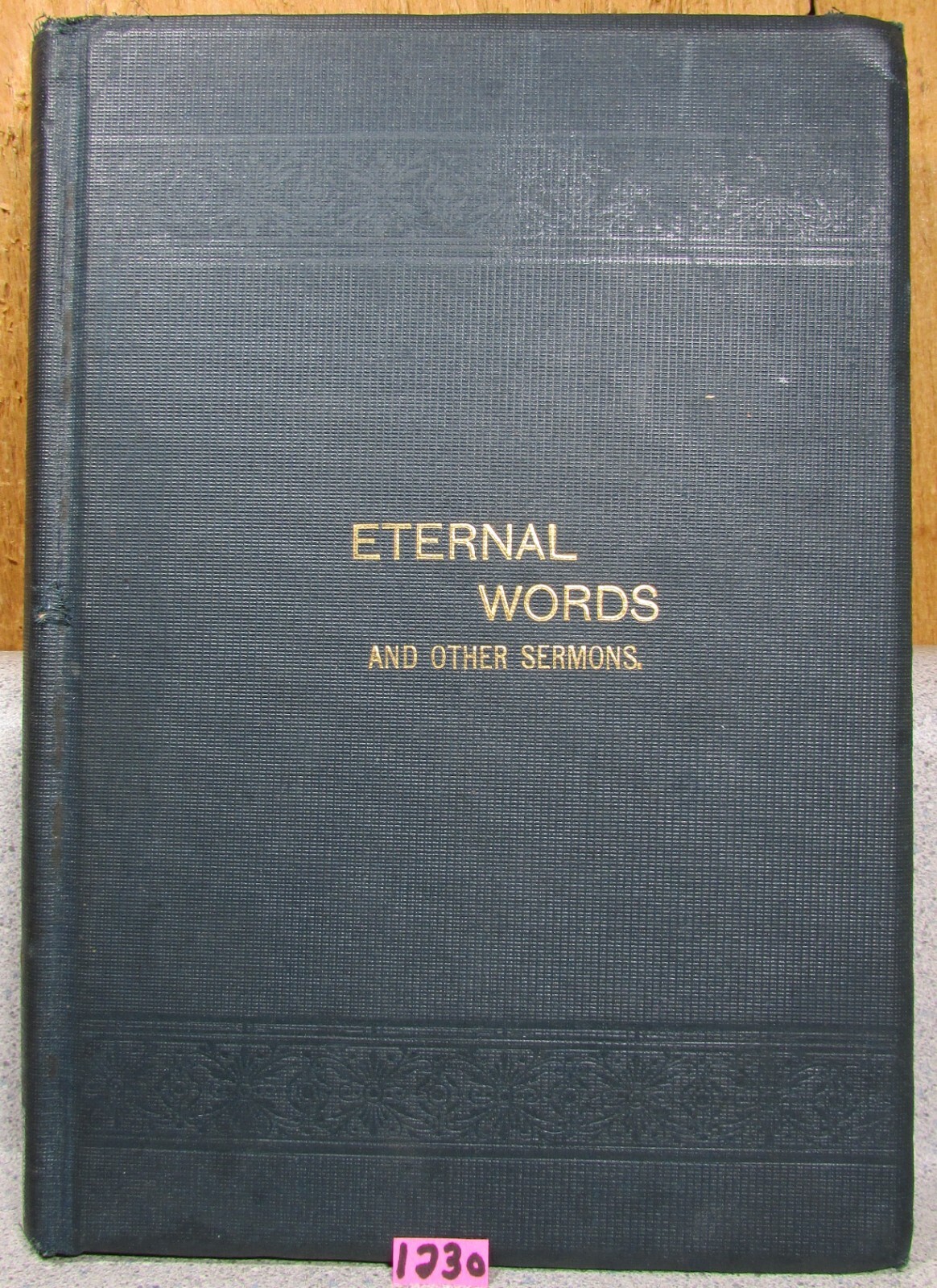
Original, antique hard cover book, printed in 1894 by Student Publishing Company, in Hartford, Connecticut, with correct period coffin cut or angled edges.
Gilt font on front cover and spine, dark green linen hardcover binding with embossed or pressed decoration wrapping around the spine.
Rev. Elisha Benjamin Andrews was a prolific author in the late 19th, and early 20th century.
He wrote many works on American history, US conservative and Christian politics and economics, and other church related subjects.
I\'ve been a book lover, collector, and dealer for 40 years.
But despite searching over a half a billion book listings online (And yes, I know how to search the internet for all of those obscure nooks and crannies)! LOL!
I am unable to locate another title of this book!
I saw a paperback reprint sell for $400.00 about a year ago.
This is a first edition of this title.
Book measures 8 & 1/4\" high x 6\" wide x 1\" thick.
Weighs 1 lb., 2 ozs.
I will accept returns, with a 15% restocking fee, you pay return shipping.
The author\'s bibliography is below.
Rev. Elisha Benjamin Andrews, 1847-1917.
Early American Baptist minister,historian, economist, educator and president of Brown University.
Elisha Benjamin Andrews was born in Hinsdale, New Jersey, the son of a line of Baptist ministers. He interrupted his studies at the Connecticut Literary Institute, a Baptist academy in Suffield, Connecticut, to enlist in the Union Army, and served during the Civil War. He was discharged after being wounded in October 1864 and losing the sight in one eye at the battle of Petersburg. After the war, Andrews resumed his studies, and, after some preparation, eventually enrolled at Brown University in 1866, graduating in 1870.
For the next two years, Andrews served as principal of the Connecticut Literary Institute. Intent on entering the Baptist ministry. Andrews enrolled at the Newton Theological Institution in 1872, graduating in 1874. He was ordained a Baptist minister in July 1874. E. Benjamin Andrews subsequently served for a year as a pastor in Beverly, Massachusetts before being tapped to take up the presidency of Denison University in Granville, Ohio in 1875. At Denison, Andrews was mentor of futureChicagopresident W.R. Harper. Andrews left Denison in 1879, to teach theology at Newton TI, while simultaneously teaching philosophy courses nearby at Colby College.In 1882, E. Benjamin Andrews was appointed by Brown University to become professor of history and political economy. He delayed his appointment by a year, to undertake an academic tour inGermany, studying in Berlin and Munich, and coming under the influence of theGerman HistoricalSchool.Andrews parlayed his lectures at Brown into a series of textbooks. In 1888, Andrews left Brown to take up an appointment as professor of economics and public finance atCornell. But he did not stay for long. After merely a year, E. Benjamin Andrews was elected to take up the presidency of Brown University in 1889. Following American tradition of college presidents, E. Benjamin Andrews was responsible for the moral philosophy course at Brown, which included elements of political economy. Andrews is regarded as a watershed president of Brown, presiding over the expansion of the college, and its transformation into a modern university. Andrews expanded the offerings in economics, modern languages and science.Andrews served as president of Brown for a decade. During this period, Andrews continued contributing to economics debates, and served as US Commissioner to the International Monetary Conference in Brussels in 1892. In 1897, he was briefly associated with Cosmopolitan University, a fledgling correspondence college financed byCosmopolitanmagazine owner, J.B. Walker.
In 1897, Andrews got embroiled in a controversy with the Trustees of Brown University. Andrews was a long-time supporter of bimetallism and the free coinage of silver, which became a major issue in the 1896 US election. The Brown trustees complained that Andrews was frightening off donors, and, at a meeting in July 1897, requested that he change his position. Andrews refused and promptly resigned. It quickly became a much-advertised case of academic freedom, and fellow professors and alumni pressured Brown to reject his resignation. The matter seemed resolved, but the atmosphere remain charged. Andrews stayed on at Brown for one more year, before finally resigning in July 1898, to take up a position as superintendent of Chicago public schools.
Andrews moved again in 1900, to become chancellor at the University of Nebraska. E. Benjamin Andrews retired from Nebraska in 1908.

Related Items:

Punisher #1 Dell Otto Virgin Variant Rare Htf Cgc 9.8 Marvel 2018
$300.00

Titan Comics Little Nightmares #2 HTF RARE Variant
$65.00

Superpatriot: War on Terror #1x2, #4 (Image) HTF rare series. Robert Kirkman
$250.00