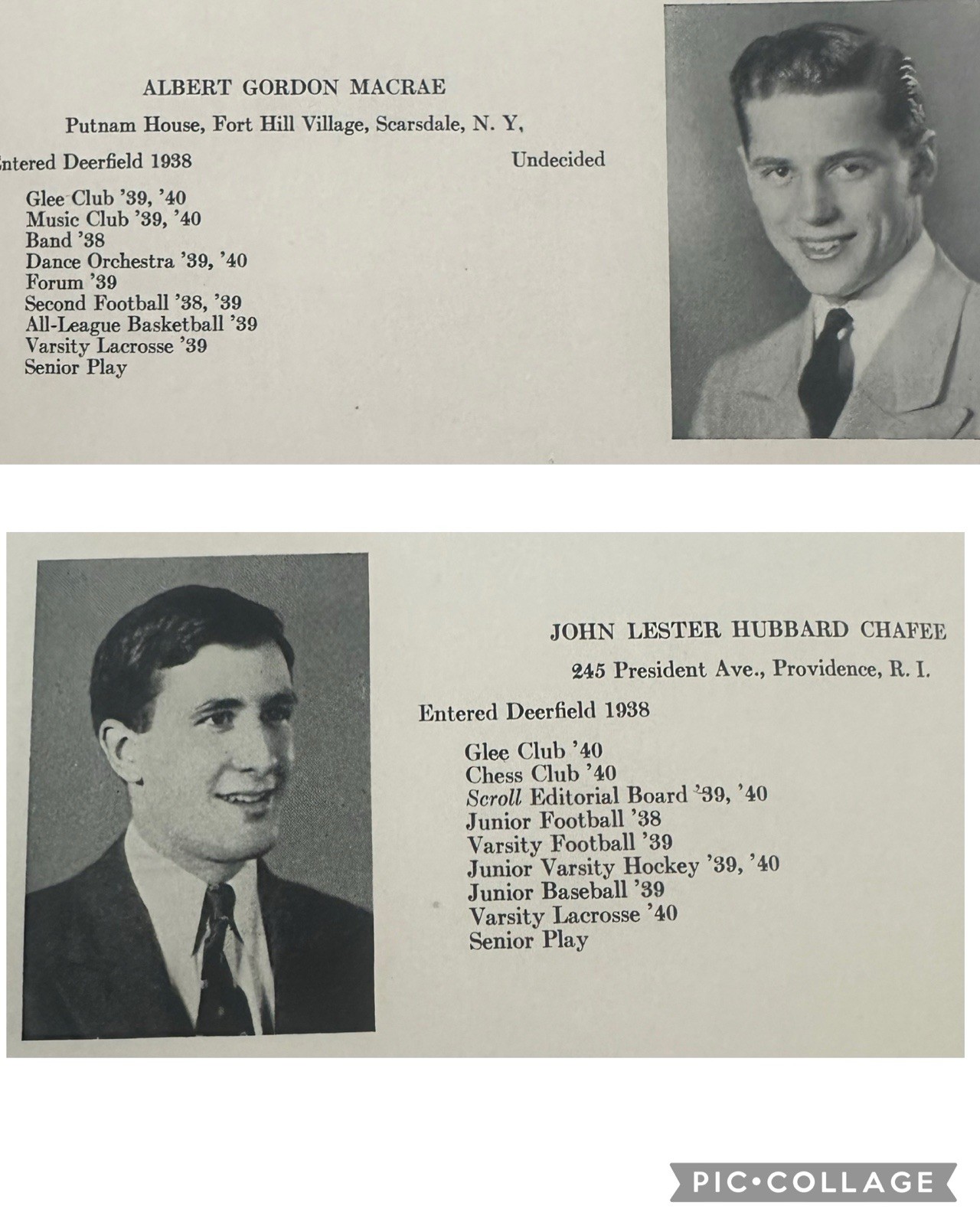
1940 Deerfield Academy
Deerfield, Massachusetts
The Pocumtuck Yearbook
Hardcover
258 Pages
8.25” x 10.5”
Gordon Macrae (Actor) Oklahoma! (1955) and Carousel (1956)
John Chafee (Governor Rhode Island)
Gordon MacRae
Albert Gordon MacRae (March 12, 1921 – January 24, 1986) was an American actor, singer, and television and radio host. He appeared in the film versions of two Rodgers and Hammerstein musicals, Oklahoma! (1955) and Carousel (1956), and played the leading man opposite Doris Day in On Moonlight Bay (1951) and its sequel, By The Light of the Silvery Moon (1953).
Gordon MacRae
Born Albert Gordon MacRae
March 12, 1921
East Orange, New Jersey, U.S.
Died
January 24, 1986 (aged 64)
Lincoln, Nebraska, U.S.
Resting place
Wyuka Cemetery, Lincoln, and radio show host
Years MacRae
(m. 1941; div. 1967)
Elizabeth Lambert Schrafft
(m. 1967)
Children
5, including Heather and Meredith
MacRae was a baritone. Winning a contest enabled him to sing at the 1939 New York World's Fair with the Harry James and Les Brown orchestras.
Broadway
He made his Broadway debut in 1942, acquiring his first recording contract soon afterwards. Many of his recordings were made with Jo Stafford.[2]
Radio
On the radio in 1945, his talents were showcased on the Gordon MacRae Show on the CBS network in collaboration with the conductor Archie Bleyer.[6] In 1946, his fifteen minute variety show Skyline Roof also featured emerging musical talent, including the accordionist John Serry Sr. MacRae was also the host and lead actor on The Railroad Hour, a half-hour anthology series made up of condensed versions of hit Broadway musicals.[10] The programs were later released as popular studio cast albums, most of which have been reissued on CD.
In 1946, he was in the revue Three to Make Ready, which ran for 326 performances.
Film
MacRae signed a contract with Warner Bros. in 1947. In 1948, he appeared in his first film, The Big Punch, a drama about boxing. He followed this with a film noir with Virginia Mayo, Backfire (made in 1948, released 1950).
MacRae's first on-screen musical was Look for the Silver Lining (1949),[2] a biopic of Marilyn Miller (June Haver), where MacRae played Frank Carter. David Butler directed. MacRae was reunited with Haver and Butler in The Daughter of Rosie O'Grady (1950). Warners put him in a Western, Return of the Frontiersman (1950). Then he starred with Doris Day in Tea for Two (1950), a reworking of No, No, Nanette, also for Butler. Public response was enthusiastic. MacRae and Day were teamed again in The West Point Story (1950) starring James Cagney and Mayo, On Moonlight Bay (1951), and the all-star Korean War tribute, Starlift (1951).[2]
MacRae was in a military school musical, About Face (1952) with Eddie Bracken, then he and Day did a sequel to On Moonlight Bay, By the Light of the Silvery Moon (1953).[2] That same year, he starred opposite Kathryn Grayson in the third film version of The Desert Song and teamed with Jane Powell in Three Sailors and a Girl (1953).[2] MacRae's best known film role was Curly in the big screen adaptation of Oklahoma! (1955) alongside Shirley Jones.[2] He and Jones were used on another Rodgers and Hammerstein adaptation, Carousel (1956), at 20th Century Fox (now 20th Century Studios).[2] MacRae played Buddy De Sylva in The Best Things in Life Are Free (1956) for 20th was host and singer on The Gordon MacRae Show on NBC in 1956.[12] He appeared frequently on television, on such variety programs as The Ford Show, Starring Tennessee Ernie Ford. He also appeared on drama shows such as Lux Video Theatre.
During Christmas 1958, MacRae and Ford performed the Christmas hymn "O Holy Night".[13] Earlier in 1958, MacRae guest-starred on the short-lived NBC variety series The Polly Bergen Show.
He starred in the TV musical The Gift of the Magi (1958). Thereafter, MacRae appeared on The Ed Sullivan Show, The Dinah Shore Chevy Show, The Pat Boone Chevy Showroom, and The Bell Telephone Hour.
MacRae guest starred on McCloud. He had supporting roles in the films Zero to Sixty (1978) and The Pilot (1980).
John Chafee
John Lester Hubbard Chafee (/ˈtʃeɪfiː/ CHAY-fee; October 22, 1922 – October 24, 1999) was an American politician and officer in the United States Marine Corps. A member of the Republican Party, he served as the 66th governor of Rhode Island, as the secretary of the Navy, and as a United States senator.
John Chafee
Chair of the Senate Environment Committee
In office
January 4, 1995 – October 24, 1999
Preceded by
Max Baucus
Succeeded by
Bob Smith
United States Senator
from Rhode Island
In office
December 29, 1976 – October 24, 1999
Preceded by
John Pastore
Succeeded by
Lincoln Chafee
60th United States Secretary of the Navy
In office
January 31, 1969 – May 4, 1972
President
Richard Nixon
Preceded by
Paul Ignatius
Succeeded by
John Warner
66th Governor of Rhode Island
In office
January 1, 1963 – January 7, 1969
Lieutenant
Edward P. Gallogly
Giovanni Folcarelli
Joseph O'Donnell
Preceded by
John Notte
Succeeded by
Frank Licht
Member of the Rhode Island House of Representatives
from the Warwick's 3rd district
In office
January 1957 – January 1963
Preceded by
Herbert B. Carkin
Succeeded by
Carmine R. DiPetrillo
Personal details
Born
John Lester Hubbard Chafee
October 22, 1922
Providence, Rhode Island, U.S.
Died
October 24, 1999 (aged 77)
Bethesda, Maryland, Coates
Children
6, including Lincoln
Education
Yale University (BA)
Harvard University (LLB)
Awards
Presidential Medal of Freedom
Military service
Allegiance
United States
Branch/service
United States Marine Corps
Years of War II
Guadalcanal campaign
Battle of Okinawa
Korean War
Battle of Chosin Reservoir
Chafee's voice
Duration: 18 minutes and 1 second.18:01
Chafee on amendments to the Safe Drinking Water Act.
Recorded November 29, 1995
Early life and family
Marine Corps service
Early political career
Governor of Rhode Island
Official portrait in the Rhode Island State House
Chafee was elected governor in 1962, defeating Democratic incumbent John A. Notte Jr. The election was notable for being one of the narrowest in Rhode Island history, Chafee received 50.06% of the vote to Notte's 49.94%, winning by a margin of just 398 votes. However, Chafee quickly became popular with both Rhode Island's Republicans and Democrats, allowing him to win re-election by margins of almost 2-to-1 in 1964 and 1966. The 1964 victory made Chafee one of the few bright spots in a disastrous year for Republicans nationally; in the concurrent presidential election, Lyndon Johnson carried the state with an unheard-of 81 percent of the vote.
As governor, Chafee helped create the state's public transportation administration as well as what was known as the Green Acres program, a conservation effort. In 1968, he served as chair of the Republican Governors Association. He served as governor until 1969, when he was surprisingly defeated by underdog Democrat Frank Licht. Reasons ascribed for the defeat include the fact that, after running three times on a strong anti-income tax platform, Chafee now said that such a tax was imperative (indeed his anti-tax opponent went on to champion one in 1971);[8] and that he stopped campaigning after his daughter was killed.[9]
Secretary of the Navy
edit
Chafee in 1969
He was appointed Secretary of the Navy in 1969 by President Richard Nixon. Chafee's tenure as secretary was marked by a willingness to make bold decisions and stand by them. Emblematic of this was his decision to elevate Admiral Elmo Zumwalt as Chief of Naval Operations over 33 more senior officers, and his judicious handling of the USS Pueblo situation, in which North Korean forces, during the previous administration, had boarded and captured a navy intelligence ship. His action as Secretary of the Navy that is most clearly remembered is his disapproval of the recommendation to court martial Commander Lloyd Bucher, the commanding officer of the Pueblo, once the release of the crew had been secured. Because it was clear that the guilt clearly rested on the North Koreans and not Bucher or the sailors on the Pueblo, Chafee stated that "Bucher and his men have suffered enough", and that a court martial would only add insult to injury. He served as Secretary of the Navy until 1972, when he resigned to run for the U.S. Senate.
U.S. Senate
edit
After an unsuccessful candidacy for the Senate in 1972 against Democratic incumbent Claiborne Pell, Chafee was elected to that body in 1976 to succeed retiring Democrat John Pastore. He was the first Republican to win a Rhode Island Senate election since 1930.[10][11] He joined the Senate Committee on Environment and Public Works in 1977 and made environmental matters a chief concern, often breaking with his party to the delight of conservation groups. He chaired that committee during his last term in office, from 1995 to 1999. As a result of his work, Chafee was a recipient of the Lady Bird Johnson Environmental Award.
Among the bills Chafee fostered while in the minority was the Clean Water Act of 1986, and the 1990 amendments to the Clean Air Act. He also was an architect of the 1980 Superfund program to clean up hazardous waste sites as well as the Oil Pollution Act of 1990. Chafee authored the Coastal Barrier Resources Act of 1982, establishing the Coastal Barrier Resources System (CBRS). Upon Chafee's death in 1999, the CBRS was renamed the John H. Chafee Coastal Barrier Resources System.
Like most Republicans from New England, Chafee's voting record was moderate to liberal. He was pro-choice on abortion and supported the North American Free Trade Agreement. He took a moderate stance on taxes and government assistance to the needy. He opposed the death penalty, school prayer, and the ban on homosexuals serving in the military. Chafee was one of the few Republicans to support strict gun control laws. He sponsored a bill that, if passed, would have prohibited the "manufacture, importation, exportation, sale, purchase, transfer, receipt, possession, or transportation of handguns and hand ammunition." Chafee voted in favor of the bill establishing Martin Luther King Jr. Day as a federal holiday and the Civil Rights Restoration Act of 1987 (as well as to override President Reagan's veto).[12][13][14] Chafee voted in favor of the nomination of William Rehnquist as Chief Justice of the United States and the nomination of Clarence Thomas to the U.S. Supreme Court,[15] but voted against the nomination of Robert Bork.
During the late 1980s and 1990s, Senator Chafee became an advocate for improving the U.S. health care system. He supported legislation to expand Medicaid coverage for low-income children and pregnant women, sponsored legislation to expand the availability of home and community-based services for persons with disabilities, and worked to enact legislation to establish Federally Qualified Health Centers. In 1992, he was appointed chairman of the Senate Republican Task Force on Health, and he worked to develop a consensus among Republicans on health care. In 1993, he joined with Democratic Louisiana Senator John Breaux to form the Senate Mainstream Coalition, a coalition of six Democratic and six Republican senators seeking bipartisan consensus on health reform. He sponsored legislation that increased funds to states to assist youths in making the transition from foster care to independent living; recognized the need for special help for youths ages 18 to 21 who have left foster care; offered states greater flexibility in designing their independent living programs; and, established accountability for states in implementing independent living programs. As a testimonial to the late Senator Chafee, the program is now entitled the John H. Chafee Foster Care Independence Program.
Chafee sat on the U.S. Senate Select Committee on Intelligence and was chairman of the Senate Finance Committee's Subcommittee on Health Care, but his biggest imprint was on environmental concerns. He also served in his party's leadership, chairing the Senate Republican Conference from 1985 to 1990.
On February 12, 1999, Chafee voted against both articles of impeachment against President Bill Clinton.
On March 15, 1999, Chafee announced he would not seek re-election in 2000.[16]
In October 1999, less than two weeks before his death, Chafee was one of four Senate Republicans to vote in favor of the Comprehensive Test Ban Treaty. The treaty was designed to ban underground nuclear testing and was the first major international security pact to be defeated in the Senate since the Treaty of Versailles.[17][18] His last major act was authoring and sponsoring the Transportation Equity Act for the 21st century, which authorized funding for transportation programs for the next six years.[19][20]

Related Items:
Gordon MacRae, Full Page Vintage Pinup
$2.25
Gordon MacRae Photo 8x10 Portrait Actor Musician Headshot
$13.99
Gordon MacRae, Full Page Vintage Pinup
$2.25