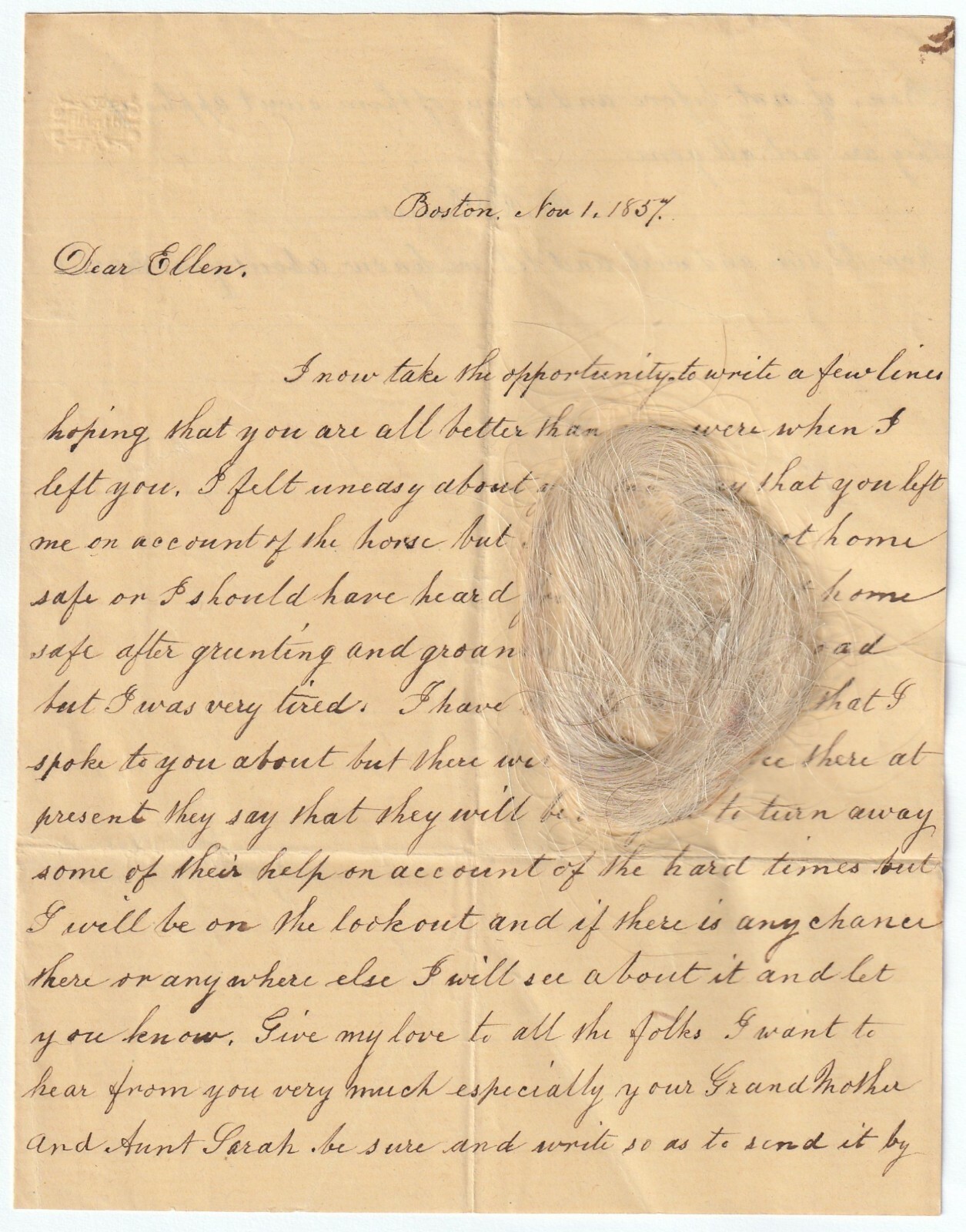
Victorian era Signed LETTER
with Lock of Blonde Hair
From E. R. DavisonBoston, Massachusetts
1857
For offer, a nice old letter! Fresh from an old prominent estate. Never offered on the market until now. Vintage, Old, Original - NOTa Reproduction - Guaranteed !!
Pre Civil War. Addressed to Ellen. 2 pgs, signed. Not sure who E.R. Davison is - more research needed. Large lock of hair. Hair was in letter when unfolded. In very good condition. Please see photos and scans for all details and condition. NOTE: will be sent folded up as found.If you collect19thcentury Americana history, American manuscript handwriting, Americans of note, etc.this is a nice one for your paper or ephemera collection. Genealogy research importance as well. You will never see another one like this! 2583
A lock of hair is a piece or pieces of hair that has been cut from, or remains singly on, a human head, most commonly bunched or tied together in some way. A standard dictionary definition defines a lock as a tress, curl, or ringlet of hair.[1]
Symbolic value
Preserved locks of the hair of Percy and Mary Shelley, now in the British Library.
Locks of hair carry symbolic value and have been utilized throughout history in various religious, superstitious, and sentimental roles.
A traditional belief maintains that owning a lock of hair from another's head gives one power over that individual, in the same manner that owning a piece of clothing or image of an individual grants the owner such powers.
Historically, giving a lock of one's hair to someone has been considered a sign of love and devotion, especially before an impending separation. It is still a popular trope in fiction, particularly the romance genre.
During antiquity, Roman girls who were about to be married offered locks of hair to Jove (Jupiter) in his forest god aspect, Virbius (Virbio).
An ancient and worldwide (e.g. China, Egypt, Thailand, Albania, Ukraine, India, Israel, etc.) pre-adolescent custom was to shave children's heads but leave a lock of hair (sometimes several locks) remaining on their heads. Upon reaching adulthood the lock of hair was usually cut off (see Rites of passage).
The scalplock was a lock of hair kept throughout a man's life. Like childhood locks, the scalplock was also a worldwide phenomenon, particularly noted amongst eastern woodland Native American tribes (see Iroquois, Huron, Mahican, Mohawk) in North America (see also Scalping and Mohawk hairstyle).
Sviatoslav I of Kiev was reported to have worn a scalp lock according to Leo the Deacon, a Byzantine historian. Later Ukrainian Cossacks (Zaporozhians) sported scalplocks called oseledets or khokhol. In India this custom remains active but usually only amongst orthodox Hindus. See Sikha.
In Mark Twain's travel book The Innocents Abroad, he describes Moroccan men sporting scalp locks.[2]
Riffian (Berber) men of Morocco had the custom of shaving the head but leaving a single lock of hair on either the crown, left, or right side of the head, so that the angel Azrael is able "...to pull them up to heaven of the Last Day."[3]
A common superstition holds that a lock of hair from a baby's first haircut should be kept for good luck.
An old Irish superstition holds that it is unlucky to accept a lock of hair (or a four-footed beast) from a lover.
A lock of Beethoven's hair, cut from his head in 1827, was saleed in 1994 through Sotheby's of London.[4] Research on the hair determined that the composer's lifelong illness was caused by lead poisoning.
A Polish plait (Koltun in Polish, meaning "Knot", but often referred to in English as an "Elf-Lock") is a lock of matted hair similar to a dreadlock. Due to a scalp disease (Plica polonica), King Christian IV of Denmark (1577–1648) had a Polish plait hanging from the left side of his head which in an engraved portrait in the Royal Collection is adorned by a large pearl. His courtiers were said to have adopted the hairstyle in order to flatter the king.[5] Due to superstitious beliefs, the Polish plait used to be particularly common in Poland (hence its name). Initially, the plait was treated as an amulet, supposed to bring good health, as the plait was supposed to take the illness "out" of the body, and therefore it was rarely cut off.
A lovelock was popular amongst European "men of fashion" from the end of the 16th century until well into the 17th century. The lovelock was a long lock of usually plaited (braided) hair made to rest over the left shoulder (the heart side) to show devotion to a loved one.[6]
In Victorian times, it was common for bereaved family members to keep locks of hair from deceased children or family members. These locks of hair were seen as mementos and served to comfort the surviving loved ones. These locks of hair were typically kept in lockets, though small jars, and in some cases other kinds of jewelry, were used. Jewelry could include everything from bracelets, to earrings, as well as various types of brooches (see hair jewellery).
Boston (US: /ˈbɔːstən/, UK: /ˈbɒstən/),[5] officially the City of Boston, is the capital and most populous city of the Commonwealth of Massachusetts in the United States and 24th-most populous city in the country.[6] The city proper covers 48.4 square miles (125 km2)[7] with a population of 675,647 in 2020,[2] also making it the most populous city in New England.[8] It is the seat of Suffolk County (although the county government was disbanded on July 1, 1999).[9] The city is the economic and cultural anchor of a substantially larger metropolitan area known as Greater Boston, a metropolitan statistical area (MSA) home to a census-estimated 4.8 million people in 2016 and ranking as the tenth-largest MSA in the country.[10] A broader combined statistical area (CSA), generally corresponding to the commuting area[11] and including Providence, Rhode Island, is home to some 8.2 million people, making it the sixth most populous in the United States.[12]
Boston is one of the oldest municipalities in the United States, founded on the Shawmut Peninsula in 1630 by Puritan settlers from the English town of the same name.[13][14] It was the scene of several key events of the American Revolution, such as the Boston Massacre, the Boston Tea Party, the Battle of Bunker Hill and the siege of Boston. Upon American independence from Great Britain, the city continued to be an important port and manufacturing hub as well as a center for education and culture.[15][16] The city has expanded beyond the original peninsula through land reclamation and municipal annexation. Its rich history attracts many tourists, with Faneuil Hall alone drawing more than 20 million visitors per year.[17] Boston's many firsts include the United States' first public park (Boston Common, 1634), first public or state school (Boston Latin School, 1635)[18] and first subway system (Tremont Street subway, 1897).[19]
Today, Boston is a thriving center of scientific research. The Boston area's many colleges and universities make it a world leader in higher education,[20] including law, medicine, engineering and business, and the city is considered to be a global pioneer in innovation and entrepreneurship, with nearly 5,000 startups.[21][22][23] Boston's economic base also includes finance,[24] professional and business services, biotechnology, information technology and government activities.[25] Households in the city claim the highest average rate of philanthropy in the United States;[26] businesses and institutions rank among the top in the country for environmental sustainability and investment.[27] The city has one of the highest costs of living in the United States[28][29] as it has undergone gentrification,[30] though it remains high on world livability rankings.[31]

Related Items:
Chester A. Arthur 1880 Autograph Letter Signed - On Mourning Stationery - PSA
$1450.00
Charles Darwin Handwritten Word Cut from Autograph Letter Signed Beckett BAS
$325.00
US President Andrew Jackson Signed Autograph Letter ALS 1844 PSA Auth Framed
$10995.00