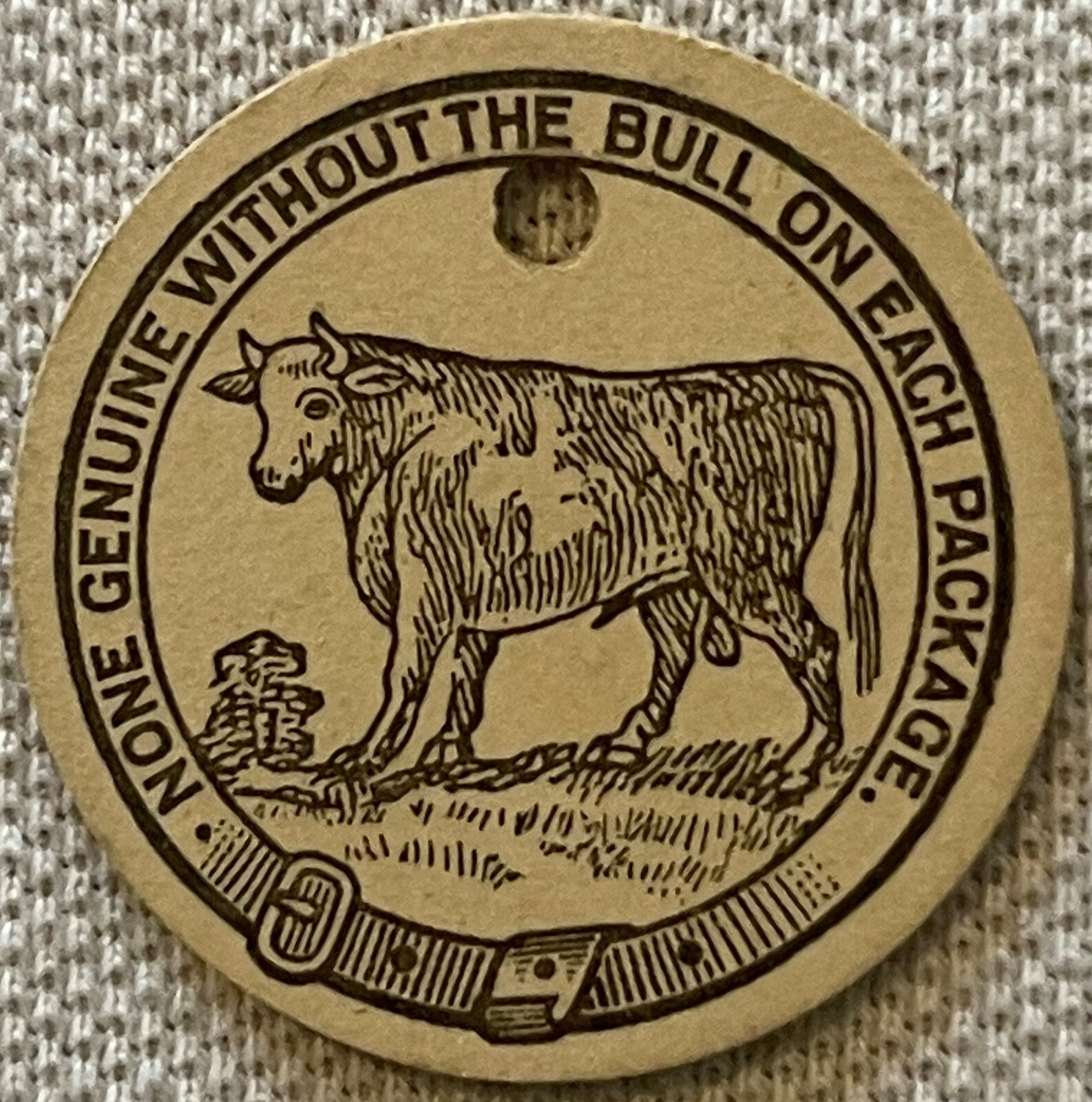
Antique 1900s Bull Durham Tobacco Plug Tag – NOS Durham NC Icon 🐂
Bull Durham Smoking Tobacco Plug Tag | American Tobacco Company, Incorporated | Durham, North Carolina | Circa 1900s–1920s | New Old Stock (NOS) | Approximately 1 1/8\" diameter cardboard
There are a handful of American brand symbols that genuinely belong to the whole country — not just to smokers, not just to North Carolina, not just to collectors — and the Bull Durham bull is one of them. 🐂 This little circular cardboard tag, roughly 1 1/8 inches across, is a real plug tag from the height of Bull Durham\'s dominance, New Old Stock (NOS), never tied to a pouch, never tucked into a package, just quietly saved while the century rolled past it.
The front carries the famous engraved bull standing in profile on a patch of grass, bold and confident, with the slogan circling the border: \"NONE GENUINE WITHOUT THE BULL ON EACH PACKAGE.\" That one line tells you everything you need to know about what these tags were for and why they matter. The printing is sharp, the bull image is clean and fully readable, and the whole disc has the warm tan color of quality period cardboard that has spent decades resting undisturbed rather than getting handled. At the top is the small factory-punched string hole — the same hole that would have let a dealer tie this tag to the neck of a pouch or thread it through packaging so every customer could see the brand was real.
The reverse carries the American Tobacco Company guarantee text — \"GUARANTEED BY The American Tobacco Co. Incorporated\" — surrounding a small portrait of a Native American chief in a full war bonnet, which served as the company\'s authentication logo. Below it, the guarantee reads plainly that if the package is unsatisfactory for any reason, the buyer can get their money back from the dealer. For a brand that had fought counterfeiting and imitation for decades by that point, that guarantee wasn\'t marketing fluff — it was a declaration of war on knock-offs.
🏭 Durham, North Carolina, and the birth of a national brand
The story of Bull Durham starts long before the American Tobacco Company got hold of it. It goes back to a tobacco peddler named John Ruffin Green, who in the 1850s was operating a small factory in Durham and selling a shredded smoking tobacco that was genuinely unlike most of what was on the market at the time. Green had a gift for branding — he borrowed the bull motif from England\'s famous Colman\'s Mustard, which used a Durham bull as its own symbol, and renamed his product \"Genuine Durham Smoking Tobacco.\" That became the seed of what the world would eventually just call Bull Durham.
The Civil War did for Bull Durham what no advertising budget could have purchased. 🪖 When troops from both sides passed through the Durham area near the end of the war in 1865, they raided Green\'s tobacco warehouse, and the legend passed down through collector circles holds that those soldiers carried the taste home with them across the entire country. Within months of the war\'s end, mail-order requests for that Durham tobacco were flowing in from every state. The story may be polished with retelling, but the documented sales surge was real — and that moment is widely credited with launching Bull Durham from a regional product into a national phenomenon.
Green brought in William T. Blackwell as a partner in 1867, and when Green died two years later, Blackwell bought the entire business. Under Blackwell\'s leadership — and with partners James R. Day and Julian S. Carr — the William T. Blackwell Company pushed Bull Durham into genuine dominance. The factory building they constructed in 1874 still stands in Durham today, declared a National Historic Landmark in 1977, and it\'s one of the best-preserved pieces of American tobacco industry history anywhere in the country. 🏛️
🏢 James B. Duke and the American Tobacco Company
By the 1890s, the tobacco industry was consolidating fast, and James B. Duke was at the center of it. Duke had famously made his move into cigarettes rather than shredded pouch tobacco — and according to a story that circulates in tobacco-history circles, one reason he steered that direction was that he genuinely feared Bull Durham\'s grip on the smoking tobacco market and didn\'t want to attack it head-on. Whether that\'s entirely true or embellished with time, what\'s documented is that Duke\'s growing tobacco empire eventually absorbed Bull Durham anyway.
In 1898, the Union Tobacco Company purchased the Blackwell company, acquiring the brand\'s millions in stock. Duke then formed a subsidiary of his American Tobacco Company — the Continental Tobacco Company — which swallowed Union (and Blackwell\'s with it) along with Liggett and Myers. By 1901, Continental and American merged into the Consolidated Tobacco Company, and Bull Durham was now a jewel in one of the most powerful corporate tobacco empires America had ever seen. The guarantee on the back of this very plug tag — \"Guaranteed by The American Tobacco Co. Incorporated\" — is a direct window into that consolidation era, the moment when the legendary Durham bull officially flew under Duke\'s corporate flag. 🐂
🎟️ What plug tags actually did
A lot of collectors encounter Bull Durham material and assume the packaging and labels were purely promotional — but plug tags had a specific functional job that went well beyond branding. Bull Durham\'s shredded pouch tobacco was so successful and so widely imitated that counterfeit and adulterated versions were a real commercial problem. Unscrupulous dealers would sometimes refill pouches or sell inferior tobacco under the Bull Durham name. Tags like this one were inserted into or tied to genuine packages so that customers and dealers alike could verify authenticity on the spot.
The lore among tobacciana collectors holds that tags found in NOS condition — still clean, still intact, never attached to anything — are actually harder to track down than tags that have been used, because the used ones were the point of the system. An authentic tag stayed sealed with the genuine product. A tag found loose and unused, as this one is, means it was saved from the supply chain before it ever reached a pouch. New Old Stock (NOS) examples carry that quiet, unhandled quality that decades in careful storage produce. 🏷️
⚾ Bull Durham, 1988, and the cultural closing
Bull Durham remained in production all the way through the 20th century, surviving Prohibition, the Depression, two World Wars, the rise of filtered cigarettes, and a half-century of shifting tobacco culture. It finally went out of production on August 15, 1988 — and in one of American pop culture\'s great coincidences, it was discontinued just about a year after the release of the Kevin Costner film Bull Durham, which brought the Durham Bulls minor league baseball team and the bull brand name roaring back into national pop culture at the exact moment the tobacco itself was disappearing. ⚾🎬
The Durham Bulls, of course, went on to become one of the most famous minor league franchises in the country. The film is still watched. The brand name still resonates with anyone who grew up with baseball. And a small cardboard plug tag from the 1900s sits at the beginning of that entire chain — before the movies, before the baseball, before the corporate mergers, back when a circle of printed cardboard tied to a tobacco pouch was doing the work of protecting a real American icon from counterfeits.
🔍 What you\'re getting — the physical tag
This is an original circular cardboard plug tag, approximately 1 1/8 inches in diameter, with a small factory-punched hole at the top center. The reverse carries the American Tobacco Company name in script, the Native American portrait mark in a circular frame, and the full guarantee text in clear block letters. Both sides display sharp, fully legible printing with no fading or obscuring of the graphics. The cardboard is the warm tan of the era\'s quality stock. This is a New Old Stock (NOS) example — it was never tied to a pouch or used in any tobacco package.
🗂️ Who collects these and why
Bull Durham plug tags pull from several different collector communities, which is part of what makes them worth knowing about:
🐂 Tobacciana collectors — plug tags, tobacco tins, pouches, and paper ephemera from pre-WWI brands are a genuine category, and Bull Durham is among the most recognized names in it
⚾ Baseball and Durham Bulls collectors — the brand\'s connection to the minor league team and the 1988 film makes Bull Durham material attractive to baseball ephemera collectors who may never have touched tobacco collecting otherwise
🏙️ Durham, NC and North Carolina history collectors — Bull Durham helped put Durham on the map, full stop, and local history enthusiasts value authentic early-20th-century material tied to the city\'s signature industry
📜 American Tobacco Company / James Duke collectors — the ATC period produced a wave of packaging, tags, and promotional material that documents one of the most significant corporate consolidations in American business history
🖼️ Display collectors — at just over an inch across, a plug tag fits beautifully in a Riker mount, shadow box, or framed tobacciana display alongside Bull Durham pouch labels, tins, or baseball cards of the era
The year the film came out, Bull Durham the tobacco was already winding down. By the time Bull Durham became a cult classic, the real product was gone. What survives — the labels, the pouches, the tins, and small cardboard authentication tags like this one — is the physical record of a brand that ran from the Civil War to the Reagan administration and somehow, along the way, got its name on a Kevin Costner movie that is still playing on cable tonight somewhere.
This tag was made before most of the 20th century had happened. It was printed when the brand was young and the American Tobacco Company was still new and consolidating power, when Bull Durham pouches hung from the ceilings of general stores across the country, and when this little circle of cardboard with a bull on it was the guarantee that you were getting the real thing. 🐂

Related Items:
ANTIQUE EARLEY 1900s BLACK CAST IRON BULL READY TO CHARGE FIGURINE original
$15.99
Antique 1890s Sitting Bull D.F. Barry Photo Print Native American Lakota Sioux
$495.95
ANTIQUE / VINTAGE 1882? CHALKWARE BULL MASTIFF DOG W/ GLASS EYES
$67.45