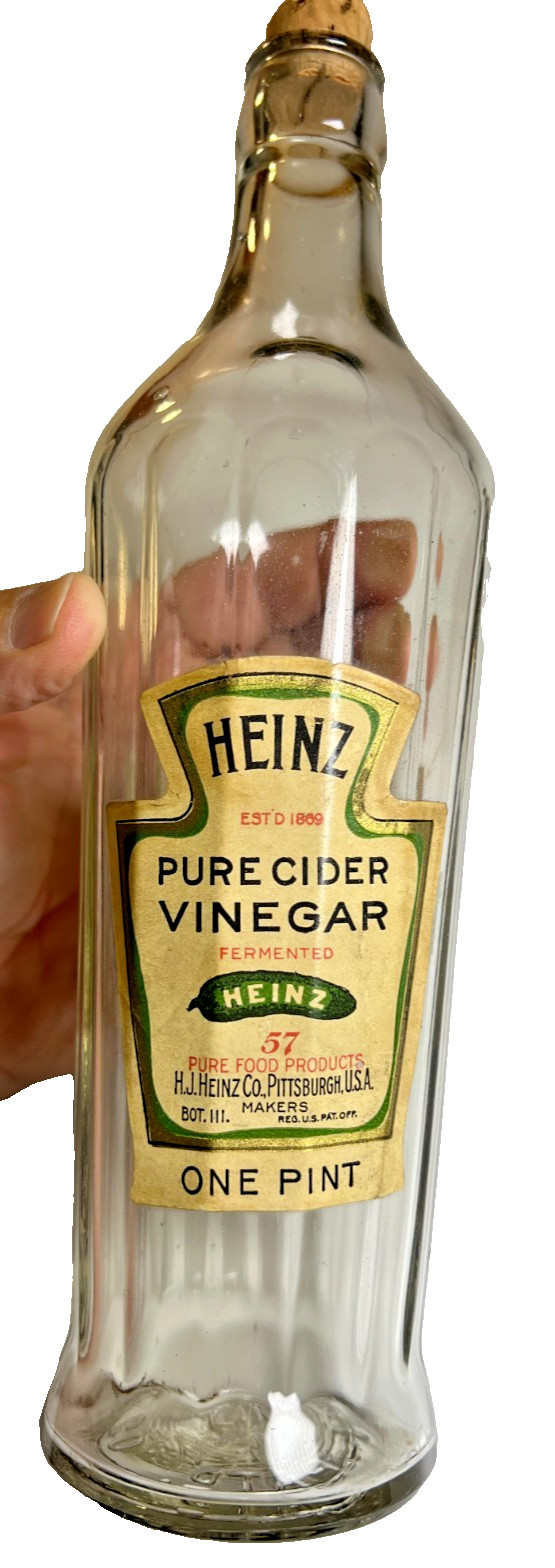
Date: circa 1918–1925 (most likely 1920–1923)
Several clues narrow the date:
- "Reg. U.S. Pat. Off." appears on the front label, a style common after about 1915.
- The rear label lists Heinz offices in New York – Chicago – San Francisco – London, a configuration seen during the late WWI and early 1920s period.
- The bottle is machine-made with an Owens-style base and machine-made finish.
- The decorative gold-bordered labels are characteristic of Heinz premium packaging from the early 1920s.
- The acid content is stated as 5.5%, reflecting the stricter food labeling standards established after the Pure Food & Drug Act.
I'd comfortably catalog it as circa 1920–1923.
Would it have had a cork?
Yes.
Although the finish resembles what collectors sometimes mistake for an early crown-top finish, this is actually a straight cork finish with a retaining bead.
Heinz used corks on vinegar bottles for many years because:
- vinegar does not build pressure
- corks were inexpensive
- easy for repeated household use
Many customers reused the bottle for homemade vinegar or cider.
Maker
H.J. Heinz Company
Founded by Henry John Heinz in Pittsburgh, Pennsylvania.
By the early 1920s Heinz had become one of America's largest food companies with factories and distribution centers throughout North America and Europe.
The Product
Unlike distilled white vinegar, Heinz proudly advertised this as
Pure Cider Vinegar
meaning it was produced by
- pressing fresh apples
- fermenting the sugars into alcohol
- fermenting again into acetic acid
- aging in wooden barrels
The rear label proudly states:
"...made from the pure juice of fresh apples..."
This was an important selling point because many inexpensive vinegars were made from diluted acetic acid or mixed with artificial coloring.
The Meaning of "57"
The famous 57 Varieties slogan had already become one of America's best-known trademarks.
Interestingly...
There never actually were only 57 products.
Henry Heinz simply liked the number 57 after seeing another company's advertising.
It became one of the greatest marketing slogans ever created.
The Labels
The labels are outstanding.
Features include:
- metallic gold borders
- deep green trademark outline
- cream stock paper
- red and black typography
- the iconic Heinz keystone shape
Collectors love these because most vinegar bottles were soaked, scrubbed and reused until the labels disappeared.
Bottle Characteristics
Your bottle displays numerous quality features:
- machine-made
- thick glass
- excellent clarity
- large trapped air bubbles
- attractive shoulder panels
- original cork
- embossed heel:
H.J. HEINZ CO. - one pint capacity
The large bubbles are normal manufacturing artifacts from early automatic bottle machines and add considerable visual appeal.
Condition
Excellent collector condition.
From your photographs:
- original cork
- original front label
- original back label
- no chips
- no cracks
- brilliant glass
- no haze
- no staining
- no residue
- attractive large seed bubbles
Label wear is very minor considering its age.
Pittsburgh during 1920
When this bottle sat on grocery shelves:
Population
Approximately 590,000
One of America's great industrial cities.
Steel
Pittsburgh produced more steel than almost anywhere on Earth.
Skyscrapers, railroads and bridges around the world depended upon Pittsburgh steel.
Transportation
Electric streetcars filled downtown.
Automobiles were becoming common.
Horse-drawn wagons still made deliveries.
Technology
Homes were beginning to gain
- electricity
- telephones
- electric irons
- vacuum cleaners
- refrigerators (for wealthier families)
Medicine
Doctors were embracing
- antiseptic surgery
- X-rays
- vaccines
- improved sanitation
The Spanish Flu pandemic had only recently ended.
Politics
The nation had entered the Roaring Twenties.
Major developments included:
- Prohibition (1920)
- women's right to vote (19th Amendment)
- rapid industrial growth
- booming consumer goods
Big Pittsburgh Events During the Decade
- Heinz expanded production dramatically.
- Pittsburgh became one of America's busiest manufacturing centers.
- New bridges connected expanding neighborhoods.
- Department stores flourished downtown.
- Professional baseball remained hugely popular, with the Pittsburgh Pirates drawing large crowds.
Why Heinz Bottles Are Collectible
Collectors appreciate them because they combine:
- iconic American advertising
- beautiful labels
- early machine-made glass
- outstanding household history
- one of America's most recognizable brands
Most surviving bottles have either missing labels or heavy staining.
Finding one with both labels and the original cork is becoming increasingly difficult.
- Circa 1920–1923
- H.J. Heinz Co., Pittsburgh, Pennsylvania
- Original front and back paper labels
- Original cork stopper
- One Pint size
- Machine-made clear glass
- Attractive large factory air bubbles
- Thick, heavy glass construction
- Embossed heel: H.J. HEINZ CO.
- Clean interior with no residue
- No chips, cracks, or haze
- Approximately 8.75 inches tall

Related Items:
Antique 1920s Lincoln Natl Bank Igraham Clock & Bank Abraham
$95.00
collectibles Antique 1920 Piatnik 53 playing cards good condition
$219.00
Set/5 Antique 1920s Art Deco Silver Gilt Ornate Wood Picture Frame VTG Photo Lot
$75.00