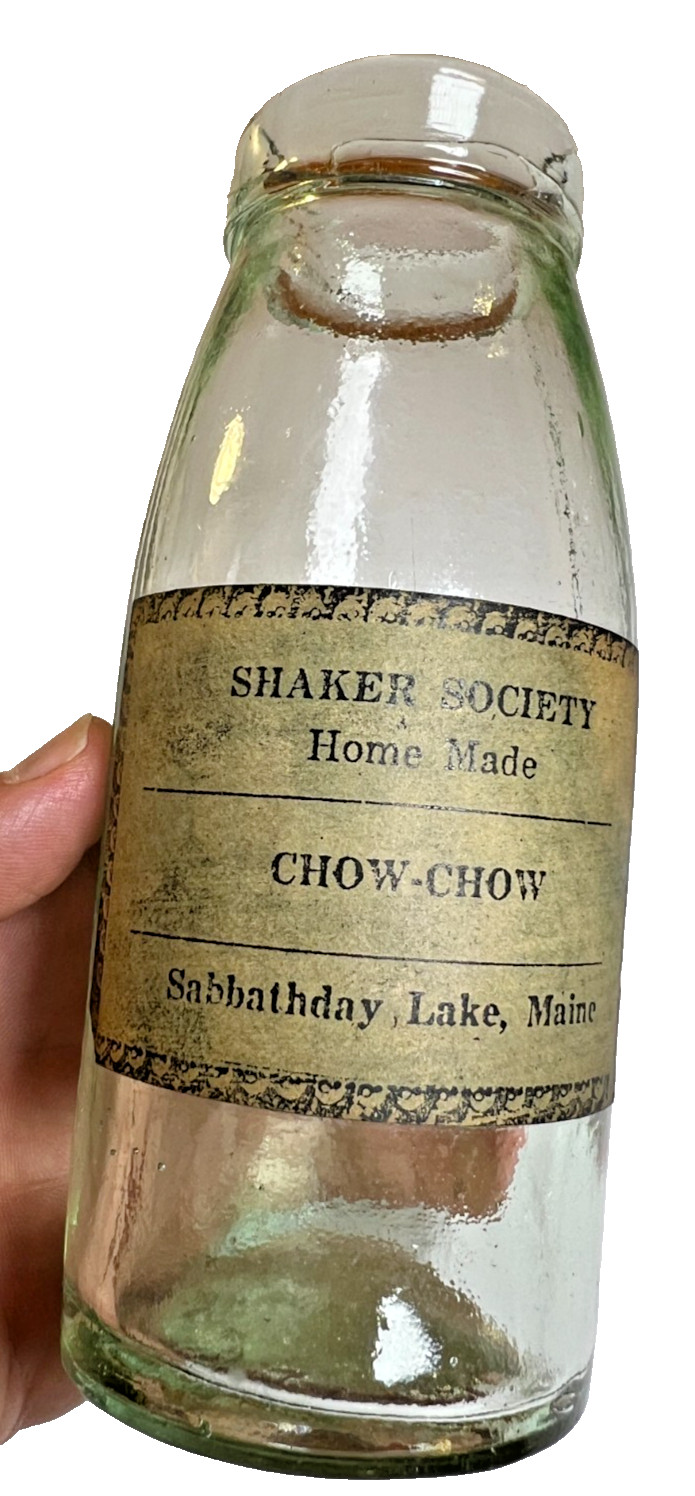
RARE ORIGINAL-LABELED MAINE SHAKER FOOD BOTTLE — CIRCA 1880–1884
An extraordinary survivor from the historic Shaker community at Sabbathday Lake, Maine!
This early aqua-green glass food bottle retains its original printed paper label:
SHAKER SOCIETY
Home Made
CHOW-CHOW
Sabbathday Lake, Maine
Chow-chow was a traditional mixed-vegetable pickle or relish, generally prepared with vegetables such as green tomatoes, cabbage, cucumbers, onions, and peppers in a seasoned vinegar-and-mustard mixture. It was a pantry staple served with meats, beans, potatoes, and bread.
The Shakers were celebrated for the exceptional cleanliness, honesty, and consistency of their commercially sold foods, herbs, medicines, seeds, and household goods. “Home Made” was not casual wording—it advertised a product prepared within the Sabbathday Lake community according to its exacting standards.
The base appears marked E.B. & Co. / 6625, generally attributed to Edgar Breffit & Company of Castleford, Yorkshire, England. The number is a factory pattern or mold number. The absence of “Ltd.,” together with the mouth-blown construction and hand-finished lip, supports a likely date of approximately 1880–1884.
This may predate the better-known E.D. Pettengill Company labels introduced for commercially distributed Sabbathday Lake Shaker pickles beginning in 1885. The understated label may represent the Shakers’ earlier direct-sale packaging.
The bottle was mouth-blown in a mold and has a crudely applied or tooled rolled-style lip. Its rich aqua-green glass displays scattered bubbles, attractive surface character, and minor manufacturing irregularities.
Measurements
Approximately 6 1/8 inches tall.
Condition
The glass is bright, clean, and shiny, with no chips, no cracks, and no haze.
The original paper label remains remarkably complete and legible. It displays authentic age toning, darkening, surface wear, and minor edge loss, all visible in the photographs. These natural signs of age have not been disguised or restored.
A rare opportunity to acquire an intact piece of Maine Shaker commercial history—not merely an empty period bottle, but an identified Sabbathday Lake food container retaining its remarkable original Home Made Chow-Chow label.
LIFE IN MAINE AND AT SABBATHDAY LAKE — CIRCA 1880–1884
When this bottle was filled, Maine was still overwhelmingly rural. Most families lived by farming, fishing, lumbering, shipbuilding, quarrying, or mill work. Portland was a growing commercial city, while Lewiston and offerdeford were dominated by enormous textile mills powered by Maine’s rivers. Railroads connected country towns with Portland, Boston, and markets far beyond New England, but horses, wagons, and walking remained the ordinary means of local travel.
Electric lighting was only beginning to appear in larger cities. Most Maine homes were illuminated by kerosene lamps and heated with wood or coal. Indoor plumbing and telephones remained uncommon outside prosperous urban households. Food preservation depended upon root cellars, icehouses, drying, salting, smoking, and pickling—making a jar of Shaker chow-chow a practical pantry food rather than merely a condiment.
Maine’s population was changing as young people left farms for factory towns or moved west. French-Canadian immigration supplied much of the labor for the state’s expanding textile and manufacturing industries. Political life was dominated by the Republican Party, Civil War memory remained fresh, and Maine was nationally famous for its early and controversial prohibition laws.
Life at Sabbathday Lake followed a distinctly different rhythm. In the early 1880s, approximately forty Shakers still lived communally at the village. Men and women were considered spiritually equal but generally worked in separate groups. Their days were organized around worship, communal meals, farming, cooking, cleaning, gardening, preserving food, caring for livestock, and producing goods for sale.
The Shakers practiced celibacy, held property collectively, and valued order, usefulness, cleanliness, and excellence in workmanship. Their plain surroundings were not the result of poverty but of a conscious rejection of needless ornament and individual excess. Even an everyday food such as chow-chow was expected to be carefully prepared, honestly labeled, and consistently good.
The community was far from isolated from commerce. Sabbathday Lake operated a substantial farm and sold herbs, medicines, seeds, pickles, preserves, fancy goods, and other products to the outside world. Shaker salespeople traveled established routes through Maine, New Hampshire, and the fashionable resort districts of northern New England. Money earned from products such as this chow-chow helped maintain the village and sustain its religious way of life.
The community was also entering a moment of transition. Its membership had declined considerably from its early-19th-century peak, yet in 1883–1884 the Shakers constructed their large new Central Dwelling House—powerful evidence that they still expected Sabbathday Lake to endure. This bottle dates from that pivotal period: a time when an old communal faith was adapting its farms, industries, and famously trusted name to an increasingly modern commercial world.
WHY THE ENGLISH BOTTLE MARK SUPPORTS—RATHER THAN CONTRADICTS—THE LABEL
Some collectors may wonder why a product made by the Sabbathday Lake Shakers was packaged in a bottle apparently manufactured by E.B. & Co. of England. This is not a cause for concern. Nineteenth-century American businesses routinely purchased empty bottles and jars from commercial glassworks rather than manufacturing their own containers. Imported British glassware was widely available through American wholesalers and shipping ports—especially in Maine, where Portland maintained an active Atlantic trade.
The Shakers were highly practical businesspeople. They grew and prepared the contents, printed or commissioned labels, and purchased suitable containers wherever quality and price were favorable. The bottle did not need to be made in Maine for the finished product to be authentically Shaker-made. The label identifies the producer of the chow-chow, while the base mark identifies the company that manufactured the glass container—two entirely compatible facts.
The bottle itself is exactly the sort of wide-mouthed food container needed for chunky pickled vegetables. Its heavy aqua glass, broad mouth, hand-finished lip, and late-19th-century construction all agree with the label’s period.
Most importantly, the apparent E.B. & Co. mark—without “Ltd.”—is associated with Edgar Breffit & Company before its reorganization as a limited company around 1884. That dating fits exceptionally well with the evidence that Sabbathday Lake’s better-known E.D. Pettengill distribution labels began appearing in the mid-1880s. This simpler “Shaker Society—Home Made” label may represent the community’s earlier direct-sale packaging.
Rather than undermining the piece, the English maker’s mark adds another fascinating layer to its story: a British-made commercial food bottle imported through the Atlantic trade, filled with homemade chow-chow by a Maine Shaker community, labeled at Sabbathday Lake, and sold to the outside world approximately 145 years ago.

Related Items:
Antique 1880's Carved Leather Holy Bible Old And New Testaments Ornate AS IS
$249.99
Antique 1880’s Victorian Post Mortem Photo Deceased Young Boy
$95.00
Huge Victorian Antique 1880's Cabochon Jeweled Lamp Shade
$450.00