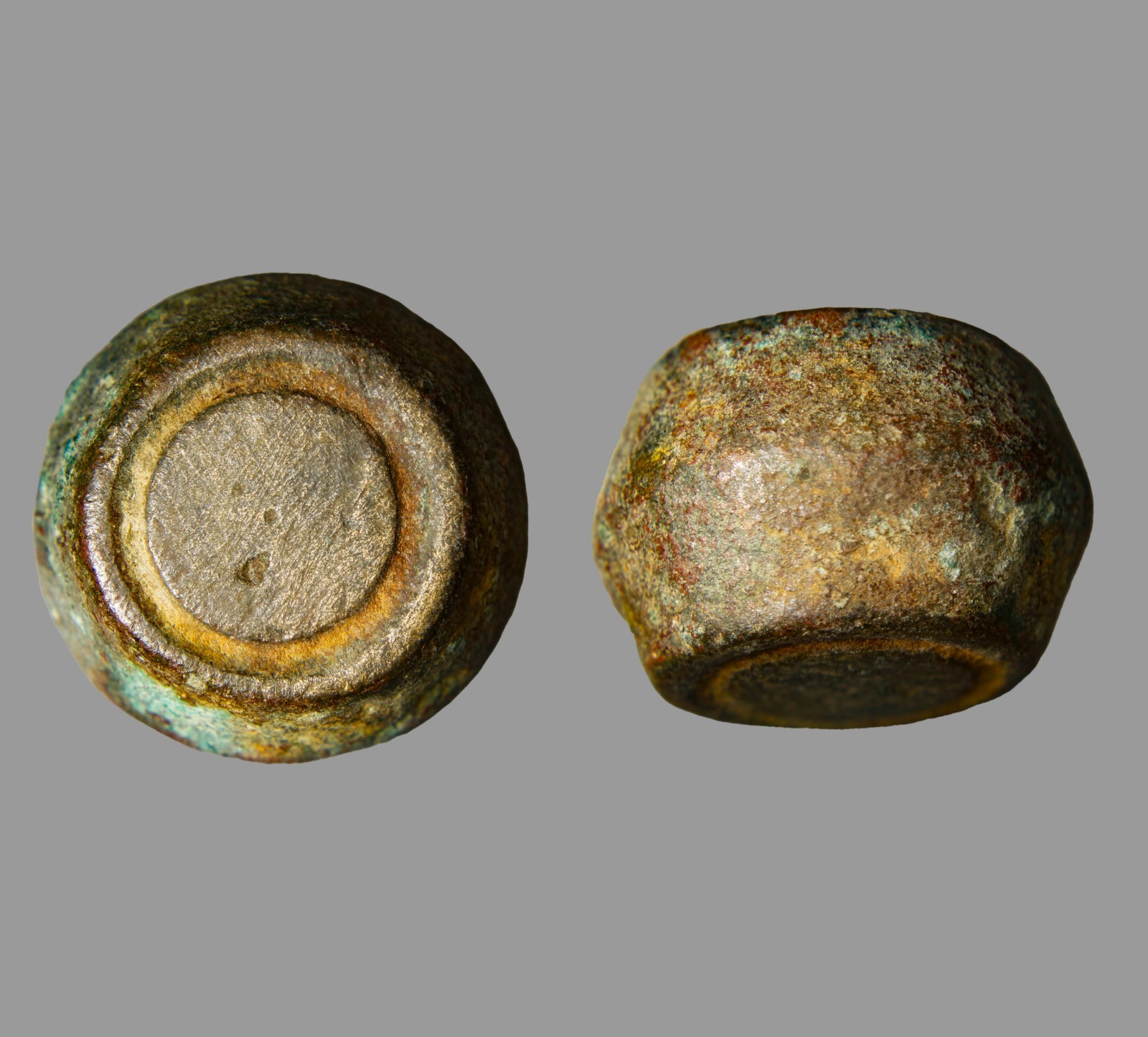
Ancient Roman Judaea Cast Bronze Barrel-Shaped Commercial Weight — 1 Uncia Standard (29.82g — c. 1st–4th Century AD)
Authenticity & Guarantee
Certification: Certified Authentic — includes signed Certificate of Authenticity (COA) with full provenance documentation.
Provenance: Ex-private European collection, legally acquired from international sales; Roman Judaea / Holy Land Sphere.
Item Specifications & Exact Dimensions
Object: Cast Bronze Commercial Trade Weight / Scale Weight
Culture / Period: Roman Imperial Era (Roman Judaea / Levantine Commercial Sphere)
Date Range: Circa 1st Century AD – 4th Century AD (c. 100 – 400 AD)
Exact Mass: 29.82 grams (Matches the official Roman Uncia standard)
Estimated Dimensions: Approx. 20 mm diameter × 15 mm height
Material: Cast Bronze (Copper Alloy / High-Density Leaded Bronze)
Form & Architecture: Heavy barrel-shaped / truncated biconical profile engineered with a faceted mid-section for non-slip handling on market balance scales; flat top and bottom faces feature precise lathe-turned concentric circular grooves
Condition: Exceptional, 100% complete ancient condition. Sharp turned lathe rings, solid heavy density, preserved under a rich olive-green to warm chocolate bronze patina with light sandy-tan earthen burial encrustations. Free of modern restoration or tooling.
HISTORICAL CONTEXT & TYPOLOGICAL LORE
Roman Metrology & The Uncia Weight Standard
Across the urban market squares (agorae or macella) of Roman Judaea—including Jerusalem, Caesarea Maritima, and Tiberias—trade in precious spices, metals, medicinal powders, and coins relied on strict weight standards. The fundamental Roman mass unit was the libra (pound), which was divided into 12 equal ounces (unciae). A single theoretical Roman uncia weighed approximately 27.28g to 29.8g depending on provincial calibration and copper alloy composition. At exactly 29.82 grams, this artifact represents a full-weight, official 1-Uncia commercial market standard.
Lathe-Turned Concentric Rings & Anti-Fraud Measures
The crisp circular grooves cut into the flat top and bottom faces served a crucial anti-counterfeiting function. In ancient bazaars, dishonest merchants often attempted to clip or shave metal off the edges of official bronze weights to tilt balance scales in their favor. Lathe-turned concentric rings proved to municipal market inspectors (agoranomoi or aediles) that the surface of the weight remained pristine and untampered with.
Typological Analysis & Exact Classification
Primary Class: Roman Commercial Equipment / Marketplace Metrology
Sub-Class: Lathe-Turned Concentric Ring Barrel-Shaped Uncia Class
Manufacturing Technique: High-density bronze lost-wax casting with lathe-turned concentric face detailing.
Comparable Archaeological Examples & Museum Accession Numbers
Israel Museum, Jerusalem: Roman period commercial scale weights recovered from Judaean market strata.
British Museum (Accession No. 1856,0701.2290): Roman bronze barrel-shaped weight with turned concentric face rings.
Metropolitan Museum of Art (Accession No. 74.51.5350): Roman Imperial copper alloy commercial weight standards
TRN-1-7

Related Items:
NGC King of Judaea AE Herod The Great (40-4 BC) Bronze Prutah High Grade
$112.59
200 BC Ancient Roman Combat Gladius Legionary Battle Dagger Pugio Fight Weapon
$460.00
Ancient Bronze Arrowheads - Roman, Greek, Luristan, etc.
$325.00